Understanding GPU performance#
This topic explains the theoretical foundations of GPU performance on AMD hardware. Understanding these concepts helps you analyze performance characteristics, identify bottlenecks, and make informed optimization decisions.
For practical optimization techniques and step-by-step guidance, see Performance guidelines.
Performance bottlenecks#
The neck of a bottle limits the rate at which liquid can be poured. A performance bottleneck in a computing system similarly limits the rate at which work can be completed.
A performance bottleneck is the limiting factor that prevents a GPU kernel from achieving higher performance. Understanding which bottleneck applies helps identify the appropriate optimization approach.
Performance bottlenecks for GPU kernels fall into three main categories:
Compute-bound: The kernel is limited by arithmetic throughput (the arithmetic bandwidth of compute units)
Memory-bound: The kernel is limited by memory bandwidth (how quickly data can move between High Bandwidth Memory (HBM) and on-chip caches or Local Data Share (LDS))
Overhead-bound: The kernel is limited by latency (host-side scheduling, kernel launch overhead, or small array operations)
This categorization aligns with the textbook approach to optimization: determine the bottleneck, elevate the bottleneck until it is no longer limiting, and repeat on the new bottleneck.
Roofline model analysis helps quickly identify whether a kernel’s performance is bottlenecked by compute throughput or memory bandwidth.
Roofline model#
The roofline model is a simplified, visual model of performance used to quickly determine whether a program is limited by memory bandwidth or arithmetic bandwidth.
In the roofline model, two hardware-derived “roofs” place upper bounds—or ceilings—on achievable performance:
Compute roof: The peak arithmetic rate of the target hardware (vector Arithmetic Logic Units (ALUs) or Matrix Fused Multiply-Add (MFMA) units), sometimes referred to as its arithmetic bandwidth
Memory roof: The peak data transfer rate of the memory subsystem, or memory bandwidth
These are plotted on a plane with arithmetic intensity (operations per byte) on the x-axis and performance (operations per second) on the y-axis.
The compute roof is a horizontal line at a height equal to the hardware’s maximum arithmetic throughput. The memory roof is a slanted line whose slope equals the memory bandwidth (in bytes per second). Because slope is “rise over run,” its units correspond to throughput per intensity.
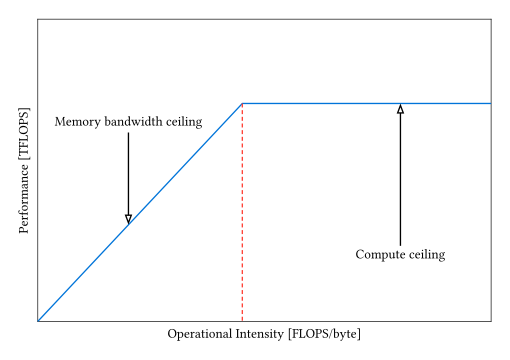
Roofline model showing the relationship between arithmetic intensity and achievable performance. The memory bandwidth ceiling represents the GPU’s memory bandwidth limit, while the compute ceiling shows the maximum achievable TFLOPs. Kernels falling into the area to the left of the ridge point are memory-bound, while they are compute-bound if they fall into the right area.#
A kernel’s position on the x-axis indicates whether it is fundamentally compute-bound (beneath the flat roof) or memory-bound (beneath the slanted roof). In practice, few kernels ever fully reach either roof due to overhead, latency, and control-divergence effects.
The point where the diagonal and horizontal roofs intersect is called the ridge point. Its x-coordinate gives the minimum arithmetic intensity required to escape the memory bottleneck. Systems with ridge points farther to the left are easier to saturate, but over time, improvements in compute throughput have far outpaced memory growth—pushing ridge points steadily to the right.
On AMD platforms, roofline analysis is built into ROCm’s profiling and performance visualization ecosystem. rocprofv3 can be used to gather achieved FLOPs, memory transactions, and operational intensity.
The roofline model’s elegance lies in its simplicity—but also in its deliberate omissions. It ignores latency entirely, focusing only on sustained throughput limits. Understanding those assumptions—and when they hold—is essential to applying the model correctly.
Compute-bound performance#
A kernel is compute-bound when its performance is limited by the GPU’s arithmetic throughput rather than memory bandwidth. These kernels have high arithmetic intensity, spending most cycles executing arithmetic operations.
Kernels that are compute-bound are limited by the arithmetic bandwidth of the GPU’s Compute Units (CUs)—on AMD architectures, this means the vector ALUs and MFMA units within each CU or Single Instruction Multiple Data (SIMD) unit.
Characteristics of compute-bound kernels:
High ratio of arithmetic operations to memory accesses (high arithmetic intensity)
Performance scales with GPU compute capacity
Limited benefit from memory bandwidth optimization
Can often achieve a high percentage of peak theoretical FLOPS
The limiting factor is utilization of arithmetic pipelines: the number of concurrent floating-point or integer operations the GPU can sustain per clock
The theoretical maximum is determined by:
Number of compute units and SIMD lanes
Clock frequency
Instruction throughput per cycle
Specialized unit capabilities (matrix cores, Special Function Units (SFUs))
Memory-bound performance#
A kernel is memory-bound when its performance is limited by memory bandwidth rather than compute capacity. These kernels have low arithmetic intensity and spend significant time waiting for memory operations.
Kernels that are memory-bound are limited by the memory bandwidth of the GPU—that is, by how quickly data can move between HBM and the on-chip caches or LDS of the GPU’s compute units.
Memory-bound kernels are limited by the bandwidth between GPU RAM and local caches because the working sets of most real-world GPU workloads are far larger than any higher level of the memory hierarchy. When data reuse is low and arithmetic operations per byte are few, the speed of computation is dominated by how quickly memory can feed operands to the arithmetic units.
Characteristics of memory-bound kernels:
Low ratio of arithmetic operations to memory accesses (low arithmetic intensity)
Performance scales with memory bandwidth
Sensitive to memory access patterns
Typically achieve lower percentage of peak FLOPS
Fall to the left of the ridge point on the roofline diagram
The theoretical maximum is determined by:
HBM bandwidth capacity
Memory controller efficiency
Cache hierarchy effectiveness
Memory access pattern efficiency
Arithmetic intensity#
Arithmetic intensity is the ratio of arithmetic operations to memory operations in a kernel. It is the ratio of floating-point operations (FLOPs) to memory traffic (bytes) for a given kernel or algorithm.
This metric determines whether a kernel is compute-bound or memory-bound.
Key points:
Higher arithmetic intensity indicates more computation per byte transferred
A high arithmetic intensity indicates that a kernel performs many arithmetic operations per byte loaded
The balance point (ridge point) depends on the GPU’s compute-to-bandwidth ratio
It can be calculated theoretically or measured empirically
Different precision types affect both FLOPs and bytes
For modern AMD GPUs:
The compute-to-bandwidth ratio varies by GPU generation
Higher-end models have higher ratios
Kernels above the GPU’s specific ratio (ridge point) are compute-bound
Because modern GPUs deliver far more arithmetic throughput than memory bandwidth, the most efficient kernels are those with high arithmetic intensity
Algorithmic complexity and intensity scaling#
Because algorithms have different operational and memory complexities, they scale differently in arithmetic intensity:
An algorithm with \(\mathcal{O}(1)\) operations and \(\mathcal{O}(N)\) memory has \(\mathcal{O}(\frac{1}{N})\) intensity (decreasing with size)
One with \(\mathcal{O}(N)\) operations and \(\mathcal{O}(1)\) memory has \(\mathcal{O}(N)\) intensity (increasing with size)
Examples of kernel complexity scaling:
SAXPY (\(y = ax + y\)): \(2N \text{ FLOPs}\), \(8N \text{ bytes}\) → intensity \(\frac{1}{4}\) → \(\mathcal{O}(1)\) scaling
Single-Precision Real Fast Fourier Transform (FFT): \(\frac{5}{2} N \log N \text{ FLOPs}\), \(16N \text{ bytes}\) → intensity \(\frac{5}{32} \log N\) → \(\mathcal{O}(\log N)\) scaling
SGEMM (matrix multiplication): \(2N^3 \text{ FLOPs}\), \(6N^2 \text{ bytes}\) → \(\mathcal{O}(N)\) scaling
Matrix multiplication scales linearly in arithmetic intensity— \(\mathcal{O}(N^3)\) operations versus \(\mathcal{O}(N^2)\) memory—making it an ideal match for high-throughput architectures. This favorable scaling is a key reason why many machine-learning algorithms built around dense linear algebra achieve high GPU utilization.
Techniques that shift memory transfers to additional compute operations reduce memory traffic but increase arithmetic load, thereby raising the arithmetic intensity. For example:
Compressing data in global memory reduces bytes transferred but adds decompression arithmetic—raising arithmetic intensity
In training and inference of neural networks, techniques like gradient checkpointing reduce memory storage of activations (fewer bytes stored and loaded) but add recompute work—again increasing arithmetic intensity
Latency hiding mechanisms#
GPUs hide memory and instruction latency through massive hardware multithreading rather than complex CPU techniques like out-of-order execution.
Latency hiding is the strategy of masking long-latency operations by running them concurrently. On AMD GPUs, performant kernels interleave the execution of many threads across warps keeping overall throughput high even when individual instructions take many cycles. When one warp stalls on a slow global-memory access, the scheduler immediately issues instructions from another eligible warp.
How latency hiding works:
warp switching: Context switches occur every cycle with zero overhead
Multiple warps per CU: Many concurrent warps supported
Instruction-level parallelism: Multiple independent instructions in flight
This keeps the compute units busy: while one warp drives MFMA matrix ops, another runs scalar and vector ALU work (e.g., quantize and dequantize), and a third issues loads and stores through the memory pipeline (LDS, L1, and L2 ↔ HBM).
The hardware can completely hide memory latency if there are enough active warps with independent work. The number of instructions required from other warps to hide latency depends on the GPU’s specific memory latency and instruction throughput characteristics.
Little’s Law#
Little’s Law relates concurrency (how much work is in flight) to latency and throughput:
In GPU terms, it tells you how much independent work you must have in flight to hide latency via fine-grained scheduling. On AMD GPUs, warp switching by the warp schedulers is the primary latency-hiding mechanism.
Little’s Law determines how many independent memory transactions or instructions must be outstanding across active warps to keep the compute units busy.
Concretely, consider a simple sequence in AMD CDNA terms:
global_load_dword    v1, v[2:3], off   ; long-latency global load (hundreds of cycles)
v_mul_lo_u32         v2, v1, 0xBEEF    ; integer multiply
v_add_u32            v4, v2, 0xAFFE    ; integer add
v_mul_lo_u32         v6, v4, 0x1337    ; integer multiply
Executed strictly serially, the total time is dominated by the global load. Using Little’s Law, if your effective issue rate is ~1 inst/cycle and the load takes hundreds of cycles, you need hundreds of independent in-flight operations to finish, on average, one such sequence per cycle—hiding the memory latency from consumers.
Issuance occurs at the warp granularity (64 threads per warp on CDNA). When latency hiding is successful, the CU maintains enough active warps and rapidly context-switches among them whenever one blocks, so execution units don’t sit idle waiting on memory or other long-latency events.
Requirements for effective latency hiding:
Sufficient occupancy (active warps)
Independent instructions to overlap
Balanced resource usage
Minimal divergence
Warp (Wavefront) execution states#
The state of the warps executing a kernel on an AMD GPU can be described using several non-exclusive terms—active, stalled, eligible, and selected.
A warp is considered active from the time its threads begin executing until all threads in that warp have completed the kernel. The warp schedulers select warps from the active pool each cycle; the selected warps then issue their instructions.
An eligible warp is an active warp ready to issue its next instruction. For a warp to be eligible:
Its next instruction has been fetched
The required pipeline (vector ALU, MFMA, or memory) is available
All data dependencies have been resolved
No synchronization barriers (for example,
s_barrier) are pending
Eligible warps are the immediate candidates for issue. A lack of eligible warps often indicates dependency or memory stalls—a key target in performance tuning.
A stalled warp is active but unable to issue its next instruction due to resource or data hazards. Common causes include:
Execution dependencies: waiting for results from previous ALU or MFMA operations
Memory dependencies: waiting for global or LDS memory fetches
Pipeline conflicts: required execution units are occupied
AMD hardware uses a scoreboard mechanism to track outstanding dependencies per warp. When waiting on LDS or ALU results, a warp is said to be on the short scoreboard; when waiting on off-chip HBM accesses, it is on the long scoreboard. This scoreboarding approach—originally from the CDC 6600 supercomputer—allows dynamic scheduling across warps (thread-level parallelism) rather than within them (instruction-level parallelism).
A selected warp is an eligible one chosen by the warp scheduler to issue an instruction in the current cycle. Each CU typically has multiple schedulers that can each issue one instruction per cycle from their eligible pool.
Understanding these states helps explain GPU utilization metrics:
Active cycles: Percentage of cycles with at least one instruction executing
Stall cycles: Percentage of cycles waiting for resources
Idle cycles: No warps available to execute
Maximizing active cycles while minimizing stall and idle cycles improves performance. Effective latency hiding on AMD hardware relies on keeping enough active and eligible warps resident so that the schedulers always have work to select, ensuring the CU pipelines remain fully utilized.
Occupancy theory#
Occupancy measures the ratio of active warp to the maximum possible warps on a compute unit.
There are two common ways to measure it:
Theoretical occupancy: The upper limit determined by the kernel’s launch configuration (threads per block, register use, LDS use) and the hardware limits of the CU
Achieved occupancy: The actual number of warps active during kernel execution, i.e., on active cycles
As part of the AMD execution model, all threads in a block are scheduled to the same CU. Each CU has finite resources—Vector General-Purpose Registers (VGPRs), Scalar General-Purpose Registers (SGPRs), LDS (shared memory), and wave slots—that must be shared among all resident blocks. These constraints jointly determine the maximum number of active warps.
Why occupancy matters:
Higher occupancy improves latency hiding
More concurrent warps mask memory and instruction latency
Enables better utilization of execution units
Limiting factors:
Register usage: VGPRs and SGPRs per thread
Shared memory (LDS): Allocation per block
Warp slots: Hardware limit on concurrent warps
Block size: Small blocks may waste resources
Trade-offs:
Higher occupancy improves latency hiding but reduces resources per thread
Lower occupancy allows more resources per thread but may expose latency
Optimal occupancy depends on kernel characteristics
Memory-bound kernels benefit more from high occupancy
Low occupancy often reduces performance when there aren’t enough eligible warps to hide memory or arithmetic latency, causing low issue efficiency and underutilized pipelines. However, once occupancy is sufficient for latency hiding, increasing it further can hurt performance by reducing the number of available registers or LDS per warp—both of which can limit arithmetic intensity.
In short, occupancy measures how fully a CU is loaded, not how efficiently it is utilized. High-performance kernels (for example, MFMA-based GEMMs on CDNA) often operate at low occupancy because only a few warps are needed to fully saturate the MFMA and memory pipelines.
Memory hierarchy impact on performance#
The GPU memory hierarchy has different bandwidths and latencies:
Memory types by speed:
Registers: Fastest, lowest latency (per-thread storage)
LDS (shared memory): Very fast, on-chip (per-block storage)
L1 cache: Fast, on-chip (per-CU cache)
L2 cache: Moderate, on-chip (shared across CUs)
HBM (global memory): Slower, off-chip but high bandwidth
Memory coalescing theory#
Memory coalescing is a hardware technique that improves effective memory bandwidth by servicing many logical loads or stores with a small number of physical memory transactions.
Memory coalescing combines memory accesses from multiple threads into fewer transactions. When consecutive threads access consecutive memory addresses, the hardware can merge requests into efficient cache line accesses.
Memory coalescing is relevant when accessing global memory (HBM and GDDR attached to the GPU). For efficient access to LDS and shared memory, see the discussion of bank conflicts below.
On AMD GPUs, global memory is backed by HBM (in data-center parts) or GDDR (on many client parts). These Dynamic Random-Access Memory (DRAM) technologies provide very high bandwidth but have relatively long access latency. If each thread’s load or store were always turned into its own physical DRAM transaction, the GPU would leave a large fraction of that raw bandwidth unused.
Coalescing takes advantage of how DRAM is organized internally. When a DRAM address is accessed, the hardware actually fetches or writes a burst: a run of consecutive addresses fetched together in a single transaction. If multiple threads in a warp access addresses that fall into the same burst, those logical accesses can be coalesced into that single transaction.
This fits naturally with the warp execution model: in normal
execution, all threads in a warp execute the same instruction at the
same time. If each lane in the warp loads or stores a value from a
contiguous region (e.g., lane i accesses base + i), the memory system
can typically serve the entire warp’s request with a small number of
large, aligned bursts. When addresses are scattered (e.g., large strides or
irregular indexing), more bursts are needed, and effective bandwidth drops.
Why coalescing matters:
Reduces number of memory transactions
Improves memory bandwidth utilization
Decreases memory access latency
Coalesced pattern: Consecutive threads accessing consecutive addresses achieve high bandwidth utilization.
Non-coalesced pattern: Random or strided addresses result in many separate transactions and low bandwidth utilization.
Example: strided access pattern#
Consider this kernel that reads from an input array with a configurable stride (distance between consecutive elements accessed by each thread):
__global__ void strided_read_kernel(const float* __restrict__ in,
                                    float* __restrict__ out,
                                    std::size_t N, std::size_t stride)
{
    const std::size_t t  = blockIdx.x * blockDim.x + threadIdx.x;
    const std::size_t T  = gridDim.x * blockDim.x;

    float acc = 0.f;

    for (std::size_t j = t * stride; j < N; j += T * stride)
    {
        // across a warp, addresses differ by (stride * sizeof(float))
        float v = in[j]; // perfectly coalesced for stride == 1
        acc = acc * 1.000000119f + v;  // force compiler to keep the load
    }

    // one write per thread (negligible vs reads)
    if (t < N) out[t] = acc;
}
When stride == 1, threads in the same warp access consecutive 4-byte
elements (in[j], in[j+1], in[j+2], …). These accesses fall into a
small number of aligned DRAM bursts, so the memory system can coalesce them
efficiently and deliver high bandwidth.
As stride increases:
The addresses accessed by neighboring threads move farther apart
Each warp’s loads spread across more bursts
The number of physical transactions per logical access increases
Effective bandwidth drops
Bank conflict theory#
Shared memory (LDS) is organized into banks that can be accessed independently. Bank conflicts occur when multiple threads access different addresses in the same bank.
A bank conflict occurs when multiple threads in a warp simultaneously access different addresses that reside in the same LDS bank. When that happens, the accesses to that bank must be serialized, reducing effective LDS throughput by an integer factor and preventing full utilization of the on-chip memory bandwidth.
On AMD GPUs, the on-chip LDS (HIP’s “shared memory”) inside each compute unit is physically organized into banks. These banks can be accessed in parallel, which is how LDS achieves very high bandwidth. On CDNA and RDNA architectures, LDS is divided into 32 (CDNA, CDNA2 and CDNA3) or 64 (CDNA4+ and RDNA2+) banks, each 4 bytes wide. Conceptually, addresses map to banks like this (low bits only, in bytes):
Address: 0x00 0x04 0x08 0x0C 0x10 0x14 0x18 0x1C ... 0x7C
Bank:       0    1    2    3    4    5    6    7 ...   31

Address: 0x80 0x84 0x88 0x8C 0x90 0x94 0x98 0x9C ... 0xFC
Bank:       0    1    2    3    4    5    6    7 ...   31
Any two addresses that differ by \(32 \times 4 = 128 \text{bytes}\) map to the same bank.
Why bank conflicts matter:
Conflicts serialize accesses, reducing throughput
LDS bandwidth drops proportionally to conflict degree
Can turn parallel operations into sequential ones
Common patterns:
No conflict: Each thread accesses a different bank (full bandwidth)
Broadcast: Multiple threads read the same address (no conflict)
N-way conflict: N threads access the same bank (1/N bandwidth)
Example: conflict-free access#
If you access sequential elements of a float array in LDS, different lanes in a warp naturally land in different banks:
__shared__ float data[1024];  // in HIP, __shared__ maps to LDS

int tid = threadIdx.x;
float value = data[tid];  // addresses: 0x00, 0x04, 0x08, ...
For 32 consecutive float elements, this maps cleanly: each 4-byte word goes to a different bank (0–31). All these accesses can be serviced in one LDS transaction, so there are no bank conflicts. This is the “good” pattern.
Example: pathological strided access (conflict-heavy)#
Now consider a pattern that walks down a column of a row-major LDS array where each row has 32 floats:
__shared__ float data[32 * 32];  // 32 columns per row

int tid = threadIdx.x;
float value = data[tid * 32];    // addresses: 0x00, 0x80, 0x100, ...
// recall: sizeof(float) == 4 bytes
Here, each successive access is offset by \(32 \times 4 = 128 \text{bytes}\) —exactly one full bank span. So:
data[0]→ bank 0data[32]→ bank 0data[64]→ bank 0
Every lane in the warp is hitting bank 0, but at different addresses, all in the same cycle. These accesses must be serialized by the LDS hardware, which can turn a fast LDS access into a slow operation.
When conflicts don’t happen#
If all threads in a warp access the exact same address in a bank (e.g., all lanes reading the same control value from LDS), hardware can often broadcast that value. In that case, the request is not treated as a conflict—it’s one read, fanned out to many lanes.
Register pressure theory#
Register pressure refers to a situation where the register file becomes a performance bottleneck due to excessive demand for registers by active threads.
Register pressure occurs when a kernel requires more registers than optimal for the target occupancy.
In GPU programming, registers are the fastest level of the memory hierarchy, holding per-thread variables for arithmetic and address computation. However, while the compiler (amdclang++ for ROCm) works with an unbounded set of virtual registers, the hardware has only a finite number of physical registers per compute unit.
How register pressure arises#
Each thread in a warp consumes a number of registers as determined by the compiled Instruction Set Architecture (ISA) code (AMD CDNA or RDNA assembly). All threads in a work-group share the same CU, so the total register file usage per work-group depends on both:
The number of threads per work-group (launch configuration), and
The number of registers required per thread (kernel complexity)
As the register footprint per work-group increases, fewer work-groups can be resident on a CU at once. This directly reduces occupancy, which in turn limits the ability of the GPU to hide latency through thread-level parallelism. In extreme cases, the compiler may even “spill” register values into global memory—orders of magnitude slower than register access.
Why register pressure matters:
Reduces maximum occupancy
May cause register spilling to memory
Decreases ability to hide latency
Lowers overall throughput
The relationship between registers and occupancy:
More registers per thread → fewer concurrent warps
Fewer registers per thread → higher occupancy but may need memory spills
Optimal balance depends on kernel memory access patterns
Performance metrics explained#
Understanding performance metrics is essential for analyzing GPU behavior:
Peak rate#
Peak rate is the theoretical maximum throughput a hardware system can achieve. It represents the absolute upper bound of GPU performance—the architecture’s effective ‘speed of light.’
Peak rate assumes ideal conditions: every compute unit is fully active, all execution pipelines are perfectly fed, and no constraints (e.g., register pressure, memory stalls, synchronization, or bandwidth limits) impede progress.
The theoretical maximum performance of a GPU:
Peak FLOPS: Maximum floating-point operations per second
Peak bandwidth: Maximum memory throughput
Peak instruction rate: Maximum instructions per cycle
In performance analysis, peak rate serves several roles:
It defines the compute-bound “roof” in a roofline model
It forms the denominator for utilization metrics such as pipe utilization or CU utilization
It provides the theoretical yardstick against which achieved performance (measured FLOPs per second) is compared
Actual performance is always below peak due to various inefficiencies.
Utilization metrics#
Pipe utilization#
Pipe utilization measures how effectively a kernel uses the execution pipelines within each compute unit.
Each CU contains multiple independent execution pipes, each specialized for a different class of operations—for example:
VALU pipes handle general vector arithmetic (add, multiply, Fused Multiply-Add (FMA))
MFMA pipes handle matrix operations on matrix-fused multiply–accumulate units
SALU pipes handle scalar operations
Load and Store (LDS and VMEM) units handle memory access instructions
Branch and Control units handle program flow
Pipe utilization quantifies the percentage of each pipeline’s peak theoretical throughput that is being achieved, averaged over all active CUs and cycles in which the pipeline is active.
Pipe utilization: The percentage of execution cycles where the pipeline is actively processing instructions. Low utilization indicates stalls or insufficient work.
Before analyzing performance at the level of pipe utilization, you should first examine kernel utilization (how often CUs are busy) and CU utilization (how evenly work is distributed across CUs). Once those are sufficient, per-pipe metrics reveal whether the performance limit is arithmetic, memory, or control-bound.
On AMD GPUs, these measurements are exposed through ROCm profiling tools
such as rocprofv3.
Relevant counters include:
SQ_ACCUM_PREV_HI_BUSY(VALU pipeline busy percentage)SQ_ACCUM_MFMA_BUSY(MFMA utilization)SQ_ACCUM_LDS_BUSYandSQ_ACCUM_VMEM_BUSY(memory pipelines)SQ_ACCUM_SALU_BUSY(scalar ALU activity)
Together, these form the pipe utilization profile—showing how well each instruction pipeline is being fed with eligible warps and how close the kernel is to saturating the hardware’s arithmetic or memory throughput.
Issue efficiency#
Issue efficiency measures how effectively the warp scheduler on each compute unit keeps the execution pipelines busy by issuing instructions from eligible warps. In a perfectly efficient kernel, the scheduler issues one instruction every cycle for every active CU.
An issue efficiency of 100% means that on every active cycle, at least one warp was eligible and an instruction was successfully issued. Lower values indicate that during some cycles, all active warps were stalled—waiting on memory, dependencies, or resources—and the scheduler was idle, reducing total instruction throughput.
Issue efficiency: The ratio of issued instructions to the maximum possible. Low efficiency can indicate instruction cache misses, scheduling inefficiencies, or resource conflicts.
On AMD GPUs, issue efficiency can be measured using hardware performance counters exposed through ROCProfiler or Omnitrace, such as:
SQ_WAVES_BUSY— percentage of cycles where any warp was actively executingSQ_WAVES_ISSUED— number of issued waves per cycleSQ_ACCUM_INSTS_ISSUED— total instructions issued per CUSQ_ACCUM_CYCLES_BUSY— number of cycles the CU was active
By combining these metrics, you can estimate how efficiently the scheduler keeps the CU’s pipelines fed. Low issue efficiency typically signals insufficient concurrency (low occupancy) or high memory latency, both of which prevent the hardware from issuing instructions continuously.
CU utilization#
CU utilization measures the percentage of time that compute units on an AMD GPU are actively executing instructions.
Instead of reporting the fraction of time a kernel is executing somewhere on the GPU, CU utilization reports the fraction of time all CUs spend executing warps.
CU utilization: The percentage of compute units actively executing work. Low utilization suggests insufficient parallelism, load imbalance, or synchronization overhead.
As with GPU utilization, high CU utilization is generally desirable. It indicates that most CUs are busy executing instructions across the device. However, high CU utilization alone does not guarantee full performance.
If CU utilization is high but throughput remains low, the kernel may not be effectively using the functional pipelines within each CU—such as vector ALUs, MFMA tensor cores, or load and store units. In that case, you should examine pipe utilization, which measures how fully those individual execution paths are being used.
CU utilization can be observed with AMD’s profiling and monitoring tools:
amd-smi metric --usage— reports overall GPU activity percentagerocprofv3— provides performance counters likeSQ_WAVE_CYCLES,SQ_BUSY_CYCLES, and per-pipe instruction metricsrocminfo— shows the number of CUs available per GPU
In summary, CU utilization captures how actively the GPU’s compute units are engaged in running warps. High CU utilization indicates good parallel workload distribution, while low CU utilization may point to poor occupancy, launch configuration limits, or insufficient concurrency.
Branch efficiency#
Branch efficiency measures how often all threads within a warp take the same execution path when encountering conditional statements.
It quantifies control-flow uniformity—that is, how often all lanes in a warp evaluate a conditional identically. It is calculated as the ratio of uniform branch decisions to total branch instructions executed. High branch efficiency indicates little to no warp divergence, while low branch efficiency means many lanes are masked off due to diverging control flow.
Branch efficiency: The ratio of non-divergent to total branches. Low efficiency indicates significant divergence overhead.
Not all conditionals reduce branch efficiency. The common “bounds check” pattern found in most GPU kernels, for instance:
int idx = blockIdx.x * blockDim.x + threadIdx.x;
if (idx < n)
usually has very high branch efficiency, since nearly all warps consist entirely
of threads that either satisfy idx < n or not—except perhaps for the last
partial warp, which straddles the boundary of n.
While CPUs also optimize branch behavior, they focus on temporal uniformity—predicting whether the same branch will be taken or not over repeated iterations. GPUs, on the other hand, care about spatial uniformity: whether all lanes in the warp take the same branch at the same time.
On AMD architectures, this spatial uniformity is tracked via the EXEC mask. Divergence forces EXEC to toggle individual bits to deactivate lanes following a different control path. High branch efficiency implies minimal EXEC manipulation, meaning nearly all lanes execute the same instruction stream simultaneously—maximizing SIMD efficiency and overall throughput.
Theoretical performance limits#
Understanding theoretical limits helps set realistic performance expectations.
Peak performance bounds#
Every GPU has theoretical maximum performance determined by:
Clock frequency and number of compute units
Instruction throughput per clock cycle
Memory bandwidth capacity
Specialized unit capabilities (matrix cores, SFUs)
Achievable performance#
Real applications typically achieve a fraction of theoretical peak due to:
Imperfect resource utilization
Memory access inefficiencies
Control flow divergence
Synchronization overhead
Launch and scheduling costs
The gap between theoretical and achieved performance reveals optimization opportunities. The roofline model provides a framework for understanding these limits and identifying which factor (compute or memory) constrains performance.
Summary#
Understanding GPU performance requires knowledge of several interconnected concepts:
Performance bottlenecks: Whether compute, memory, or overhead limits performance
Roofline model: Visual framework for analyzing performance limits based on arithmetic intensity
Arithmetic intensity: The compute-to-memory ratio of algorithms
Latency hiding: How concurrent execution masks delays through warp switching
Occupancy: How warp concurrency affects resource utilization
Memory hierarchy: How different memory types affect bandwidth and the importance of coalescing
Performance metrics: Quantitative measures for analysis including pipe utilization, issue efficiency, CU utilization, and branch efficiency
These theoretical foundations inform practical optimization decisions. For step-by-step optimization techniques and practical guidance, see Performance guidelines.