Application tracing and profiling using rocprofv3#
rocprofv3 is a CLI tool that helps you optimize applications and analyze the low-level kernel details without requiring any modification in the source code.
It’s backward compatible with its predecessor, rocprof, and provides enhanced features for application profiling with better accuracy.
The following sections demonstrate the use of rocprofv3 for application tracing and kernel counter collection using various command-line options.
rocprofv3 is installed with ROCm under /opt/rocm/bin. To use the tool from anywhere in the system, export the PATH variable:
export PATH=$PATH:/opt/rocm/bin
Before tracing or profiling your HIP application using rocprofv3, build it using:
cmake -B <build-directory> <source-directory> -DCMAKE_PREFIX_PATH=/opt/rocm
cmake --build <build-directory> --target all --parallel <N>
Setting GPU performance level for PMC profiling#
On RDNA3 (Navi3x) and RDNA4 (Navi4x) GPUs, the AUTO performance mode disables PMC profiling in some GPU hardware blocks:
the perfmon clock is gated off, which prevents performance counters from functioning. Setting the performance level to
STABLE_STD turns the perfmon clock back on and enables PMC profiling on all GPU hardware blocks.
This is a hardware feature enablement requirement. Without it, PMC profiling on these GPUs produces no meaningful counter data in some GPU hardware blocks.
There are two ways to configure the GPU performance level:
Option 1: Using the power_dpm_force_performance_level sysfs entry
Set the performance level to profile_standard via the sysfs interface. Replace <N> with
the card index (for example, 0 for card0):
sudo chmod 777 /sys/class/drm/card<N>/device/power_dpm_force_performance_level
sudo sh -c 'echo profile_standard > /sys/class/drm/card<N>/device/power_dpm_force_performance_level'
To verify the setting:
cat /sys/class/drm/card<N>/device/power_dpm_force_performance_level
To restore the default behavior after PMC profiling:
sudo sh -c 'echo auto > /sys/class/drm/card<N>/device/power_dpm_force_performance_level'
Option 2: Using amd-smi
Alternatively, use the amd-smi tool installed with ROCm to query and set the performance level.
One advantage of using amd-smi is that it can be used to query and set the performance level on multiple
GPUs in a single command. For example, to set the performance level to STABLE_STD on all GPUs in the
system, use:
$ sudo /opt/rocm/bin/amd-smi set --perf-level STABLE_STD
GPU: 0
    PERFLEVEL: Successfully set performance level STABLE_STD
GPU: 1
    PERFLEVEL: Successfully set performance level STABLE_STD
The following examples show how to query and set the performance level for a specific GPU. Replace <N>
with the card index:
To check the current performance level:
$ sudo /opt/rocm/bin/amd-smi metric --gpu <N> --perf-level
GPU: <N>
    PERF_LEVEL: AMDSMI_DEV_PERF_LEVEL_AUTO
To set the performance level to STABLE_STD (the amd-smi name for profile_standard):
$ sudo /opt/rocm/bin/amd-smi set --gpu <N> --perf-level STABLE_STD
GPU: <N>
    PERFLEVEL: Successfully set performance level STABLE_STD
To verify the change:
$ sudo /opt/rocm/bin/amd-smi metric --gpu <N> --perf-level
GPU: <N>
    PERF_LEVEL: AMDSMI_DEV_PERF_LEVEL_STABLE_STD
To restore the default performance level after PMC profiling:
$ sudo /opt/rocm/bin/amd-smi set --gpu <N> --perf-level AUTO
GPU: <N>
    PERFLEVEL: Successfully set performance level AUTO

$ sudo /opt/rocm/bin/amd-smi metric --gpu <N> --perf-level
GPU: <N>
    PERF_LEVEL: AMDSMI_DEV_PERF_LEVEL_AUTO
Application tracing#
Application tracing provides the big picture of a program’s execution by collecting data on the execution times of API calls and GPU commands, such as kernel execution, async memory copy, and barrier packets. This information can be used as the first step in the profiling process to answer important questions, such as how much percentage of time was spent on memory copy and which kernel took the longest time to execute.
To use rocprofv3 for application tracing, run:
rocprofv3 <tracing_option> -- <application_path>
Warning
The tracing examples below use --output-format csv to demonstrate the CSV data layout.
Direct CSV, PFTrace (Perfetto), and OTF2 output from rocprofv3 is deprecated and might omit data for some tracing features, including hipFILE and rocSHMEM tracing.
Use the default rocpd format for data collection, then use rocpd convert when CSV output is needed:
rocprofv3 <tracing_option> --output-format rocpd -- <application_path>
rocpd convert -i <output-file>_results.db --output-format csv
You can omit --output-format rocpd because rocpd is the default.
For more conversion options, see Using rocpd output format.
HIP trace#
HIP trace comprises execution traces for the entire application at the HIP level. This includes HIP API functions and their asynchronous activities at the runtime level. In general, HIP APIs directly interact with the user program. It is easier to analyze HIP traces as you can directly map them to the program.
Unlike previous iterations of rocprof, this does not enable kernel tracing, memory copy tracing, and so on. If you want to enable kernel tracing, memory copy tracing, they need to be provided explicitly.
To trace HIP runtime APIs, use:
rocprofv3 --hip-trace --output-format csv -- <application_path>
The preceding command generates a hip_api_trace.csv file prefixed with the process ID.
$ cat 238_hip_api_trace.csv
Here are the contents of hip_api_trace.csv file:
Domain |
Function |
Process_Id |
Thread_Id |
Correlation_Id |
Start_Timestamp |
End_Timestamp |
|---|---|---|---|---|---|---|
HIP_COMPILER_API_EXT |
__hipRegisterFatBinary |
15 |
15 |
1 |
1055015439953054 |
1055015439976484 |
HIP_COMPILER_API_EXT |
__hipRegisterFunction |
15 |
15 |
2 |
1055015439992584 |
1055015440011104 |
HIP_COMPILER_API_EXT |
__hipRegisterFunction |
15 |
15 |
3 |
1055015440011744 |
1055015440013824 |
HIP_COMPILER_API_EXT |
__hipRegisterFunction |
15 |
15 |
4 |
1055015440014244 |
1055015440014534 |
HIP_COMPILER_API_EXT |
__hipRegisterFunction |
15 |
15 |
5 |
1055015440014854 |
1055015440015524 |
HIP_RUNTIME_API_EXT |
hipGetDeviceCount |
15 |
15 |
6 |
1055015440617618 |
1055015539800733 |
HIP_RUNTIME_API_EXT |
hipSetDevice |
15 |
15 |
7 |
1055015539819503 |
1055015539821693 |
HIP_RUNTIME_API_EXT |
hipDeviceSynchronize |
15 |
15 |
8 |
1055015539832333 |
1055015539840903 |
HIP_RUNTIME_API_EXT |
hipStreamCreateWithFlags |
15 |
15 |
9 |
1055015539861673 |
1055015865247140 |
HIP_RUNTIME_API_EXT |
hipHostMalloc |
15 |
15 |
10 |
1055015865309761 |
1055015865849494 |
HIP_RUNTIME_API_EXT |
hipHostMalloc |
15 |
15 |
11 |
1055015865850944 |
1055015866265546 |
HIP_RUNTIME_API_EXT |
hipHostMalloc |
15 |
15 |
12 |
1055015866266646 |
1055015867082900 |
HIP_RUNTIME_API_EXT |
hipMallocAsync |
15 |
15 |
13 |
1055015867356542 |
1055015867662314 |
HIP_RUNTIME_API_EXT |
hipMallocAsync |
15 |
15 |
14 |
1055015867664174 |
1055015867937465 |
HIP_RUNTIME_API_EXT |
hipMallocAsync |
15 |
15 |
15 |
1055015867938815 |
1055015868219987 |
HIP_RUNTIME_API_EXT |
hipMemcpyAsync |
15 |
15 |
16 |
1055015868240137 |
1055015917307652 |
HIP_RUNTIME_API_EXT |
hipMemcpyAsync |
15 |
15 |
17 |
1055015917337263 |
1055015917360493 |
rocprofv3 provides options to collect traces at more granular level. For HIP, you can collect traces for HIP compile-time APIs and runtime APIs separately.
HIP compile-time API traces#
To collect HIP compile-time API traces, use:
rocprofv3 --hip-compiler-trace --output-format csv -- <application_path>
The preceding command generates a hip_api_trace.csv file prefixed with the process ID.
$ cat 208_hip_api_trace.csv
Here are the contents of hip_api_trace.csv file:
Domain |
Function |
Process_Id |
Thread_Id |
Correlation_Id |
Start_Timestamp |
End_Timestamp |
|---|---|---|---|---|---|---|
HIP_COMPILER_API_EXT |
__hipRegisterFatBinary |
15 |
15 |
1 |
1055015439953054 |
1055015439976484 |
HIP_COMPILER_API_EXT |
__hipRegisterFunction |
15 |
15 |
2 |
1055015439992584 |
1055015440011104 |
HIP_COMPILER_API_EXT |
__hipRegisterFunction |
15 |
15 |
3 |
1055015440011744 |
1055015440013824 |
HIP_COMPILER_API_EXT |
__hipRegisterFunction |
15 |
15 |
4 |
1055015440014244 |
1055015440014534 |
HIP_COMPILER_API_EXT |
__hipRegisterFunction |
15 |
15 |
5 |
1055015440014854 |
1055015440015524 |
HIP runtime API traces#
To collect HIP runtime time API traces, use:
rocprofv3 --hip-runtime-trace --output-format csv -- <application_path>
The preceding command generates a hip_api_trace.csv file prefixed with the process ID.
$ cat 208_hip_api_trace.csv
Here are the contents of hip_api_trace.csv file:
Domain |
Function |
Process_Id |
Thread_Id |
Correlation_Id |
Start_Timestamp |
End_Timestamp |
|---|---|---|---|---|---|---|
HIP_RUNTIME_API_EXT |
hipGetDevicePropertiesR0600 |
238 |
238 |
1 |
1191915574691984 |
1191915687784011 |
HIP_RUNTIME_API_EXT |
hipMalloc |
238 |
238 |
2 |
1191915691312459 |
1191915691388696 |
HIP_RUNTIME_API_EXT |
hipMalloc |
238 |
238 |
3 |
1191915691390637 |
1191915691423279 |
HIP_RUNTIME_API_EXT |
hipMemcpy |
238 |
238 |
4 |
1191915691439107 |
1191916547828448 |
HIP_RUNTIME_API_EXT |
hipLaunchKernel |
238 |
238 |
5 |
1191916547842972 |
1191916548408842 |
HIP_RUNTIME_API_EXT |
hipMemcpy |
238 |
238 |
6 |
1191916548412677 |
1191916550217834 |
HIP_RUNTIME_API_EXT |
hipFree |
238 |
238 |
7 |
1191916562618151 |
1191916562789093 |
HIP_RUNTIME_API_EXT |
hipFree |
238 |
238 |
8 |
1191916562790923 |
1191916562836351 |
For the description of the fields in the output file, see Output file fields.
HSA trace#
The HIP runtime library is implemented with the low-level HSA runtime. HSA API tracing is more suited for advanced users who want to understand the application behavior at the lower level. In general, tracing at the HIP level is recommended for most users. You should use HSA trace only if you are familiar with HSA runtime.
HSA trace contains the start and end time of HSA runtime API calls and their asynchronous activities.
rocprofv3 --hsa-trace --output-format csv -- <application_path>
The preceding command generates a hsa_api_trace.csv file prefixed with process ID. Note that the contents of this file have been truncated for demonstration purposes.
$ cat 197_hsa_api_trace.csv
Here are the contents of hsa_api_trace.csv file:
Domain |
Function |
Process_Id |
Thread_Id |
Correlation_Id |
Start_Timestamp |
End_Timestamp |
|---|---|---|---|---|---|---|
HSA_CORE_API |
hsa_system_get_major_extension_table |
197 |
197 |
1 |
1507843974724237 |
1507843974724947 |
HSA_CORE_API |
hsa_agent_get_info |
197 |
197 |
3 |
1507843974754471 |
1507843974755014 |
HSA_AMD_EXT_API |
hsa_amd_memory_pool_get_info |
197 |
197 |
5 |
1507843974761705 |
1507843974762398 |
HSA_AMD_EXT_API |
hsa_amd_memory_pool_get_info |
197 |
197 |
6 |
1507843974763901 |
1507843974764030 |
HSA_AMD_EXT_API |
hsa_amd_memory_pool_get_info |
197 |
197 |
7 |
1507843974765121 |
1507843974765224 |
HSA_AMD_EXT_API |
hsa_amd_memory_pool_get_info |
197 |
197 |
8 |
1507843974766196 |
1507843974766328 |
HSA_AMD_EXT_API |
hsa_amd_memory_pool_get_info |
197 |
197 |
9 |
1507843974767534 |
1507843974767641 |
HSA_AMD_EXT_API |
hsa_amd_memory_pool_get_info |
197 |
197 |
10 |
1507843974768639 |
1507843974768779 |
HSA_AMD_EXT_API |
hsa_amd_agent_iterate_memory_pools |
197 |
197 |
4 |
1507843974758768 |
1507843974769238 |
HSA_CORE_API |
hsa_agent_get_info |
197 |
197 |
11 |
1507843974771091 |
1507843974771537 |
rocprofv3 provides options to collect HSA traces at more granular level. HSA traces can be collected separately for four API domains: HSA_AMD_EXT_API, HSA_CORE_API, HSA_IMAGE_EXT_API and HSA_FINALIZE_EXT_API.
To collect HSA core API traces, use:
rocprofv3 --hsa-core-trace --output-format csv -- <application_path>
The preceding command generates a hsa_api_trace.csv file prefixed with process ID. Note that the contents of this file have been truncated for demonstration purposes.
$ cat 197_hsa_api_trace.csv
Here are the contents of hsa_api_trace.csv file:
Domain |
Function |
Process_Id |
Thread_Id |
Correlation_Id |
Start_Timestamp |
End_Timestamp |
|---|---|---|---|---|---|---|
HSA_CORE_API |
hsa_system_get_major_extension_table |
57 |
57 |
1 |
1056813747808832 |
1056813747809252 |
HSA_CORE_API |
hsa_agent_get_info |
57 |
57 |
3 |
1056813747826572 |
1056813747826672 |
HSA_CORE_API |
hsa_agent_get_info |
57 |
57 |
4 |
1056813747837582 |
1056813747837622 |
HSA_CORE_API |
hsa_agent_get_info |
57 |
57 |
5 |
1056813747838542 |
1056813747838582 |
HSA_CORE_API |
hsa_agent_get_info |
57 |
57 |
6 |
1056813747839042 |
1056813747839082 |
HSA_CORE_API |
hsa_agent_get_info |
57 |
57 |
7 |
1056813747839512 |
1056813747839622 |
HSA_CORE_API |
hsa_iterate_agents |
57 |
57 |
2 |
1056813747821012 |
1056813747839832 |
HSA_CORE_API |
hsa_agent_get_info |
57 |
57 |
8 |
1056813747843832 |
1056813747844132 |
HSA_CORE_API |
hsa_agent_get_info |
57 |
57 |
9 |
1056813747844482 |
1056813747844542 |
HSA_CORE_API |
hsa_agent_iterate_isas |
57 |
57 |
10 |
1056813747849402 |
1056813747850422 |
HSA_CORE_API |
hsa_isa_get_info_alt |
57 |
57 |
11 |
1056813747853542 |
1056813747875253 |
HSA_CORE_API |
hsa_isa_get_info_alt |
57 |
57 |
12 |
1056813747875883 |
1056813747878353 |
HSA_CORE_API |
hsa_agent_get_info |
57 |
57 |
13 |
1056813747886343 |
1056813747886403 |
HSA_CORE_API |
hsa_agent_get_info |
57 |
57 |
54 |
1056813748282015 |
1056813748282085 |
HSA_CORE_API |
hsa_system_get_info |
57 |
57 |
55 |
1056813748282465 |
1056813748282505 |
HSA_CORE_API |
hsa_signal_create |
57 |
57 |
56 |
1056813749083419 |
1056813749085399 |
HSA_CORE_API |
hsa_agent_get_info |
57 |
57 |
57 |
1056813749741363 |
1056813749741443 |
HSA_CORE_API |
hsa_queue_create |
57 |
57 |
58 |
1056813749744053 |
1056813856914188 |
HSA_CORE_API |
hsa_signal_create |
57 |
57 |
59 |
1056813857149169 |
1056813857154109 |
HSA_CORE_API |
hsa_signal_create |
57 |
57 |
60 |
1056813857154929 |
1056813857155389 |
HSA_CORE_API |
hsa_signal_create |
57 |
57 |
61 |
1056813857155949 |
1056813857156429 |
HSA_CORE_API |
hsa_signal_create |
57 |
57 |
62 |
1056813857157169 |
1056813857157349 |
HSA_CORE_API |
hsa_executable_create_alt |
57 |
57 |
63 |
1056813965439362 |
1056813965466952 |
HSA_CORE_API |
hsa_code_object_reader_create_from_memory |
57 |
57 |
64 |
1056813965476642 |
1056813965587493 |
HSA_CORE_API |
hsa_executable_load_agent_code_object |
57 |
57 |
65 |
1056813965592483 |
1056813965965295 |
HSA_CORE_API |
hsa_signal_create |
57 |
57 |
67 |
1056813966149786 |
1056813966151706 |
HSA_CORE_API |
hsa_signal_wait_scacquire |
57 |
57 |
68 |
1056813966156596 |
1056813966158646 |
HSA_CORE_API |
hsa_signal_destroy |
57 |
57 |
69 |
1056813966162276 |
1056813966163746 |
HSA_CORE_API |
hsa_executable_freeze |
57 |
57 |
66 |
1056813965973105 |
1056813966778050 |
HSA_CORE_API |
hsa_executable_get_symbol_by_name |
57 |
57 |
70 |
1056813966800070 |
1056813966801880 |
HSA_CORE_API |
hsa_executable_symbol_get_info |
57 |
57 |
71 |
1056813966805750 |
1056813966805980 |
HSA_CORE_API |
hsa_executable_symbol_get_info |
57 |
57 |
72 |
1056813966806300 |
1056813966806340 |
For the description of the fields in the output file, see Output file fields.
Marker trace#
Note
To use rocprofv3 for marker tracing, including and linking to old ROCTx works but it’s recommended to switch to the new ROCTx to utilize new APIs.
To use the new ROCTx, include header "rocprofiler-sdk-roctx/roctx.h" and link your application with librocprofiler-sdk-roctx.so.
To see the complete list of ROCTx APIs, see public header file "rocprofiler-sdk-roctx/roctx.h".
To see usage of ROCTx or marker library, see Using ROCTx.
Kokkos trace#
Kokkos is a C++ library for writing performance portable applications. Kokkos is widely used in scientific applications to write performance-portable code for CPUs, GPUs, and other accelerators.
rocprofv3 loads an inbuilt Kokkos Tools library, which emits roctx ranges with the labels passed using Kokkos APIs. For example, Kokkos::parallel_for(“MyParallelForLabel”, …) calls roctxRangePush internally and enables the kernel renaming option to replace the highly templated kernel names with the Kokkos labels.
To enable the inbuilt marker support, use the kokkos-trace option. Internally, this option automatically enables marker-trace and kernel-rename:
rocprofv3 --kokkos-trace --output-format csv -- <application_path>
The preceding command generates a marker-trace file prefixed with the process ID.
 $ cat 210_marker_api_trace.csv
"Domain","Function","Process_Id","Thread_Id","Correlation_Id","Start_Timestamp","End_Timestamp"
"MARKER_CORE_API","Kokkos::Initialization Complete",4069256,4069256,1,56728499773965,56728499773965
"MARKER_CORE_API","Kokkos::Impl::CombinedFunctorReducer<CountFunctor, Kokkos::Impl::FunctorAnalysis<Kokkos::Impl::FunctorPatternInterface::REDUCE, Kokkos::RangePolicy<Kokkos::Serial>, CountFunctor, long int>::Reducer, void>",4069256,4069256,2,56728501756088,56728501764241
"MARKER_CORE_API","Kokkos::parallel_reduce: fence due to result being value, not view",4069256,4069256,4,56728501767957,56728501769600
"MARKER_CORE_API","Kokkos::Finalization Complete",4069256,4069256,6,56728502054554,56728502054554
Kernel trace#
To trace kernel dispatch traces, use:
rocprofv3 --kernel-trace --output-format csv -- <application_path>
The preceding command generates a kernel_trace.csv file prefixed with the process ID.
$ cat 199_kernel_trace.csv
Here are the contents of kernel_trace.csv file:
Kind |
Agent_Id |
Queue_Id |
Stream_Id |
Thread_Id |
Dispatch_Id |
Kernel_Id |
Kernel_Name |
Correlation_Id |
Start_Timestamp |
End_Timestamp |
LDS_Block_Size |
Scratch_Size |
VGPR_Count |
Accum_VGPR_Count |
SGPR_Count |
Workgroup_Size_X |
Workgroup_Size_Y |
Workgroup_Size_Z |
Grid_Size_X |
Grid_Size_Y |
Grid_Size_Z |
|---|---|---|---|---|---|---|---|---|---|---|---|---|---|---|---|---|---|---|---|---|---|
KERNEL_DISPATCH |
Agent 4 |
1 |
1 |
834304 |
1 |
10 |
void addition_kernel<float>(float*, float const*, float const*, int, int) |
1 |
1550151853029637 |
1550151853042437 |
0 |
0 |
8 |
0 |
16 |
64 |
1 |
1 |
1024 |
1024 |
1 |
KERNEL_DISPATCH |
Agent 4 |
1 |
1 |
834304 |
4 |
11 |
divide_kernel(float*, float const*, float const*, int, int) |
4 |
1550151853064037 |
1550151853075237 |
0 |
0 |
12 |
4 |
16 |
64 |
1 |
1 |
1024 |
1024 |
1 |
KERNEL_DISPATCH |
Agent 4 |
1 |
1 |
834304 |
3 |
12 |
multiply_kernel(float*, float const*, float const*, int, int) |
3 |
1550151853052877 |
1550151853064037 |
0 |
0 |
8 |
0 |
16 |
64 |
1 |
1 |
1024 |
1024 |
1 |
KERNEL_DISPATCH |
Agent 4 |
1 |
1 |
834304 |
2 |
13 |
subtract_kernel(float*, float const*, float const*, int, int) |
2 |
1550151853042437 |
1550151853050677 |
0 |
0 |
8 |
0 |
16 |
64 |
1 |
1 |
1024 |
1024 |
1 |
KERNEL_DISPATCH |
Agent 4 |
2 |
2 |
834304 |
5 |
10 |
void addition_kernel<float>(float*, float const*, float const*, int, int) |
5 |
1550151853082957 |
1550151853094357 |
0 |
0 |
8 |
0 |
16 |
64 |
1 |
1 |
1024 |
1024 |
1 |
KERNEL_DISPATCH |
Agent 4 |
2 |
2 |
834304 |
6 |
13 |
subtract_kernel(float*, float const*, float const*, int, int) |
6 |
1550151853094357 |
1550151853103517 |
0 |
0 |
8 |
0 |
16 |
64 |
1 |
1 |
1024 |
1024 |
1 |
KERNEL_DISPATCH |
Agent 4 |
4 |
4 |
834304 |
13 |
10 |
void addition_kernel<float>(float*, float const*, float const*, int, int) |
13 |
1550151853164197 |
1550151853174037 |
0 |
0 |
8 |
0 |
16 |
64 |
1 |
1 |
1024 |
1024 |
1 |
KERNEL_DISPATCH |
Agent 4 |
3 |
3 |
834304 |
12 |
11 |
divide_kernel(float*, float const*, float const*, int, int) |
12 |
1550151853148397 |
1550151853160837 |
0 |
0 |
12 |
4 |
16 |
64 |
1 |
1 |
1024 |
1024 |
1 |
KERNEL_DISPATCH |
Agent 4 |
3 |
3 |
834304 |
11 |
12 |
multiply_kernel(float*, float const*, float const*, int, int) |
11 |
1550151853138477 |
1550151853148397 |
0 |
0 |
8 |
0 |
16 |
64 |
1 |
1 |
1024 |
1024 |
1 |
For the description of the fields in the output file, see Output file fields.
HIP graph attribution#
When profiling HIP graphs, rocprofv3 can attribute individual GPU
operations back to the specific graph node that produced them. This enables
consumers to group dispatches across many graph launches by source node and
to track per-node statistics over a workload’s lifetime.
Graph attribution is emitted by direct JSON output and by the rocpd database. For kernel dispatches and memory copies, the graph fields are:
graph_exec_id: process-monotonic ID assigned perhipGraphExec_t. Zero for operations that did not originate from a graph launch.graph_node_id: 0-based ordinal within a singlehipGraphLaunchcall. Zero for non-graph operations.
In direct JSON output, these fields appear as top-level siblings of
stream_id. In rocpd, they are stored on the kernel-dispatch and
memory-copy tables and exposed through rocpd post-processing. Direct
rocprofv3 CSV, OTF2, and Perfetto output do not carry graph attribution;
use rocpd conversion for those formats.
A new --hip-graph-trace flag enables a separate
graph_launch JSON/rocpd record containing one row per successful
hipGraphLaunch call, including graph_exec_id,
kernel_dispatch_count, agent, and launch timestamps. This flag is
independent of --kernel-trace – the launch summary records are emitted
regardless of whether kernel-dispatch tracing is subscribed. Since HIP graphs
are part of the HIP runtime, --hip-graph-trace is automatically enabled by
--hip-trace and --hip-runtime-trace unless explicitly disabled. For
CSV, OTF2, and Perfetto views of graph launches, collect rocpd output and
convert it with the rocpd tools.
The graph_node_id value identifies the same source node across launches of
the same hipGraphExec_t if and only if all of the following hold:
Segmented scheduling is in use (default; suppressed by
DEBUG_HIP_GRAPH_SEGMENT_SCHEDULING=0).AMD_DIRECT_DISPATCH=1(default on Linux).The same host thread is the sole launcher of that
hipGraphExec_t.The graph has not been updated via
hipGraphExecUpdatebetween launches.
Outside these conditions, attribution may be missing entirely for some or
all dispatches produced by the launch. The tool maintains the per-thread
attribution state on the thread that calls hipGraphLaunch; if HIP’s
underlying scheduling writes AQL packets from a different host thread
(e.g., the classic-path command-processor thread when
AMD_DIRECT_DISPATCH=0, or any worker thread under non-segmented
scheduling), those packets do not see the attribution state and their
records are produced with zero graph_exec_id / graph_node_id
fields. Kernel_Dispatch_Count on the HIP_GRAPH summary record
may then under-report the actual count. Consumers cannot distinguish
missing-attribution rows from genuinely non-graph rows.
On AMD HIP, in-graph memcpy operations are typically dispatched as blit kernels (
__amd_rocclr_copyBuffer) and surface as kernel dispatches rather than memory-copy records. They are still attributed (via the kernel-dispatch path) but appear as kernel-dispatch records, not memory-copy records.graph_exec_idis per-hipGraphExec_t. TwohipGraphInstantiatecalls on the same sourcehipGraph_tproduce different IDs; consumers wanting cross-instantiation grouping must track that separately.Child graphs nested via
hipGraphAddChildGraphNodeare attributed to the outer launch’sgraph_exec_id; the inner graph’s instantiation ID is not surfaced.
Memory copy trace#
Memory copy traces track hipMemcpy and hipMemcpyAsync functions, which use the hsa_amd_memory_async_copy_on_engine HSA functions internally. To trace memory moves across the application, use:
rocprofv3 –-memory-copy-trace --output-format csv -- <application_path>
The preceding command generates a memory_copy_trace.csv file prefixed with the process ID.
$ cat 197_memory_copy_trace.csv
Here are the contents of memory_copy_trace.csv file:
Kind |
Direction |
Stream_Id |
Source_Agent_Id |
Destination_Agent_Id |
Correlation_Id |
Start_Timestamp |
End_Timestamp |
|---|---|---|---|---|---|---|---|
MEMORY_COPY |
MEMORY_COPY_HOST_TO_DEVICE |
0 |
Agent 0 |
Agent 4 |
1 |
1057963336487172 |
1057963336564212 |
MEMORY_COPY |
MEMORY_COPY_HOST_TO_DEVICE |
0 |
Agent 0 |
Agent 4 |
2 |
1057963336783973 |
1057963336859334 |
MEMORY_COPY |
MEMORY_COPY_DEVICE_TO_HOST |
0 |
Agent 4 |
Agent 0 |
23 |
1057963497396292 |
1057963497471732 |
MEMORY_COPY |
MEMORY_COPY_DEVICE_TO_HOST |
0 |
Agent 4 |
Agent 0 |
24 |
1057963498099125 |
1057963498200446 |
For the description of the fields in the output file, see Output file fields.
Memory allocation trace#
Memory allocation traces track the HSA functions hsa_memory_allocate,
hsa_amd_memory_pool_allocate, and hsa_amd_vmem_handle_create`. The function
hipMalloc calls these underlying HSA functions allowing memory allocations to be
tracked.
In addition to the HSA memory allocation functions listed above, the corresponding HSA
free functions hsa_memory_free, hsa_amd_memory_pool_free, and hsa_amd_vmem_handle_release
are also tracked. Unlike the allocation functions, however, only the address of the freed memory
is recorded. As such, the agent id and size of the freed memory are recorded as 0 in the CSV and
JSON outputs. It should be noted that it is possible for some free functions to records a null
pointer address of 0x0. This situation can occur when some HIP functions such as hipStreamDestroy
call underlying HSA free functions with null pointers, even if the user never explicitly calls
free memory functions with null pointer addresses.
To trace memory allocations during the application run, use:
rocprofv3 –-memory-allocation-trace --output-format csv -- <application_path>
The preceding command generates a memory_allocation_trace.csv file prefixed with the process ID.
$ cat 6489_memory_allocation_trace.csv
Here are the contents of memory_allocation_trace.csv file:
Kind |
Operation |
Agent_Id |
Allocation_Size |
Address |
Correlation_Id |
Start_Timestamp |
End_Timestamp |
|---|---|---|---|---|---|---|---|
MEMORY_ALLOCATION |
MEMORY_ALLOCATION_ALLOCATE |
Agent 0 |
1024 |
0x00007ffb26354000 |
1 |
816098791282238 |
816098791339655 |
MEMORY_ALLOCATION |
MEMORY_ALLOCATION_ALLOCATE |
Agent 0 |
1024 |
0x00007ffb168d6000 |
2 |
816098791350331 |
816098791386746 |
MEMORY_ALLOCATION |
MEMORY_ALLOCATION_FREE |
0 |
0x00007ffb26354000 |
7 |
816098791533678 |
816098791678768 |
|
MEMORY_ALLOCATION |
MEMORY_ALLOCATION_FREE |
0 |
0x00007ffb168d6000 |
8 |
816098791681482 |
816098791873422 |
For the description of the fields in the output file, see Output file fields.
Runtime trace#
This is a shorthand option that targets the most relevant tracing options for a standard user by excluding traces for HSA runtime API and HIP compiler API.
The HSA runtime API is excluded because it is a lower-level API upon which HIP and OpenMP target are built and thus, tends to be an implementation detail irrelevant to most users. Similarly, the HIP compiler API is also excluded for being an implementation detail as these functions are automatically inserted during HIP compilation.
--runtime-trace traces the HIP runtime API, marker API, kernel dispatches, and
memory operations (copies, allocations, and scratch).
rocprofv3 –-runtime-trace --output-format csv -- <application_path>
Running the preceding command generates hip_api_trace.csv, kernel_trace.csv, memory_copy_trace.csv, scratch_memory_trace.csv, memory_allocation_trace.csv, and marker_api_trace.csv (if ROCTx APIs are specified in the application) files prefixed with the process ID.
System trace#
This is an all-inclusive option to collect HIP, HSA, kernel, memory copy, memory allocation, and marker trace (if ROCTx APIs are specified in the application).
rocprofv3 –-sys-trace --output-format csv -- <application_path>
Running the preceding command generates hip_api_trace.csv, hsa_api_trace.csv, kernel_trace.csv, memory_copy_trace.csv, scratch_memory_trace.csv, memory_allocation_trace.csv, and marker_api_trace.csv if ROCTx APIs are specified in the application.
Scratch memory trace#
This option collects scratch memory operation traces. Scratch is an address space on AMD GPUs roughly equivalent to the local memory in NVIDIA CUDA. The local memory in CUDA is a thread-local global memory with interleaved addressing, which is used for register spills or stack space. This option helps to trace when the rocr runtime allocates, frees, and tries to reclaim scratch memory.
To trace scratch memory allocations during the application run, use:
rocprofv3 –-scratch-memory-trace --output-format csv -- <application_path>
The preceding command generates a scratch_memory_trace.csv file prefixed with the process ID.
$ cat 100_scratch_memory_trace.csv
Here are the contents of scratch_memory_trace.csv file:
Kind |
Operation |
Agent_Id |
Queue_Id |
Thread_Id |
Alloc_Flags |
Start_Timestamp |
End_Timestamp |
Allocation_Size |
|---|---|---|---|---|---|---|---|---|
SCRATCH_MEMORY |
SCRATCH_MEMORY_ALLOC |
Agent 1 |
1 |
5007 |
1 |
932256089068634 |
932256089388582 |
173015040 |
SCRATCH_MEMORY |
SCRATCH_MEMORY_FREE |
Agent 1 |
1 |
5007 |
1 |
932256090345618 |
932256090348789 |
0 |
SCRATCH_MEMORY |
SCRATCH_MEMORY_ALLOC |
Agent 1 |
1 |
5007 |
1 |
932256090411506 |
932256090623279 |
1131626496 |
SCRATCH_MEMORY |
SCRATCH_MEMORY_FREE |
Agent 1 |
1 |
5007 |
1 |
932256093521432 |
932256093530990 |
0 |
SCRATCH_MEMORY |
SCRATCH_MEMORY_ALLOC |
Agent 1 |
1 |
5007 |
1 |
932256093595575 |
932256093602095 |
45056000 |
SCRATCH_MEMORY |
SCRATCH_MEMORY_FREE |
Agent 1 |
1 |
5007 |
1 |
932256093902695 |
932256093906831 |
0 |
SCRATCH_MEMORY |
SCRATCH_MEMORY_ALLOC |
Agent 1 |
1 |
5007 |
1 |
932256093962398 |
932256093966689 |
67764224 |
SCRATCH_MEMORY |
SCRATCH_MEMORY_FREE |
Agent 1 |
1 |
5007 |
1 |
932256094295337 |
932256094299259 |
0 |
SCRATCH_MEMORY |
SCRATCH_MEMORY_ALLOC |
Agent 1 |
1 |
5007 |
1 |
932256094404371 |
932256094408713 |
45056000 |
SCRATCH_MEMORY |
SCRATCH_MEMORY_FREE |
Agent 1 |
1 |
5007 |
1 |
932256094685921 |
932256094689887 |
0 |
SCRATCH_MEMORY |
SCRATCH_MEMORY_ALLOC |
Agent 1 |
1 |
5007 |
1 |
932256094793960 |
932256094798362 |
1131626496 |
SCRATCH_MEMORY |
SCRATCH_MEMORY_FREE |
Agent 1 |
1 |
5007 |
1 |
932256097416678 |
932256097426118 |
0 |
SCRATCH_MEMORY |
SCRATCH_MEMORY_ALLOC |
Agent 1 |
1 |
5007 |
1 |
932256097478295 |
932256097484647 |
1025024000 |
SCRATCH_MEMORY |
SCRATCH_MEMORY_FREE |
Agent 1 |
1 |
5007 |
1 |
932256100066945 |
932256100076315 |
0 |
SCRATCH_MEMORY |
SCRATCH_MEMORY_ALLOC |
Agent 1 |
1 |
5007 |
1 |
932256100125207 |
932256100131825 |
1025024000 |
SCRATCH_MEMORY |
SCRATCH_MEMORY_FREE |
Agent 1 |
1 |
5007 |
1 |
932256102744204 |
932256102753599 |
0 |
For the description of the fields in the output file, see Output file fields.
RCCL trace#
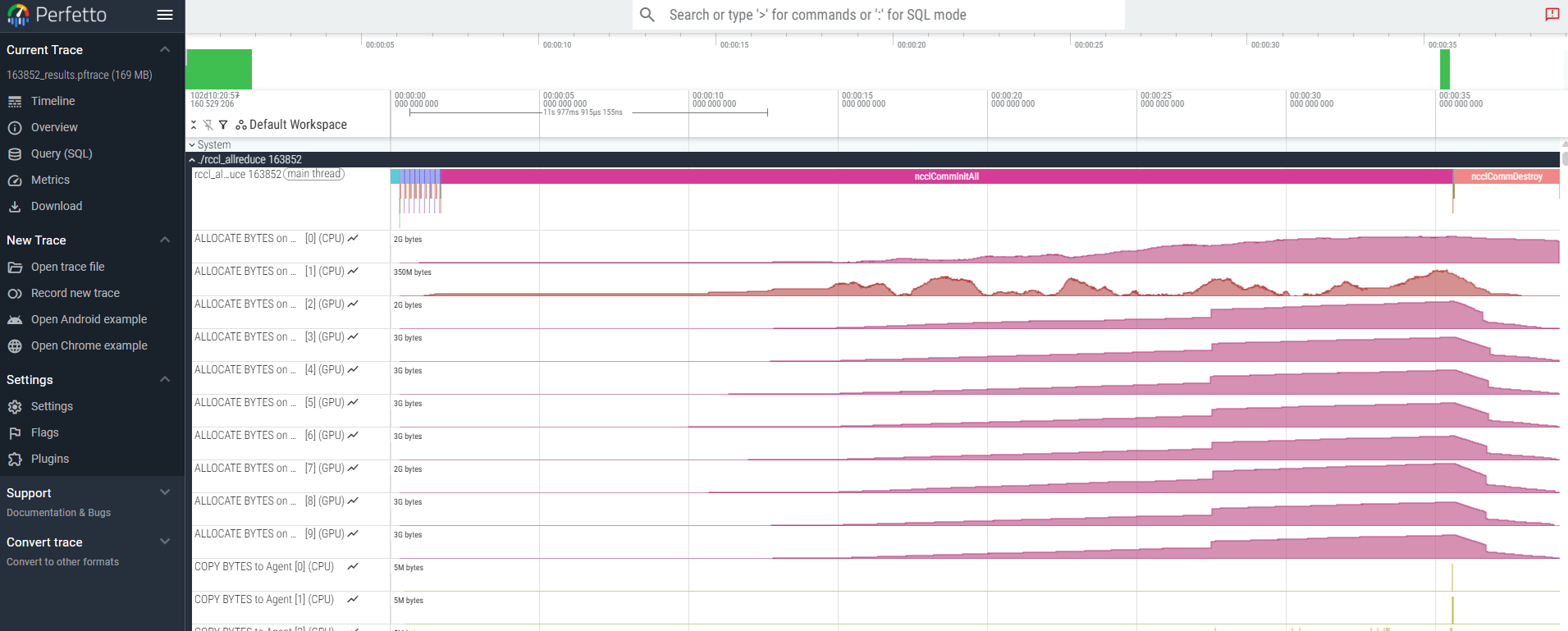
This section demonstrates how to trace RCCL (Rickle) collective communication routines using rocprofv3. RCCL (pronounced “Rickle”) is a stand-alone library that provides standard collective communication operations for GPUs. The trace output is captured in a rocpd database file and can be converted to pftrace format for visualization in the Perfetto UI. This approach is useful for analyzing GPU communication performance and identifying bottlenecks in collective operations.
rocprofv3 --rccl-trace --sys-trace -- <application_path>
The preceding command generates a rocpd database file prefixed with the process ID, which can be converted into PFTrace for visualization in the Perfetto UI.
$ /opt/rocm/bin/rocpd2pftrace -i 163852_results.db
The following image visualizes the RCCL trace for the referenced allreduce_rccl sample application using the Perfetto UI.
The host thread track and select compute streams are pinned in the visualization to enhance readability.
This enables clear observation of the RCCL compute kernels launched during ncclAllReduce operations on the host thread.
rocDecode trace#
rocDecode is a high-performance video decode SDK for AMD GPUs. This option traces the rocDecode API.
rocprofv3 --rocdecode-trace --output-format csv -- <application_path>
The above command generates a rocdecode_api_trace file prefixed with the process ID.
$ cat 41688_rocdecode_api_trace.csv
Here are the contents of rocdecode_api_trace.csv file:
Domain |
Function |
Process_Id |
Thread_Id |
Correlation_Id |
Start_Timestamp |
End_Timestamp |
|---|---|---|---|---|---|---|
ROCDECODE_API |
rocDecCreateVideoParser |
41688 |
41688 |
583 |
615449881677279 |
615449882001583 |
ROCDECODE_API |
rocDecGetDecoderCaps |
41688 |
41688 |
584 |
615449882016054 |
615449882163756 |
ROCDECODE_API |
rocDecGetDecoderCaps |
41688 |
41688 |
588 |
615449886038750 |
615449886050880 |
ROCDECODE_API |
rocDecCreateDecoder |
41688 |
41688 |
591 |
615449886084210 |
615450756910310 |
ROCDECODE_API |
rocDecDecodeFrame |
41688 |
41688 |
595 |
615450757036042 |
615450767147413 |
ROCDECODE_API |
rocDecGetDecodeStatus |
41688 |
41688 |
812 |
615450836779385 |
615450836779575 |
Perfetto will also show rocDecode API arguments. Pointers will not be dereferenced and only the address will be displayed.
rocJPEG trace#
rocJPEG is a high-performance jpeg decode SDK for decoding jpeg images. This option traces the rocJPEG API.
rocprofv3 --rocjpeg-trace --output-format csv -- <application_path>
The above command generates a rocjpeg_api_trace file prefixed with the process ID.
$ cat 41688_rocjpeg_api_trace.csv
Here are the contents of rocjpeg_api_trace.csv file:
Domain |
Function |
Process_Id |
Thread_Id |
Correlation_Id |
Start_Timestamp |
End_Timestamp |
|---|---|---|---|---|---|---|
ROCJPEG_API |
rocJpegCreate |
41884 |
41884 |
105 |
1286306029650499 |
1286306248201233 |
ROCJPEG_API |
rocJpegStreamCreate |
41884 |
41884 |
502 |
1286306248250747 |
1286306248268715 |
ROCJPEG_API |
rocJpegStreamParse |
41884 |
41884 |
503 |
1286306248421385 |
1286306248680757 |
ROCJPEG_API |
rocJpegGetImageInfo |
41884 |
41884 |
504 |
1286306248684203 |
1286306248686556 |
rocSHMEM trace#
rocSHMEM is an intra-kernel networking library that provides GPU-centric networking through an OpenSHMEM-like interface. This option traces the rocSHMEM host-stream API (the rocshmem_*_on_stream routines that enqueue communication and synchronization operations on a HIP stream).
Note
rocSHMEM tracing requires rocSHMEM to be built with rocprofiler-register support (the USE_ROCPROFILER_REGISTER build option, enabled by default). See the rocSHMEM build documentation for details.
rocprofv3 --rocshmem-trace -- <application_path>
rocSHMEM is emitted directly only to the JSON and rocpd (default) output formats. CSV, Perfetto (.pftrace), and OTF2 output are produced from the rocpd database via rocpd convert. --rocshmem-trace is also enabled implicitly by --sys-trace and --runtime-trace.
rocprofv3 --rocshmem-trace -- <application_path>
rocpd convert -i out_results.db --output-format csv
The conversion generates a rocshmem_api_trace.csv file. Here are its contents:
Domain |
Function |
Process_Id |
Thread_Id |
Correlation_Id |
Start_Timestamp |
End_Timestamp |
|---|---|---|---|---|---|---|
ROCSHMEM_API |
putmem_on_stream |
41688 |
41688 |
142 |
615449881677279 |
615449881701583 |
ROCSHMEM_API |
getmem_on_stream |
41688 |
41688 |
143 |
615449882016054 |
615449882043756 |
ROCSHMEM_API |
quiet_on_stream |
41688 |
41688 |
144 |
615449886038750 |
615449886050880 |
ROCSHMEM_API |
barrier_all_on_stream |
41688 |
41688 |
145 |
615449886084210 |
615449887910310 |
ROCSHMEM_API |
broadcastmem_on_stream |
41688 |
41688 |
146 |
615450757036042 |
615450767147413 |
ROCSHMEM_API |
sync_all_on_stream |
41688 |
41688 |
147 |
615450836779385 |
615450837779575 |
Perfetto will also show rocSHMEM API arguments. Pointers will not be dereferenced and only the address will be displayed.
HIP event trace#
HIP event tracing captures GPU-side barrier packets produced by hipEventRecord and hipStreamWaitEvent. Each record includes the operation type, the hipEvent_t handle, the queue where the barrier executed, and (for cross-stream waits) the source queue where the event was originally recorded. This enables visibility into cross-stream synchronization dependencies at the GPU level.
rocprofv3 --hip-event-trace -- <application_path>
rocpd convert -i <output-file>_results.db --output-format csv
HIP event records are emitted to the JSON and rocpd output formats. Use rocpd convert to produce CSV or Perfetto output from the database. --hip-event-trace is automatically enabled by --hip-trace and --hip-runtime-trace.
hipFILE trace#
hipFILE is a GPU-aware file I/O library for HIP applications. This option traces the hipFILE API.
rocprofv3 --hipfile-trace -- <application_path>
rocpd convert -i <output-file>_results.db --output-format csv
The first command stores hipFILE API records in the default rocpd database.
hipFILE is emitted directly only to the JSON and rocpd formats; use rocpd convert to produce CSV, Perfetto, or OTF2 output from the database.
The hipFILE records include API arguments. Pointers are not dereferenced unless argument iteration is configured to do so.
OMPT trace#
OMPT (OpenMP Tools Interface) is the standard interface exposed by OpenMP runtimes for tools to subscribe to runtime events. This option traces host-side OpenMP execution (parallel regions, work-sharing, tasks, sync regions, mutexes, thread lifecycle) and, for applications that offload to a device, the host-side target events (target, target_data_op, target_submit). For end-to-end examples, see Using rocprofv3 with OpenMP.
rocprofv3 --ompt-trace --output-format rocpd -- <application_path>
OMPT is a rocpd-only trace: records are written to the rocpd database (the default output format) and are not emitted by the direct CSV / JSON / Perfetto / OTF2 generators. OMPT records are only captured when rocpd is among the requested --output-format values, so a run that requests only the deprecated direct generators contains no OMPT data; use rocpd convert to export OMPT to CSV / Perfetto / OTF2. --ompt-trace is also enabled implicitly by --sys-trace and --runtime-trace.
Note
Requires an OMPT-capable OpenMP runtime that implements ompt_start_tool — for example the LLVM-based libomp shipped with ROCm / AOMP. GCC’s libgomp does not implement the OMPT interface (see the GOMP status page), so g++ -fopenmp binaries do not produce OMPT records.
Dynamic process attachment#
To profile applications dynamically without requiring to restart the application,``rocprofv3`` provides dynamic process attachment. This is particularly useful for profiling long-running applications, services, or applications in a specific state.
Dynamic process attachment uses the -p, --pid, or --attach options (all equivalent) followed by the target process ID. The profiler instruments the target process and collects the specified tracing or counter data for the configured duration.
For more information, see Dynamic process attachment using rocprofv3.
Post-processing tracing options#
rocprofv3 provides options to collect tracing summary or statistics after conclusion of a tracing session. These options are described here.
This option collects statistics for the enabled tracing types. For example, it collects statistics of HIP APIs, when HIP trace is enabled. The statistics help to determine the API or function that took the most amount of time.
rocprofv3 --stats --hip-trace --output-format csv -- <application_path>
The preceding command generates a hip_api_stats.csv, domain_stats.csv and hip_api_trace.csv file prefixed with the process ID.
$ cat hip_api_stats.csv
Here are the contents of hip_api_stats.csv file:
Name |
Calls |
TotalDurationNs |
AverageNs |
Percentage |
MinNs |
MaxNs |
StdDev |
|---|---|---|---|---|---|---|---|
hipStreamCreateWithFlags |
4 |
262497406 |
65624351.500000 |
85.15 |
3991286 |
249121840 |
122332531.343496 |
hipGetDeviceCount |
1 |
32505687 |
32505687.000000 |
10.54 |
32505687 |
32505687 |
0.00000000e+00 |
hipHostMalloc |
12 |
6096409 |
508034.083333 |
1.98 |
443793 |
548024 |
39236.753678 |
hipFree |
12 |
1994421 |
166201.750000 |
0.6470 |
7790 |
1036046 |
299086.860470 |
hipMemcpyAsync |
12 |
1368378 |
114031.500000 |
0.4439 |
2490 |
764044 |
249308.051619 |
hipMallocAsync |
12 |
927255 |
77271.250000 |
0.3008 |
51540 |
107671 |
20487.475966 |
hipStreamSynchronize |
12 |
870486 |
72540.500000 |
0.2824 |
140 |
866606 |
250065.900069 |
hipLaunchKernel |
16 |
692734 |
43295.875000 |
0.2247 |
1000 |
670044 |
167133.656647 |
hipStreamDestroy |
4 |
619905 |
154976.250000 |
0.2011 |
92901 |
339252 |
122852.320356 |
hipDeviceSynchronize |
4 |
404252 |
101063.000000 |
0.1311 |
570 |
385212 |
189518.505401 |
hipHostFree |
12 |
271202 |
22600.166667 |
0.0880 |
11950 |
34950 |
7480.268600 |
__hipRegisterFatBinary |
1 |
9000 |
9000.000000 |
2.920e-03 |
9000 |
9000 |
0.00000000e+00 |
__hipRegisterFunction |
4 |
6150 |
1537.500000 |
1.995e-03 |
230 |
5370 |
2555.091323 |
__hipPushCallConfiguration |
16 |
2460 |
153.750000 |
7.980e-04 |
70 |
1140 |
267.503894 |
__hipPopCallConfiguration |
16 |
2000 |
125.000000 |
6.488e-04 |
70 |
680 |
151.613544 |
hipGetLastError |
16 |
1270 |
79.375000 |
4.120e-04 |
50 |
440 |
96.295985 |
hipSetDevice |
1 |
660 |
660.000000 |
2.141e-04 |
660 |
660 |
0.00000000e+00 |
Here are the contents of domain_stats.csv file:
Name |
Calls |
TotalDurationNs |
AverageNs |
Percentage |
MinNs |
MaxNs |
StdDev |
|---|---|---|---|---|---|---|---|
HIP_API |
13 |
458514859 |
35270373.769231 |
100.00 |
2300 |
352276613 |
99315857.546240 |
For the description of the fields in the output file, see Output file fields.
This option displays a summary of tracing data for the enabled tracing type, after conclusion of the profiling session.
rocprofv3 -S --hip-trace -- <application_path>

This option displays a summary of each tracing domain for the enabled tracing type, after conclusion of the profiling session.
rocprofv3 -D --hsa-trace --hip-trace --output-format csv -- <application_path>
The preceding command generates a hip_trace.csv and hsa_trace.csv file prefixed with the process ID along with displaying the summary of each domain.
This option displays a summary of multiple domains for the domain names specified on the command line. The summary groups can be separated using a pipe ( | ) symbol.
To see a summary for MEMORY_COPY domains, use:
rocprofv3 --summary-groups MEMORY_COPY --sys-trace -- <application_path>

To see a summary for MEMORY_COPY and HIP_API domains, use:
rocprofv3 --summary-groups 'MEMORY_COPY|HIP_API' --sys-trace -- <application_path>
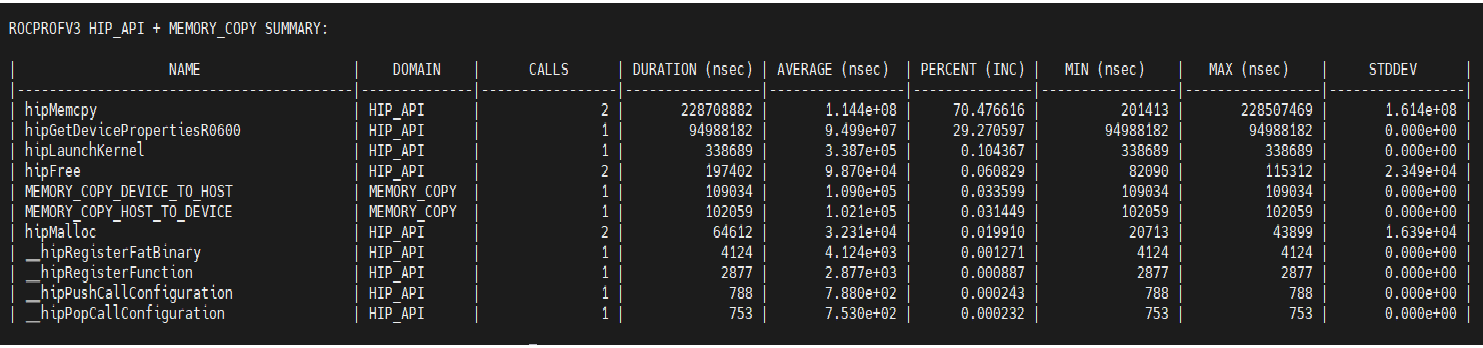
This option specifies the output file for the summary. By default, the summary is displayed on stderr. To specify another output file for summary, use:
rocprofv3 -S -D --summary-output-file filename --sys-trace -- <application_path>
The preceding command generates an output file named “filename” consisting of the summary for each domain. This also generates the files for the enabled tracing types under -sys-trace option.
ROCPROFV3 HSA_API SUMMARY:
| NAME | DOMAIN | CALLS | DURATION (nsec) | AVERAGE (nsec) | PERCENT (INC) | MIN (nsec) | MAX (nsec) | STDDEV |
|-------------------------------------------|--------------|-----------------|-----------------|-----------------|---------------|-----------------|-----------------|-----------------|
| hsa_queue_create | HSA_API | 4 | 280077621 | 7.002e+07 | 75.372632 | 55026812 | 113288760 | 2.885e+07 |
| hsa_amd_memory_async_copy_on_engine | HSA_API | 24 | 55617052 | 2.317e+06 | 14.967292 | 7580 | 55195188 | 1.126e+07 |
| hsa_amd_memory_pool_allocate | HSA_API | 67 | 26428438 | 3.945e+05 | 7.112246 | 1510 | 857592 | 1.782e+05 |
| hsa_amd_memory_pool_free | HSA_API | 72 | 5176173 | 7.189e+04 | 1.392977 | 290 | 170374 | 3.903e+04 |
| hsa_executable_freeze | HSA_API | 2 | 964125 | 4.821e+05 | 0.259459 | 437471 | 526654 | 6.306e+04 |
| hsa_signal_wait_scacquire | HSA_API | 26 | 853122 | 3.281e+04 | 0.229587 | 2530 | 100782 | 3.394e+04 |
| hsa_executable_load_agent_code_object | HSA_API | 2 | 616175 | 3.081e+05 | 0.165821 | 254476 | 361699 | 7.582e+04 |
| hsa_amd_agents_allow_access | HSA_API | 35 | 430680 | 1.231e+04 | 0.115902 | 4830 | 55182 | 9.939e+03 |
| hsa_signal_store_screlease | HSA_API | 56 | 381491 | 6.812e+03 | 0.102664 | 1560 | 41831 | 7.895e+03 |
| hsa_signal_create | HSA_API | 107 | 160889 | 1.504e+03 | 0.043297 | 80 | 5650 | 1.475e+03 |
| hsa_code_object_reader_create_from_memory | HSA_API | 2 | 151314 | 7.566e+04 | 0.040721 | 32121 | 119193 | 6.157e+04 |
| hsa_signal_load_relaxed | HSA_API | 1296 | 137626 | 1.062e+02 | 0.037037 | 20 | 2930 | 2.712e+02 |
| hsa_signal_destroy | HSA_API | 618 | 111224 | 1.800e+02 | 0.029932 | 40 | 1540 | 2.429e+02 |
| hsa_agent_get_info | HSA_API | 65 | 77472 | 1.192e+03 | 0.020849 | 30 | 47121 | 6.341e+03 |
| hsa_amd_signal_create | HSA_API | 512 | 61290 | 1.197e+02 | 0.016494 | 40 | 930 | 1.559e+02 |
| hsa_amd_signal_async_handler | HSA_API | 24 | 52641 | 2.193e+03 | 0.014166 | 1180 | 4020 | 9.252e+02 |
| hsa_executable_iterate_symbols | HSA_API | 14 | 52521 | 3.752e+03 | 0.014134 | 2740 | 6940 | 1.105e+03 |
| hsa_amd_memory_copy_engine_status | HSA_API | 18 | 47370 | 2.632e+03 | 0.012748 | 260 | 7990 | 2.274e+03 |
| hsa_iterate_agents | HSA_API | 1 | 41391 | 4.139e+04 | 0.011139 | 41391 | 41391 | 0.000e+00 |
| hsa_executable_create_alt | HSA_API | 2 | 40470 | 2.024e+04 | 0.010891 | 7530 | 32940 | 1.797e+04 |
| hsa_isa_get_info_alt | HSA_API | 2 | 30391 | 1.520e+04 | 0.008179 | 2490 | 27901 | 1.797e+04 |
| hsa_signal_silent_store_relaxed | HSA_API | 48 | 24920 | 5.192e+02 | 0.006706 | 20 | 4570 | 7.120e+02 |
| hsa_amd_agent_iterate_memory_pools | HSA_API | 5 | 20221 | 4.044e+03 | 0.005442 | 2561 | 8600 | 2.574e+03 |
| hsa_queue_add_write_index_screlease | HSA_API | 56 | 7270 | 1.298e+02 | 0.001956 | 30 | 2310 | 3.471e+02 |
| hsa_amd_profiling_set_profiler_enabled | HSA_API | 4 | 5600 | 1.400e+03 | 0.001507 | 1370 | 1470 | 4.690e+01 |
| hsa_executable_symbol_get_info | HSA_API | 152 | 5470 | 3.599e+01 | 0.001472 | 30 | 340 | 3.563e+01 |
| hsa_queue_load_read_index_relaxed | HSA_API | 56 | 4560 | 8.143e+01 | 0.001227 | 20 | 1310 | 1.863e+02 |
| hsa_executable_get_symbol_by_name | HSA_API | 14 | 4500 | 3.214e+02 | 0.001211 | 110 | 1510 | 4.732e+02 |
| hsa_queue_load_read_index_scacquire | HSA_API | 56 | 3040 | 5.429e+01 | 0.000818 | 30 | 690 | 8.705e+01 |
| hsa_amd_memory_pool_get_info | HSA_API | 43 | 1770 | 4.116e+01 | 0.000476 | 30 | 270 | 3.640e+01 |
| hsa_system_get_info | HSA_API | 4 | 1750 | 4.375e+02 | 0.000471 | 40 | 830 | 3.544e+02 |
| hsa_amd_agent_memory_pool_get_info | HSA_API | 13 | 1140 | 8.769e+01 | 0.000307 | 30 | 640 | 1.664e+02 |
| hsa_agent_iterate_isas | HSA_API | 1 | 700 | 7.000e+02 | 0.000188 | 700 | 700 | 0.000e+00 |
| hsa_system_get_major_extension_table | HSA_API | 1 | 190 | 1.900e+02 | 0.000051 | 190 | 190 | 0.000e+00 |
ROCPROFV3 HIP_API SUMMARY:
| NAME | DOMAIN | CALLS | DURATION (nsec) | AVERAGE (nsec) | PERCENT (INC) | MIN (nsec) | MAX (nsec) | STDDEV |
|------------------------------------------|--------------|-----------------|-----------------|-----------------|---------------|-----------------|-----------------|-----------------|
| hipStreamCreateWithFlags | HIP_API | 8 | 406507215 | 5.081e+07 | 71.307804 | 735979 | 233800881 | 7.889e+07 |
| hipGetDeviceCount | HIP_API | 1 | 76707894 | 7.671e+07 | 13.455780 | 76707894 | 76707894 | 0.000e+00 |
| hipMemcpyAsync | HIP_API | 24 | 56109444 | 2.338e+06 | 9.842485 | 11640 | 55299811 | 1.128e+07 |
| hipHostMalloc | HIP_API | 24 | 13007523 | 5.420e+05 | 2.281726 | 416631 | 866382 | 1.206e+05 |
| hipMallocAsync | HIP_API | 24 | 7304847 | 3.044e+05 | 1.281386 | 275397 | 353719 | 2.207e+04 |
| hipHostFree | HIP_API | 24 | 2786484 | 1.161e+05 | 0.488793 | 72242 | 221646 | 4.606e+04 |
| hipStreamDestroy | HIP_API | 8 | 2137924 | 2.672e+05 | 0.375026 | 221596 | 377469 | 5.489e+04 |
| hipLaunchKernel | HIP_API | 32 | 2080214 | 6.501e+04 | 0.364902 | 8850 | 1608721 | 2.819e+05 |
| hipFree | HIP_API | 24 | 1572948 | 6.554e+04 | 0.275920 | 2130 | 186994 | 4.815e+04 |
| hipStreamSynchronize | HIP_API | 24 | 1452706 | 6.053e+04 | 0.254828 | 20810 | 135803 | 3.469e+04 |
| __hipRegisterFunction | HIP_API | 4 | 294207 | 7.355e+04 | 0.051609 | 210 | 291807 | 1.455e+05 |
| hipDeviceSynchronize | HIP_API | 4 | 50663 | 1.267e+04 | 0.008887 | 510 | 23621 | 9.554e+03 |
| __hipRegisterFatBinary | HIP_API | 1 | 43811 | 4.381e+04 | 0.007685 | 43811 | 43811 | 0.000e+00 |
| __hipPushCallConfiguration | HIP_API | 32 | 6250 | 1.953e+02 | 0.001096 | 60 | 3640 | 6.308e+02 |
| __hipPopCallConfiguration | HIP_API | 32 | 4780 | 1.494e+02 | 0.000838 | 60 | 2520 | 4.340e+02 |
| hipGetLastError | HIP_API | 32 | 4471 | 1.397e+02 | 0.000784 | 60 | 2381 | 4.092e+02 |
| hipSetDevice | HIP_API | 1 | 2570 | 2.570e+03 | 0.000451 | 2570 | 2570 | 0.000e+00 |
ROCPROFV3 KERNEL_DISPATCH SUMMARY:
| NAME | DOMAIN | CALLS | DURATION (nsec) | AVERAGE (nsec) | PERCENT (INC) | MIN (nsec) | MAX (nsec) | STDDEV |
|---------------------------------------------------------------------------|-----------------|-----------------|-----------------|-----------------|---------------|-----------------|-----------------|-----------------|
| void addition_kernel<float>(float*, float const*, float const*, int, int) | KERNEL_DISPATCH | 8 | 184324 | 2.304e+04 | 40.681542 | 11200 | 98802 | 3.062e+04 |
| divide_kernel(float*, float const*, float const*, int, int) | KERNEL_DISPATCH | 8 | 94482 | 1.181e+04 | 20.852811 | 10240 | 13520 | 1.061e+03 |
| multiply_kernel(float*, float const*, float const*, int, int) | KERNEL_DISPATCH | 8 | 91763 | 1.147e+04 | 20.252709 | 9800 | 12800 | 9.417e+02 |
| subtract_kernel(float*, float const*, float const*, int, int) | KERNEL_DISPATCH | 8 | 82521 | 1.032e+04 | 18.212938 | 8320 | 12920 | 1.436e+03 |
ROCPROFV3 MEMORY_COPY SUMMARY:
| NAME | DOMAIN | CALLS | DURATION (nsec) | AVERAGE (nsec) | PERCENT (INC) | MIN (nsec) | MAX (nsec) | STDDEV |
|------------------------------------------|--------------|-----------------|-----------------|-----------------|---------------|-----------------|-----------------|-----------------|
| MEMORY_COPY_HOST_TO_DEVICE | MEMORY_COPY | 16 | 3691929 | 2.307e+05 | 85.494053 | 74842 | 284487 | 6.265e+04 |
| MEMORY_COPY_DEVICE_TO_HOST | MEMORY_COPY | 8 | 626417 | 7.830e+04 | 14.505947 | 74842 | 98603 | 8.207e+03 |
ROCPROFV3 MEMORY_ALLOCATION SUMMARY:
| NAME | DOMAIN | CALLS | DURATION (nsec) | AVERAGE (nsec) | PERCENT (INC) | MIN (nsec) | MAX (nsec) | STDDEV |
|------------------------------------------|-------------------|-----------------|-----------------|-----------------|---------------|-----------------|-----------------|-----------------|
| MEMORY_ALLOCATION_ALLOCATE | MEMORY_ALLOCATION | 67 | 26314096 | 3.927e+05 | 83.661617 | 950 | 856812 | 1.785e+05 |
| MEMORY_ALLOCATION_FREE | MEMORY_ALLOCATION | 72 | 5138913 | 7.137e+04 | 16.338383 | 20 | 166234 | 3.882e+04 |
ROCPROFV3 SUMMARY:
| NAME | DOMAIN | CALLS | DURATION (nsec) | AVERAGE (nsec) | PERCENT (INC) | MIN (nsec) | MAX (nsec) | STDDEV |
|---------------------------------------------------------------------------|-------------------|-----------------|-----------------|-----------------|---------------|-----------------|-----------------|-----------------|
| hipStreamCreateWithFlags | HIP_API | 8 | 406507215 | 5.081e+07 | 41.569873 | 735979 | 233800881 | 7.889e+07 |
| hsa_queue_create | HSA_API | 4 | 280077621 | 7.002e+07 | 28.641044 | 55026812 | 113288760 | 2.885e+07 |
| hipGetDeviceCount | HIP_API | 1 | 76707894 | 7.671e+07 | 7.844233 | 76707894 | 76707894 | 0.000e+00 |
| hipMemcpyAsync | HIP_API | 24 | 56109444 | 2.338e+06 | 5.737813 | 11640 | 55299811 | 1.128e+07 |
| hsa_amd_memory_async_copy_on_engine | HSA_API | 24 | 55617052 | 2.317e+06 | 5.687461 | 7580 | 55195188 | 1.126e+07 |
| hsa_amd_memory_pool_allocate | HSA_API | 67 | 26428438 | 3.945e+05 | 2.702601 | 1510 | 857592 | 1.782e+05 |
| MEMORY_ALLOCATION_ALLOCATE | MEMORY_ALLOCATION | 67 | 26314096 | 3.927e+05 | 2.690908 | 950 | 856812 | 1.785e+05 |
| hipHostMalloc | HIP_API | 24 | 13007523 | 5.420e+05 | 1.330164 | 416631 | 866382 | 1.206e+05 |
| hipMallocAsync | HIP_API | 24 | 7304847 | 3.044e+05 | 0.747002 | 275397 | 353719 | 2.207e+04 |
| hsa_amd_memory_pool_free | HSA_API | 72 | 5176173 | 7.189e+04 | 0.529321 | 290 | 170374 | 3.903e+04 |
| MEMORY_ALLOCATION_FREE | MEMORY_ALLOCATION | 72 | 5138913 | 7.137e+04 | 0.525511 | 20 | 166234 | 3.882e+04 |
| MEMORY_COPY_HOST_TO_DEVICE | MEMORY_COPY | 16 | 3691929 | 2.307e+05 | 0.377541 | 74842 | 284487 | 6.265e+04 |
| hipHostFree | HIP_API | 24 | 2786484 | 1.161e+05 | 0.284949 | 72242 | 221646 | 4.606e+04 |
| hipStreamDestroy | HIP_API | 8 | 2137924 | 2.672e+05 | 0.218626 | 221596 | 377469 | 5.489e+04 |
| hipLaunchKernel | HIP_API | 32 | 2080214 | 6.501e+04 | 0.212725 | 8850 | 1608721 | 2.819e+05 |
| hipFree | HIP_API | 24 | 1572948 | 6.554e+04 | 0.160851 | 2130 | 186994 | 4.815e+04 |
| hipStreamSynchronize | HIP_API | 24 | 1452706 | 6.053e+04 | 0.148555 | 20810 | 135803 | 3.469e+04 |
| hsa_executable_freeze | HSA_API | 2 | 964125 | 4.821e+05 | 0.098592 | 437471 | 526654 | 6.306e+04 |
| hsa_signal_wait_scacquire | HSA_API | 26 | 853122 | 3.281e+04 | 0.087241 | 2530 | 100782 | 3.394e+04 |
| MEMORY_COPY_DEVICE_TO_HOST | MEMORY_COPY | 8 | 626417 | 7.830e+04 | 0.064058 | 74842 | 98603 | 8.207e+03 |
| hsa_executable_load_agent_code_object | HSA_API | 2 | 616175 | 3.081e+05 | 0.063011 | 254476 | 361699 | 7.582e+04 |
| hsa_amd_agents_allow_access | HSA_API | 35 | 430680 | 1.231e+04 | 0.044042 | 4830 | 55182 | 9.939e+03 |
| hsa_signal_store_screlease | HSA_API | 56 | 381491 | 6.812e+03 | 0.039012 | 1560 | 41831 | 7.895e+03 |
| __hipRegisterFunction | HIP_API | 4 | 294207 | 7.355e+04 | 0.030086 | 210 | 291807 | 1.455e+05 |
| void addition_kernel<float>(float*, float const*, float const*, int, int) | KERNEL_DISPATCH | 8 | 184324 | 2.304e+04 | 0.018849 | 11200 | 98802 | 3.062e+04 |
| hsa_signal_create | HSA_API | 107 | 160889 | 1.504e+03 | 0.016453 | 80 | 5650 | 1.475e+03 |
| hsa_code_object_reader_create_from_memory | HSA_API | 2 | 151314 | 7.566e+04 | 0.015474 | 32121 | 119193 | 6.157e+04 |
| hsa_signal_load_relaxed | HSA_API | 1296 | 137626 | 1.062e+02 | 0.014074 | 20 | 2930 | 2.712e+02 |
| hsa_signal_destroy | HSA_API | 618 | 111224 | 1.800e+02 | 0.011374 | 40 | 1540 | 2.429e+02 |
| divide_kernel(float*, float const*, float const*, int, int) | KERNEL_DISPATCH | 8 | 94482 | 1.181e+04 | 0.009662 | 10240 | 13520 | 1.061e+03 |
| multiply_kernel(float*, float const*, float const*, int, int) | KERNEL_DISPATCH | 8 | 91763 | 1.147e+04 | 0.009384 | 9800 | 12800 | 9.417e+02 |
| subtract_kernel(float*, float const*, float const*, int, int) | KERNEL_DISPATCH | 8 | 82521 | 1.032e+04 | 0.008439 | 8320 | 12920 | 1.436e+03 |
| hsa_agent_get_info | HSA_API | 65 | 77472 | 1.192e+03 | 0.007922 | 30 | 47121 | 6.341e+03 |
| hsa_amd_signal_create | HSA_API | 512 | 61290 | 1.197e+02 | 0.006268 | 40 | 930 | 1.559e+02 |
| hsa_amd_signal_async_handler | HSA_API | 24 | 52641 | 2.193e+03 | 0.005383 | 1180 | 4020 | 9.252e+02 |
| hsa_executable_iterate_symbols | HSA_API | 14 | 52521 | 3.752e+03 | 0.005371 | 2740 | 6940 | 1.105e+03 |
| hipDeviceSynchronize | HIP_API | 4 | 50663 | 1.267e+04 | 0.005181 | 510 | 23621 | 9.554e+03 |
| hsa_amd_memory_copy_engine_status | HSA_API | 18 | 47370 | 2.632e+03 | 0.004844 | 260 | 7990 | 2.274e+03 |
| __hipRegisterFatBinary | HIP_API | 1 | 43811 | 4.381e+04 | 0.004480 | 43811 | 43811 | 0.000e+00 |
| hsa_iterate_agents | HSA_API | 1 | 41391 | 4.139e+04 | 0.004233 | 41391 | 41391 | 0.000e+00 |
| hsa_executable_create_alt | HSA_API | 2 | 40470 | 2.024e+04 | 0.004139 | 7530 | 32940 | 1.797e+04 |
| hsa_isa_get_info_alt | HSA_API | 2 | 30391 | 1.520e+04 | 0.003108 | 2490 | 27901 | 1.797e+04 |
| hsa_signal_silent_store_relaxed | HSA_API | 48 | 24920 | 5.192e+02 | 0.002548 | 20 | 4570 | 7.120e+02 |
| hsa_amd_agent_iterate_memory_pools | HSA_API | 5 | 20221 | 4.044e+03 | 0.002068 | 2561 | 8600 | 2.574e+03 |
| hsa_queue_add_write_index_screlease | HSA_API | 56 | 7270 | 1.298e+02 | 0.000743 | 30 | 2310 | 3.471e+02 |
| __hipPushCallConfiguration | HIP_API | 32 | 6250 | 1.953e+02 | 0.000639 | 60 | 3640 | 6.308e+02 |
| hsa_amd_profiling_set_profiler_enabled | HSA_API | 4 | 5600 | 1.400e+03 | 0.000573 | 1370 | 1470 | 4.690e+01 |
| hsa_executable_symbol_get_info | HSA_API | 152 | 5470 | 3.599e+01 | 0.000559 | 30 | 340 | 3.563e+01 |
| __hipPopCallConfiguration | HIP_API | 32 | 4780 | 1.494e+02 | 0.000489 | 60 | 2520 | 4.340e+02 |
| hsa_queue_load_read_index_relaxed | HSA_API | 56 | 4560 | 8.143e+01 | 0.000466 | 20 | 1310 | 1.863e+02 |
| hsa_executable_get_symbol_by_name | HSA_API | 14 | 4500 | 3.214e+02 | 0.000460 | 110 | 1510 | 4.732e+02 |
| hipGetLastError | HIP_API | 32 | 4471 | 1.397e+02 | 0.000457 | 60 | 2381 | 4.092e+02 |
| hsa_queue_load_read_index_scacquire | HSA_API | 56 | 3040 | 5.429e+01 | 0.000311 | 30 | 690 | 8.705e+01 |
| hipSetDevice | HIP_API | 1 | 2570 | 2.570e+03 | 0.000263 | 2570 | 2570 | 0.000e+00 |
| hsa_amd_memory_pool_get_info | HSA_API | 43 | 1770 | 4.116e+01 | 0.000181 | 30 | 270 | 3.640e+01 |
| hsa_system_get_info | HSA_API | 4 | 1750 | 4.375e+02 | 0.000179 | 40 | 830 | 3.544e+02 |
| hsa_amd_agent_memory_pool_get_info | HSA_API | 13 | 1140 | 8.769e+01 | 0.000117 | 30 | 640 | 1.664e+02 |
| hsa_agent_iterate_isas | HSA_API | 1 | 700 | 7.000e+02 | 0.000072 | 700 | 700 | 0.000e+00 |
| hsa_system_get_major_extension_table | HSA_API | 1 | 190 | 1.900e+02 | 0.000019 | 190 | 190 | 0.000e+00 |
Configuration output#
The --output-config option generates a comprehensive configuration output file that contains all resolved rocprofv3 settings and options used during a profiling session. This feature is essential for debugging, reproducibility, and configuration validation.
To generate a configuration output file during profiling, use:
rocprofv3 --output-config --hip-trace -- <application_path>
This command generates a configuration file (typically <process_id>_config.json) alongside the regular profiling output files.
The generated JSON configuration file contains detailed information about the profiling session and is structured with a rocprofiler-sdk-tool array containing comprehensive metadata and configuration details.
The metadata section includes essential session information such as process ID (pid), initialization and finalization timestamps (init_time, fini_time), the exact command executed, and detailed build specifications. The build specification contains version information, compiler details, git revision, system architecture, and kernel version, providing complete context for reproducing the environment.
The config section is the most comprehensive part, containing all profiling options with their resolved boolean and numerical values. This includes tracing options like hip_runtime_api_trace, hip_compiler_api_trace, kernel_trace, hsa_core_api_trace, memory_copy_trace, and many others. It also shows advanced configuration like PC sampling settings (pc_sampling_method, pc_sampling_interval), filtering options (kernel_filter_include, kernel_filter_exclude), output formatting choices (csv_output, json_output, pftrace_output), and performance tuning parameters.
The environment section captures all environment variables active during the profiling session, including system variables such as SHELL, COLORTERM, HOSTNAME, and ROCm-specific variables, providing complete environmental context for reproduction.
Sample configuration output structure:
{
  "rocprofiler-sdk-tool": [
    {
      "metadata": {
        "pid": 213524,
        "init_time": 682678344984459,
        "fini_time": 682678842290172,
        "config": {
          "hip_runtime_api_trace": true,
          "hip_compiler_api_trace": true,
          "kernel_trace": false,
          "hsa_core_api_trace": false,
          "memory_copy_trace": false,
          "counter_collection": false,
                      "kernel_filter_include": ".*",
          "demangle": true,
          "minimum_output_bytes": 0,
          "csv_output": true,
          "json_output": false,
          "output_path": "out",
          "output_file": "1a2b3c4d5e6f/213524"
        },
        "command": ["./MatrixTranspose"],
        "build_spec": {
          "version_major": 1,
          "version_minor": 0,
          "compiler_id": "GNU",
          "compiler_version": "11.4.0",
          "git_revision": "a1b2c3d4e5f6789012345678901234567890abcd",
          "system_name": "Linux",
          "system_processor": "x86_64"
        },
        "environment": {
          "SHELL": "/bin/bash",
          "COLORTERM": "truecolor",
          "HOSTNAME": "1a2b3c4d5e6f",
          "ROCM_ROOT": "/opt/rocm-6.4.2",
          "ROCM_VERSION": "6.4.2",
          "BUILD_NUM": "12345",
          "ROCPROF_OUTPUT_PATH": "out",
          "ROCPROF_OUTPUT_CONFIG_FILE": "1",
          "ROCPROF_OUTPUT_FORMAT": "csv",
          "ROCPROF_HIP_COMPILER_API_TRACE": "1",
          "ROCPROF_HIP_RUNTIME_API_TRACE": "1",
           ".... Output truncated for brevity ...."
        }
      }
    }
  ]
}
The configuration output file provides complete transparency into rocprofv3 operation, documenting all settings, defaults, and environmental context required for profiling sessions.
Collecting traces using input file#
The preceding sections describe how to collect traces by specifying the desired tracing type on the command line. You can also specify the desired tracing types in an input file in YAML (.yaml/.yml), or JSON (.json) format. You can supply any command-line option for tracing in the input file.
Here is a sample input.yaml file for collecting tracing summary:
jobs:
  - output_directory: "@CMAKE_CURRENT_BINARY_DIR@/%env{ARBITRARY_ENV_VARIABLE}%"
    output_file: out
    output_format: [pftrace, json, otf2]
    log_level: env
    runtime_trace: true
    kernel_rename: true
    summary: true
    summary_per_domain: true
    summary_groups: ["KERNEL_DISPATCH|MEMORY_COPY"]
    summary_output_file: "summary"
Here is a sample input.json file for collecting tracing summary:
{
  "jobs": [
    {
      "output_directory": "out-directory",
      "output_file": "out",
      "output_format": ["pftrace", "json", "otf2"],
      "log_level": "env",
      "runtime_trace": true,
      "kernel_rename": true,
      "summary": true,
      "summary_per_domain": true,
      "summary_groups": ["KERNEL_DISPATCH|MEMORY_COPY"],
      "summary_output_file": "summary"
    }
  ]
}
Here is the input schema (properties) of JSON or YAML input files:
jobs (array):
rocprofv3input data per application run.Items (object): Data for
rocprofv3hip_trace (boolean)
hip_runtime_trace (boolean)
hip_compiler_trace (boolean)
marker_trace (boolean)
kernel_trace (boolean)
memory_copy_trace (boolean)
memory_allocation_trace (boolean)
scratch_memory_trace (boolean)
stats (boolean)
hsa_trace (boolean)
hsa_core_trace (boolean)
hsa_amd_trace (boolean)
hsa_finalize_trace (boolean)
hsa_image_trace (boolean)
sys_trace (boolean)
minimum-output-data (integer)
disable-signal-handlers (boolean)
mangled_kernels (boolean)
truncate_kernels (boolean)
output_file (string)
output_directory (string)
output_format (array)
log_level (string)
preload (array)
For description of the options specified under job items, see roprofv3 command-line options.
To supply the input file for collecting traces, use:
rocprofv3 -i input.yaml -- <application_path>
Please note that input file format must be a valid YAML or JSON file.
Disabling specific tracing options#
When using aggregate tracing options like --runtime-trace or --sys-trace, you can disable specific tracing options by setting them to False. This allows fine-grained control over the traces to be collected.
rocprofv3 --runtime-trace --scratch-memory-trace=False -- <application_path>
The preceding command enables all traces included in --runtime-trace except for scratch memory tracing.
Similarly, for --sys-trace:
rocprofv3 --sys-trace --hsa-trace=False -- <application_path>
The preceding command enables all traces included in --sys-trace except for HSA API tracing.
To disable multiple specific tracing options, use:
rocprofv3 --sys-trace --hsa-trace=False --scratch-memory-trace=False -- <application_path>
This feature is particularly useful to collect most traces excluding specific ones that might be unnecessary for your analysis or that generate excessive data.
Kernel counter collection#
The application tracing functionality allows you to evaluate the duration of kernel execution but is of little help in providing insight into kernel execution details. The kernel counter collection functionality allows you to select kernels for profiling and choose the basic counters or derived metrics to be collected for each kernel execution, thus providing a greater insight into kernel execution.
AMDGPUs are equipped with hardware performance counters that can be used to measure specific values during kernel execution, which are then exported from the GPU and written into the output files at the end of the kernel execution. These performance counters vary according to the GPU. Therefore, it is recommended to examine the hardware counters that can be collected before running the profile.
There are two types of data available for profiling: hardware basic counters and derived metrics.
The derived metrics are the counters derived from the basic counters using mathematical expressions. Note that the basic counters and derived metrics are collectively referred as counters in this document.
To see the counters available on the GPU, use:
rocprofv3 --list-avail
Sample output for the list-avail command:
You can also customize the counters according to the requirement. Such counters are named Extra counters.
For a comprehensive list of counters available on MI200, see MI200 performance counters and metrics.
Note
Counter dimension collection: When collecting counters with multiple dimensions or instances, such as TCC_MISS with DIMENSION_INSTANCE[0:15], individual dimension values can’t be collected separately using bracket notation, such as TCC_MISS[0] or TCC_MISS[15] in the input files.
To collect aggregated values: Specify the counter name without dimension specifiers, such as pmc: TCC_MISS. The rocprofv3 tool automatically collects accumulated values across all instances.
To collect values per instance: Use JSON output format, which includes detailed dimension information for individual counter instances.
Counter collection using input file#
Input files can be in text (.txt), YAML (.yaml/.yml), or JSON (.json) format to specify the the desired counters for collection.
When using input file in text format, the line consisting of the counter names must begin with pmc. The number of counters that can be collected in one profiling run are limited by the GPU hardware resources. If too many counters are selected, the kernels need to be executed multiple times(multi-pass execution) to collect all the counters. For multi-pass execution, include multiple pmc rows in the input file. Counters in each pmc row can be collected in each application run.
Here is a sample input.txt file for specifying counters for collection:
$ cat input.txt

pmc: GPUBusy SQ_WAVES
pmc: GRBM_GUI_ACTIVE
While the input file in text format can only be used for counter collection, JSON and YAML formats support all the command-line options for profiling. The input file in YAML or JSON format has an array of profiling configurations called jobs. Each job is used to configure profiling for an application execution.
Here is the input schema (properties) of JSON or YAML input files:
jobs (array):
rocprofv3input data per application runItems (object): Data for
rocprofv3pmc (array): list of counters for collection
kernel_include_regex (string)
kernel_exclude_regex (string)
kernel_iteration_range (string)
mangled_kernels (boolean)
truncate_kernels (boolean)
output_file (string)
output_directory (string)
output_format (array)
list_avail (boolean)
log_level (string)
preload (array)
minimum-output-data (integer)
disable-signal-handlers (boolean)
pc_sampling_unit (string)
pc_sampling_method (string)
pc_sampling_interval (integer)
pc_sampling_beta_enabled (boolean)
For description of the options specified under job items, see roprofv3 command-line options.
Here is a sample input.json file for specifying counters for collection along with the options to filter and control the output:
$ cat input.json

{
  "jobs": [
     {
        "pmc": ["SQ_WAVES", "GRBM_COUNT", "GRBM_GUI_ACTIVE"]
     },
     {
        "pmc": ["FETCH_SIZE", "SQ_WAVE_CYCLES"],
        "kernel_include_regex": ".*_kernel",
        "kernel_exclude_regex": "multiply",
        "kernel_iteration_range": "[1-2],[3-4]",
        "output_file": "out",
        "output_format": [
           "csv",
           "json"
        ],
        "truncate_kernels": true
     }
  ]
}
Here is a sample input.yaml file for counter collection:
jobs:
  - pmc: ["SQ_WAVES", "GRBM_COUNT", "GRBM_GUI_ACTIVE"]
  - pmc: ["SQ_WAVE_CYCLES", "WRITE_SIZE"]
    kernel_include_regex: ".*_kernel"
    kernel_exclude_regex: "multiply"
    kernel_iteration_range: "[1-2],[3-4]"
    output_file: "out"
    output_format:
      - "csv"
      - "json"
    truncate_kernels: true
To supply the input file for kernel counter collection, use:
rocprofv3 -i input.yaml -- <application_path>
Counter collection using command line#
You can also collect the desired counters by directly specifying them in the command line instead of using an input file.
To supply the counters in the command line, use:
rocprofv3 --pmc SQ_WAVES GRBM_COUNT GRBM_GUI_ACTIVE -- <application_path>
Note
When specifying more than one counter, separate them using space or a comma.
Job fails if the entire set of counters can’t be collected in a single pass.
Multi-pass counter collection#
When counters can’t be collected simultaneously due to hardware limitations, you can use multi-pass counter collection. This helps you collect different sets of counters across multiple profiling passes of the same application.
Using multiple --pmc flags:
You can specify multiple --pmc flags to define different counter groups. Each --pmc flag represents a separate profiling pass:
rocprofv3 --pmc SQ_WAVES SQ_WAVE_CYCLES --pmc GRBM_COUNT GRBM_GUI_ACTIVE -- <application_path>
The preceding command creates two profiling passes:
Pass 1: Collects
SQ_WAVESandSQ_WAVE_CYCLES.Pass 2: Collects
GRBM_COUNTandGRBM_GUI_ACTIVE.
Combining CLI and input file:
You can combine --pmc flag with an input file. The counters specified in CLI and input file are combined, creating separate passes for each counter:
rocprofv3 -i input.txt --pmc GRBM_COUNT --pmc SQ_WAVES -- <application_path>
If input.txt contains:
pmc: FETCH_SIZE SQ_WAVES
pmc: GRBM_GUI_ACTIVE
The preceding command creates four profiling passes:
Pass 1:
GRBM_COUNT(from CLI).Pass 2:
SQ_WAVES(from CLI).Pass 3:
FETCH_SIZE SQ_WAVE_CYCLES(from input file).Pass 4:
GRBM_GUI_ACTIVE(from input file).
Output organization:
In multi-pass counter collection, each pass generates its output in a separate pass_n subdirectory:
output_directory/
├── pass_1/
│   └── counter_collection.csv
├── pass_2/
│   └── counter_collection.csv
├── pass_3/
│   └── counter_collection.csv
└── pass_4/
    └── counter_collection.csv
Note
Multi-pass counter collection is not compatible with attach mode (
--pid).Multi-pass counter collection is not compatible with
--collection-period.Each pass runs the application from start to finish.
Kernel replay (beta)#
By default, multiple --pmc groups are collected using application replay: the application is re-run from start to finish once per counter group (as described in the preceding section). --replay-mode kernel --kernel-replay-beta-enabled switches to kernel replay instead, collecting all --pmc groups within a single application run. Each kernel dispatch is replayed once per counter group in-process. Before replay, rocprofv3 snapshots every tracked coarse-grained device allocation owned by that agent, plus discovered module-scope device variables, and restores that snapshot between passes so every group observes identical captured inputs.
This is useful when re-running the whole application per group is expensive or non-deterministic. Without --replay-mode kernel, multiple --pmc groups use application replay as usual.
Because capture is per-agent rather than per-kernel – replay makes no attempt to determine which allocations a kernel actually reaches – host memory use during a replayed dispatch is proportional to the agent’s entire tracked device footprint, and both the initial snapshot and every restore between passes scale with it.
rocprofv3 --pmc SQ_WAVES GRBM_COUNT --pmc GRBM_GUI_ACTIVE --replay-mode kernel --kernel-replay-beta-enabled -- <application_path>
The preceding command collects both counter groups in a single run of <application_path>, replaying each dispatch once per group instead of running the application twice.
Note
--replay-mode kernelrequires--pmcand--kernel-replay-beta-enabled.--replay-mode kernelcollects counters only. It cannot be combined with--att, PC sampling, or--spm, and rocprofv3 rejects those combinations. Counter groups are the only thing that changes from one pass to the next, so any other service would stay enabled across all of the passes and report every kernel once per pass. Collect them in a separate run. Tool authors who need per-pass control over other services can get it through the SDK; see Using kernel replay.This feature is in beta. The flags, the SDK API, and the output schema may change.
There is no
--kernel-replay-passesflag. The number of passes is the number of--pmcgroups collectable on the dispatch’s GPU agent.JSON counter records include a
replay_passfield. CSVcounter_collection.csvdoes not add aReplay_Passcolumn; passes of a dispatch shareDispatch_Idand are distinguished byCounter_Name.Only coarse-grained device allocations (and module-scope
__device__/__constant__variables) are restored. Unified, managed, andhipMallocAsyncmemory are not. Snapshot is a full in-memory copy; dirty-page hashing is not implemented in this version.HIP graph launches are not replayed (warn once, run once).
Only single-packet, single-dispatch submissions are replayed. A multi-packet submission runs once without replay and warns once.
For usage, limitations, and when to prefer application replay, see Using kernel replay with rocprofv3. Tool authors should see Using kernel replay and ROCprofiler-SDK kernel replay (experimental).
Extra counters#
While the basic counters and derived metrics are available for collection by default, you can also define counters as per requirement. These user-defined counters with custom definitions are named extra counters.
You can define the extra counters in a YAML file as shown:
rocprofiler-sdk:
  counters-schema-version: 1
  counters:
    - name: GRBM_GUI_ACTIVE_SUM
      description: "Unit: cycles"
      properties: []
      definitions:
        - architectures:
            - gfx10
            - gfx1010
            - gfx1030
            - gfx1031
            - gfx1032
            - gfx11
            - gfx1100
            - gfx1101
            - gfx1102
            - gfx9
            - gfx906
            - gfx908
            - gfx90a
            - gfx942
          expression: reduce(GRBM_GUI_ACTIVE,max)*CU_NUM
    - name: CPC_CPC_STAT_BUSY
      description: CPC Busy.
      properties: []
      definitions:
        - architectures:
            - gfx940
            - gfx941
          block: CPC
          event: 25
Please note, the above sample uses the CPC_CPC_STAT_BUSY counter definition for the gfx940
and gfx941 architectures to demonstrate the YAML schema when counters have different
architecture-specific definitions.
If this YAML is placed in a extra_counters.yaml file, to collect the extra counters defined
in the extra_counters.yaml file, use the -E / --extra-counters option:
rocprofv3 -E <path-to-extra_counters.yaml> --pmc GRBM_GUI_ACTIVE_SUM --output-format csv -- <application_path>
Where the option --pmc is used to specify the extra counters to be collected.
Kernel counter collection output#
Using rocprofv3 for counter collection using input file or command line generates a ./pmc_n/counter_collection.csv file prefixed with the process ID. For each pmc row, a directory pmc_n containing a counter_collection.csv file is generated, where n = 1 for the first row and so on.
When using input file in JSON or YAML format, for each job, a directory pass_n containing a counter_collection.csv file is generated, where n = 1 for the first job and so on.
Each row of the CSV file is an instance of kernel execution. Here is a truncated version of the output file from pmc_1:
$ cat pmc_1/218_counter_collection.csv
Here are the contents of counter_collection.csv file:
Correlation_Id |
Dispatch_Id |
Agent_Id |
Queue_Id |
Process_Id |
Thread_Id |
Grid_Size |
Kernel_Id |
Kernel_Name |
Workgroup_Size |
LDS_Block_Size |
Scratch_Size |
VGPR_Count |
Accum_VGPR_Count |
SGPR_Count |
Counter_Name |
Counter_Value |
Start_Timestamp |
End_Timestamp |
|---|---|---|---|---|---|---|---|---|---|---|---|---|---|---|---|---|---|---|
1 |
1 |
Agent 1 |
1 |
15606 |
15606 |
1048576 |
17 |
void addition_kernel<float>(float*, float const*, float const*, int, int) |
64 |
0 |
0 |
8 |
0 |
16 |
SQ_WAVES |
16384.000000 |
3200098838431081 |
3200098838483232 |
2 |
2 |
Agent 1 |
1 |
15606 |
15606 |
1048576 |
20 |
subtract_kernel(float*, float const*, float const*, int, int) |
64 |
0 |
0 |
8 |
0 |
16 |
SQ_WAVES |
16384.000000 |
3200098838589014 |
3200098838638794 |
3 |
3 |
Agent 1 |
1 |
15606 |
15606 |
1048576 |
19 |
multiply_kernel(float*, float const*, float const*, int, int) |
64 |
0 |
0 |
8 |
0 |
16 |
SQ_WAVES |
16384.000000 |
3200098838746207 |
3200098838793025 |
4 |
4 |
Agent 1 |
1 |
15606 |
15606 |
1048576 |
18 |
divide_kernel(float*, float const*, float const*, int, int) |
64 |
0 |
0 |
12 |
0 |
16 |
SQ_WAVES |
16384.000000 |
3200098838879399 |
3200098838927550 |
For the description of the fields in the output file, see Output file fields.
Iteration based counter multiplexing#
Counter multiplexing allows a single run of the program to collect groups of counters. This is useful when the counters you want to collect exceed the hardware limits and you cannot run the program multiple times for collection.
This feature is available when using YAML (.yaml/.yml) or JSON (.json) input formats. Two new fields are introduced, pmc_groups and pmc_group_interval. The pmc_groups field is used to specify the groups of counters to be collected in each run. The pmc_group_interval field is used to specify the interval between each group of counters. Interval is per-device and increments per dispatch on the device (i.e. dispatch_id). When the interval is reached the next group is selected.
Here is a sample input.yaml file for specifying counter multiplexing:
jobs:
- pmc_groups: [["SQ_WAVES", "GRBM_COUNT"], ["GRBM_GUI_ACTIVE"]]
   pmc_group_interval: 4
This sample input will collect the first group of counters (SQ_WAVES, GRBM_COUNT) for the first 4 kernel executions on the device, then the second group of counters (GRBM_GUI_ACTIVE) for the next 4 kernel executions on the device, and so on.
An example of the interval period for this input is given below:
Device 1, <Kernel A>, Collect SQ_WAVES, GRBM_COUNT
Device 1, <Kernel A>, Collect SQ_WAVES, GRBM_COUNT
Device 1, <Kernel B>, Collect SQ_WAVES, GRBM_COUNT
Device 1, <Kernel C>, Collect SQ_WAVES, GRBM_COUNT
<Interval reached on Device 1, Switching Counters>
Device 1, <Kernel D>, Collect GRBM_GUI_ACTIVE
Here is the same sample in JSON format:
{
   "jobs": [
      {
            "pmc_groups": [["SQ_WAVES", "GRBM_COUNT"], ["GRBM_GUI_ACTIVE"]],
            "pmc_group_interval": 4
      }
   ]
}
Perfetto visualization#
Perfetto is an open-source tracing tool that provides a detailed view of system performance. You can use Perfetto to visualize traces and performance counter data as explained in the following sections.
Perfetto visualization for traces#
Perfetto helps you to visualize the collected traces in Perfetto viewer, which is a user-friendly interface that makes it easier to analyze and understand the performance characteristics of your application.
To generate a Perfetto trace file, use the --output-format pftrace option along with the desired tracing options. For example, to collect system traces and generate a Perfetto trace file, use:
rocprofv3 --sys-trace --output-format pftrace -- <application_path>
The generated Perfetto trace file can be opened in the Perfetto UI.
Figure 1: Generic perfetto visualization
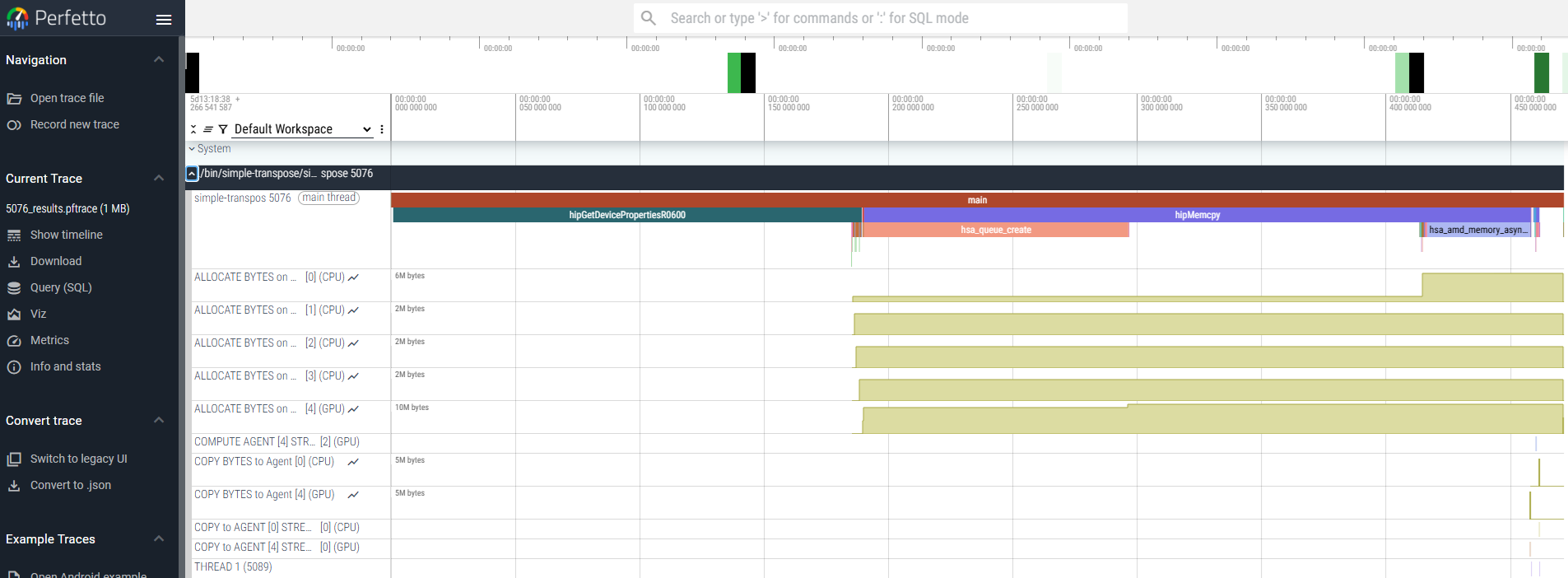
Figure 2: Visualization of ROCm flow data in Perfetto
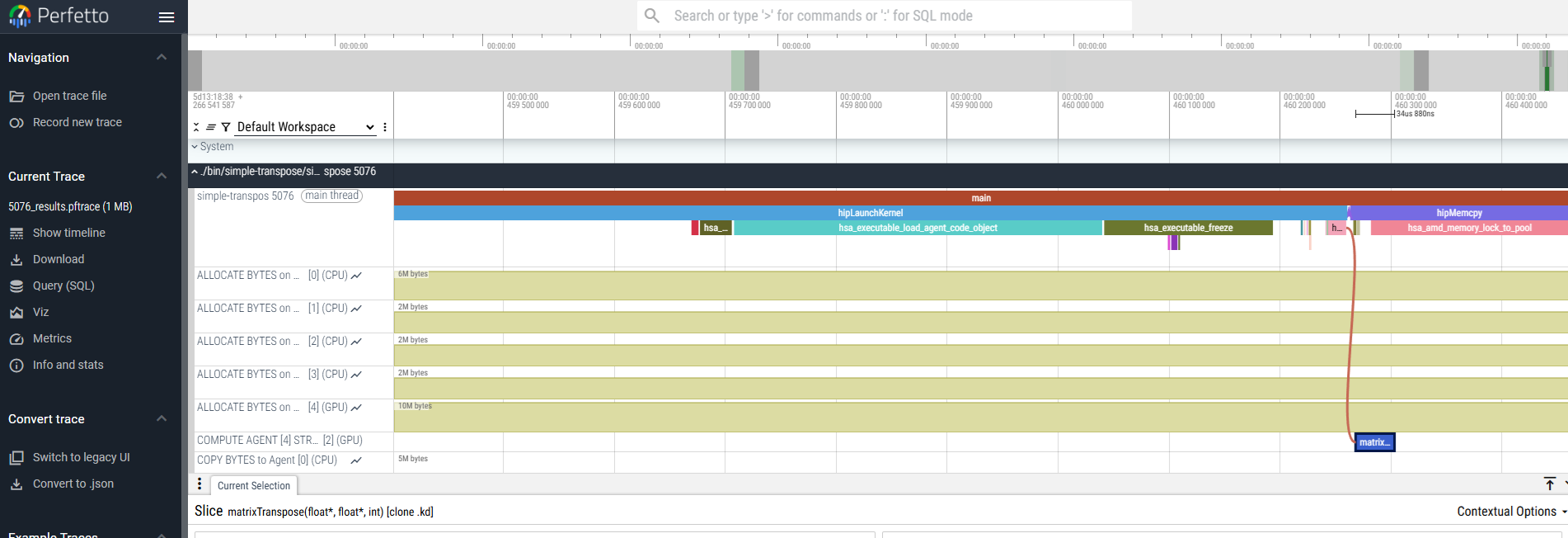
Perfetto visualization for counter collection#
When collecting performance counter data, you can visualize the counter tracks per agent in the Perfetto viewer by using the PFTrace output format. This helps you see how counter values change over time during kernel execution.
To generate a Perfetto trace file with counter data, use:
rocprofv3 --pmc SQ_WAVES GRBM_COUNT --output-format pftrace -- <application_path>
The generated Perfetto trace file can be opened in the Perfetto UI. In the viewer, performance counters will appear as counter tracks organized by agent, allowing you to visualize counter values changing over time alongside kernel executions and other traced activities.
You can also combine this with the system trace option to get a more comprehensive view of the system’s performance. For example, you can use the following command to collect both system trace and performance counter data:
rocprofv3 --pmc SQ_WAVES GRBM_COUNT --sys-trace --output-format pftrace -- <application_path>
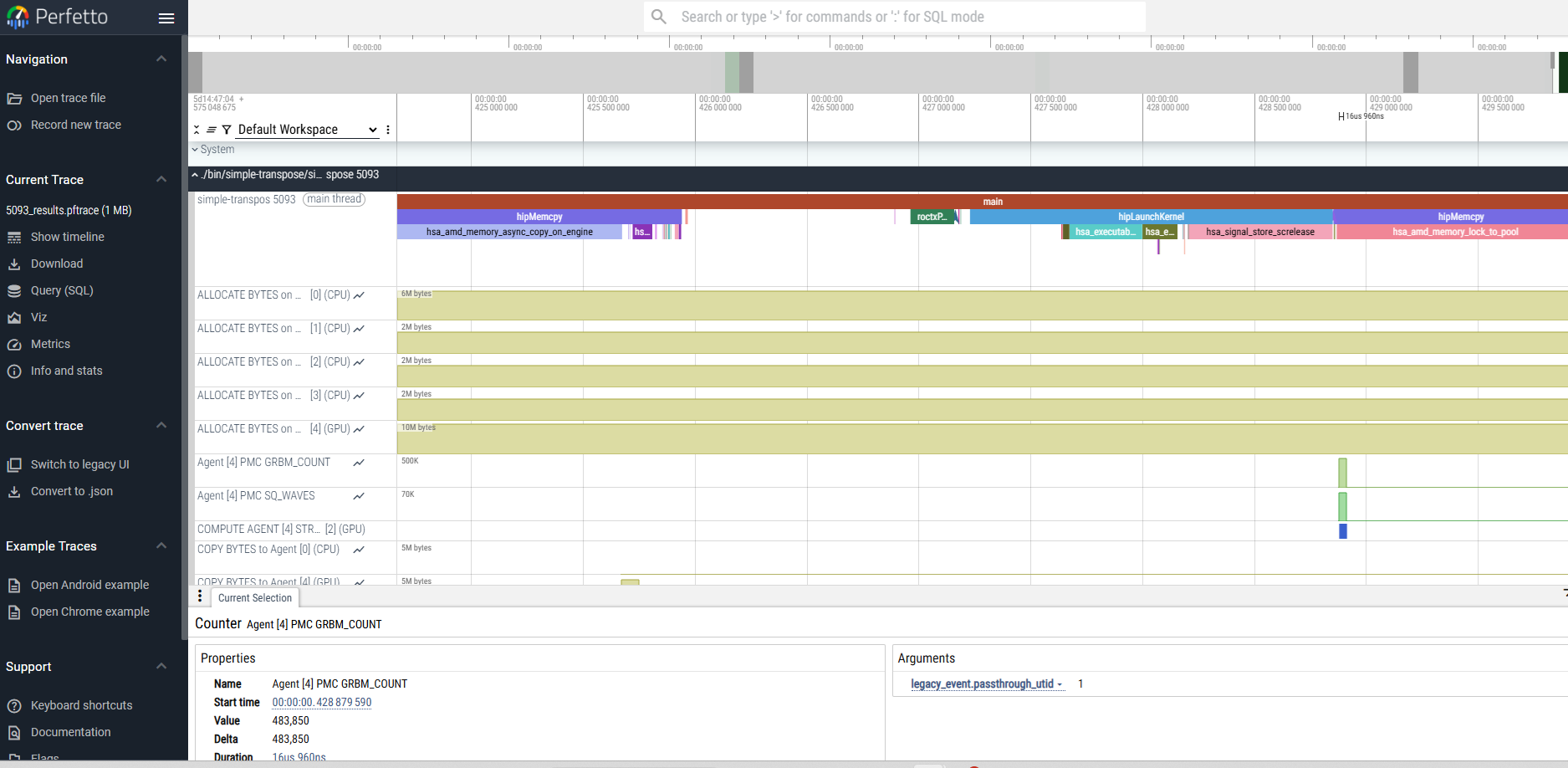
Scratch Memory Visualization in Perfetto#
When using the --scratch-memory-trace option with Perfetto output format, ROCProfiler SDK creates visualization tracks for scratch memory usage. Scratch memory operations are displayed as counter tracks organized by agent (GPU), allowing you to monitor the scratch memory allocation patterns during kernel execution.
To generate a Perfetto trace file that includes scratch memory visualization:
rocprofv3 --scratch-memory-trace --output-format pftrace -- <application_path>
In the Perfetto UI, scratch memory appears as counter tracks that show:
Allocation peaks: Each peak represents scratch memory allocation for a kernel execution
Memory usage over time: The height of each peak indicates the amount of memory allocated (typically in KB)
Allocation/deallocation pattern: You can observe when memory is allocated at kernel start and freed at kernel end
For applications with multiple kernel iterations, you’ll see multiple peaks in the scratch memory track, with each peak corresponding to a kernel execution. This visualization helps identify scratch memory usage patterns and potential optimization opportunities.
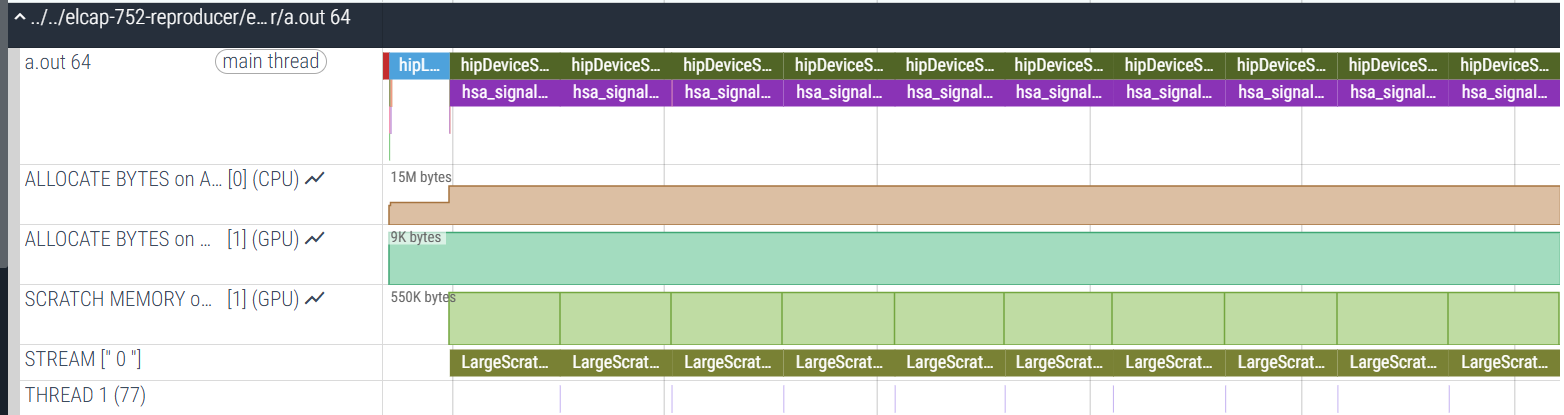
For comprehensive GPU execution insights, combine scratch memory tracing with kernel tracing:
rocprofv3 --kernel-trace --scratch-memory-trace --output-format pftrace -- <application_path>
This allows you to correlate scratch memory allocation patterns with specific kernel executions in the Perfetto visualization.
Agent info#
Note
All tracing and counter collection options generate an additional agent_info.csv file prefixed with the process ID.
The agent_info.csv file contains information about the CPU or GPU the kernel runs on.
$ cat 238_agent_info.csv

"Node_Id","Logical_Node_Id","Agent_Type","Cpu_Cores_Count","Simd_Count","Cpu_Core_Id_Base","Simd_Id_Base","Max_Waves_Per_Simd","Lds_Size_In_Kb","Gds_Size_In_Kb","Num_Gws","Wave_Front_Size","Num_Xcc","Cu_Count","Array_Count","Num_Shader_Banks","Simd_Arrays_Per_Engine","Cu_Per_Simd_Array","Simd_Per_Cu","Max_Slots_Scratch_Cu","Gfx_Target_Version","Vendor_Id","Device_Id","Location_Id","Domain","Drm_Render_Minor","Num_Sdma_Engines","Num_Sdma_Xgmi_Engines","Num_Sdma_Queues_Per_Engine","Num_Cp_Queues","Max_Engine_Clk_Ccompute","Max_Engine_Clk_Fcompute","Sdma_Fw_Version","Fw_Version","Capability","Cu_Per_Engine","Max_Waves_Per_Cu","Family_Id","Workgroup_Max_Size","Grid_Max_Size","Local_Mem_Size","Hive_Id","Gpu_Id","Workgroup_Max_Dim_X","Workgroup_Max_Dim_Y","Workgroup_Max_Dim_Z","Grid_Max_Dim_X","Grid_Max_Dim_Y","Grid_Max_Dim_Z","Name","Vendor_Name","Product_Name","Model_Name"
0,0,"CPU",24,0,0,0,0,0,0,0,0,1,24,0,0,0,0,0,0,0,0,0,0,0,0,0,0,0,0,3800,0,0,0,0,0,0,23,0,0,0,0,0,0,0,0,0,0,0,"AMD Ryzen 9 3900X 12-Core Processor","CPU","AMD Ryzen 9 3900X 12-Core Processor",""
1,1,"GPU",0,256,0,2147487744,10,64,0,64,64,1,64,4,4,1,16,4,32,90000,4098,26751,12032,0,128,2,0,2,24,3800,1630,432,440,138420864,16,40,141,1024,4294967295,0,0,64700,1024,1024,1024,4294967295,4294967295,4294967295,"gfx900","AMD","Radeon RX Vega","vega10"
Output file fields#
The following table lists the various fields or the columns in the output CSV files generated for application tracing and kernel counter collection:
| Information type | Field | Description |
|---|---|---|
| Dispatch information | Agent_Id | GPU identifier to which the kernel was submitted. |
| Correlation_Id | Unique identifier for correlation between HIP and HSA async calls during activity tracing. | |
| Dispatch_Id | Dispatch identifier | |
| Process_Id | Process identifier | |
| Thread_Id | Thread identifier | |
| Queue_Id | ROCm queue unique identifier to which the kernel was submitted. | |
| Stream_Id | Identifies HIP stream ID to which kernel or memory copy operation was submitted. Defaults to 0 if the hip-stream-display option is not enabled | |
| Kernel information | Grid_Size | The total number of work-items (or, threads) launched as a part of the kernel dispatch. In HIP, this is equivalent to the total grid size multiplied by the total workgroup (or, block) size. |
| Grid_Size_n | Number of work-items (or, threads) in the nth dimension required to launch the kernel, where n = X, Y, or Z. | |
| Kernel_Id | Kernel identifier | |
| Kernel_Name | Kernel name | |
| Workgroup_Size | The total number of work-items (or, threads) in each workgroup (or, block) launched as part of the kernel dispatch. In HIP, this is equivalent to the total block size. | |
| Workgroup_Size_n | Size of the workgroup in the nth dimension as declared by the compute shader, where n = X, Y, or Z. | |
| Private_Segment_Size | The amount of memory required in bytes for the combined private, spill, and arg segments for a work item. | |
| Group_Segment_Size | The group segment memory required by a workgroup in bytes. This does not include any dynamically allocated group segment memory that may be added when the kernel is dispatched. | |
| Resource usage | LDS_Block_Size | Thread block size for the kernel’s Local Data Share (LDS) memory (shared memory per work-group). |
| Scratch_Size | Kernel’s scratch memory (private memory per work-item) size. | |
| SGPR_Count | Kernel’s Scalar General Purpose Register (SGPR) count. | |
| VGPR_Count | Kernel’s Architected Vector General Purpose Register (VGPR) count. | |
| Accum_VGPR_Count | Kernel’s Accumulation Vector General Purpose Register (Accum_VGPR/AGPR) count. | |
| Counter data | Counter_Name | Name of the counter |
| Counter_Value | The numeric value measured by a specific hardware performance counter during a kernel dispatch | |
| Start_Timestamp | Begin time in nanoseconds (ns) when the kernel begins execution. | |
| End_Timestamp | End time in ns when the kernel finishes execution. |
Output formats#
rocpd (SQLite3 Database (Default))
CSV (direct output is deprecated)
JSON (Custom format for programmatic analysis only)
PFTrace (Perfetto trace; direct output is deprecated)
OTF2 (Open Trace Format; direct output is deprecated)
The default and recommended output format is rocpd. To know more about the rocpd format, see Using rocpd output format.
To specify the particular output format, use the --output-format option followed by the desired format.
Warning
Direct CSV, PFTrace, and OTF2 generation by rocprofv3 is deprecated.
These direct generators might not produce output for every tracing feature, including hipFILE and rocSHMEM tracing.
Collect to rocpd and convert the database instead:
rocprofv3 <tracing_option> --output-format rocpd -- <application_path>
rocpd convert -i <output-file>_results.db --output-format csv
rocprofv3 -i input.txt --output-format json -- <application_path>
Format selection is case-insensitive and multiple output formats are supported. For example, --output-format json rocpd enables both JSON and rocpd output for the run.
For PFTrace trace visualization, convert the rocpd database using rocpd convert -i <output-file>_results.db --output-format pftrace and open the trace in ui.perfetto.dev.
For OTF2 trace visualization, convert the rocpd database using rocpd convert -i <output-file>_results.db --output-format otf2 and open the trace in vampir.eu or any supported visualizer.
Note
For large converted trace files (> 10GB), it’s recommended to use OTF2 format.
JSON output schema#
rocprofv3 supports a custom JSON output format designed for programmatic analysis and NOT for visualization.
The schema is optimized for size while factoring in usability.
Note
Perfetto UI doesn’t accept this JSON output format.
To generate the JSON output, use --output-format json command-line option.
Here are the properties of the JSON output schema:
- rocprofiler-sdk-tool (array): rocprofv3 data per process (each element represents a process).
- Items (object): Data for rocprofv3.
- metadata (object, required): Metadata related to the profiler session.
pid (integer, required): Process ID.
init_time (integer, required): Initialization time in nanoseconds.
fini_time (integer, required): Finalization time in nanoseconds.
- agents (array, required): List of agents.
- Items (object): Data for an agent.
size (integer, required): Size of the agent data.
- id (object, required): Identifier for the agent.
handle (integer, required): Handle for the agent.
type (integer, required): Type of the agent.
cpu_cores_count (integer): Number of CPU cores.
simd_count (integer): Number of SIMD units.
mem_banks_count (integer): Number of memory banks.
caches_count (integer): Number of caches.
io_links_count (integer): Number of I/O links.
cpu_core_id_base (integer): Base ID for CPU cores.
simd_id_base (integer): Base ID for SIMD units.
max_waves_per_simd (integer): Maximum waves per SIMD.
lds_size_in_kb (integer): Size of LDS in KB.
gds_size_in_kb (integer): Size of GDS in KB.
num_gws (integer): Number of GWS (global work size).
wave_front_size (integer): Size of the wave front.
num_xcc (integer): Number of XCC (execution compute units).
cu_count (integer): Number of compute units (CUs).
array_count (integer): Number of arrays.
num_shader_banks (integer): Number of shader banks.
simd_arrays_per_engine (integer): SIMD arrays per engine.
cu_per_simd_array (integer): CUs per SIMD array.
simd_per_cu (integer): SIMDs per CU.
max_slots_scratch_cu (integer): Maximum slots for scratch CU.
gfx_target_version (integer): GFX target version.
vendor_id (integer): Vendor ID.
device_id (integer): Device ID.
location_id (integer): Location ID.
domain (integer): Domain identifier.
drm_render_minor (integer): DRM render minor version.
num_sdma_engines (integer): Number of SDMA engines.
num_sdma_xgmi_engines (integer): Number of SDMA XGMI engines.
num_sdma_queues_per_engine (integer): Number of SDMA queues per engine.
num_cp_queues (integer): Number of CP queues.
max_engine_clk_ccompute (integer): Maximum engine clock for compute.
max_engine_clk_fcompute (integer): Maximum engine clock for F compute.
- sdma_fw_version (object): SDMA firmware version.
uCodeSDMA (integer, required): SDMA microcode version.
uCodeRes (integer, required): Reserved microcode version.
- fw_version (object): Firmware version.
uCode (integer, required): Microcode version.
Major (integer, required): Major version.
Minor (integer, required): Minor version.
Stepping (integer, required): Stepping version.
- capability (object, required): Agent capability flags.
HotPluggable (integer, required): Hot pluggable capability.
HSAMMUPresent (integer, required): HSAMMU present capability.
SharedWithGraphics (integer, required): Shared with graphics capability.
QueueSizePowerOfTwo (integer, required): Queue size is power of two.
QueueSize32bit (integer, required): Queue size is 32-bit.
QueueIdleEvent (integer, required): Queue idle event.
VALimit (integer, required): VA limit.
WatchPointsSupported (integer, required): Watch points supported.
WatchPointsTotalBits (integer, required): Total bits for watch points.
DoorbellType (integer, required): Doorbell type.
AQLQueueDoubleMap (integer, required): AQL queue double map.
DebugTrapSupported (integer, required): Debug trap supported.
WaveLaunchTrapOverrideSupported (integer, required): Wave launch trap override supported.
WaveLaunchModeSupported (integer, required): Wave launch mode supported.
PreciseMemoryOperationsSupported (integer, required): Precise memory operations supported.
DEPRECATED_SRAM_EDCSupport (integer, required): Deprecated SRAM EDC support.
Mem_EDCSupport (integer, required): Memory EDC support.
RASEventNotify (integer, required): RAS event notify.
ASICRevision (integer, required): ASIC revision.
SRAM_EDCSupport (integer, required): SRAM EDC support.
SVMAPISupported (integer, required): SVM API supported.
CoherentHostAccess (integer, required): Coherent host access.
DebugSupportedFirmware (integer, required): Debug supported firmware.
Reserved (integer, required): Reserved field.
- counters (array, required): Array of counter objects.
- Items (object)
- agent_id (object, required): Agent ID information.
handle (integer, required): Handle of the agent.
- id (object, required): Counter ID information.
handle (integer, required): Handle of the counter.
is_constant (integer, required): Indicator if the counter value is constant.
is_derived (integer, required): Indicator if the counter value is derived.
name (string, required): Name of the counter.
description (string, required): Description of the counter.
block (string, required): Block information of the counter.
expression (string, required): Expression of the counter.
- dimension_ids (array, required): Array of dimension IDs.
Items (integer): Dimension ID.
- strings (object, required): String records.
- callback_records (array): Callback records.
- Items (object)
kind (string, required): Kind of the record.
- operations (array, required): Array of operations.
Items (string): Operation.
- buffer_records (array): Buffer records.
- Items (object)
kind (string, required): Kind of the record.
- operations (array, required): Array of operations.
Items (string): Operation.
- marker_api (array): Marker API records.
- Items (object)
key (integer, required): Key of the record.
value (string, required): Value of the record.
- counters (object): Counter records.
- dimension_ids (array, required): Array of dimension IDs.
- Items (object)
id (integer, required): Dimension ID.
instance_size (integer, required): Size of the instance.
name (string, required): Name of the dimension.
pc_sample_instructions (array): Array of decoded instructions matching sampled PCs from pc_sample_host_trap section.
pc_sample_comments (array): Comments matching assembly instructions from pc_sample_instructions array. If debug symbols are available, comments provide instructions to source-line mapping. Otherwise, a comment is an empty string.
- code_objects (array, required): Code object records.
- Items (object)
size (integer, required): Size of the code object.
code_object_id (integer, required): ID of the code object.
- rocp_agent (object, required): ROCP agent information.
handle (integer, required): Handle of the ROCP agent.
- hsa_agent (object, required): HSA agent information.
handle (integer, required): Handle of the HSA agent.
uri (string, required): URI of the code object.
load_base (integer, required): Base address for loading.
load_size (integer, required): Size for loading.
load_delta (integer, required): Delta for loading.
storage_type (integer, required): Type of storage.
memory_base (integer, required): Base address for memory.
memory_size (integer, required): Size of memory.
- kernel_symbols (array, required): Kernel symbol records.
- Items (object)
size (integer, required): Size of the kernel symbol.
kernel_id (integer, required): ID of the kernel.
code_object_id (integer, required): ID of the code object.
kernel_name (string, required): Name of the kernel.
kernel_object (integer, required): Object of the kernel.
kernarg_segment_size (integer, required): Size of the kernarg segment.
kernarg_segment_alignment (integer, required): Alignment of the kernarg segment.
group_segment_size (integer, required): Size of the group segment.
private_segment_size (integer, required): Size of the private segment.
formatted_kernel_name (string, required): Formatted name of the kernel.
demangled_kernel_name (string, required): Demangled name of the kernel.
truncated_kernel_name (string, required): Truncated name of the kernel.
- callback_records (object, required): Callback record details.
- counter_collection (array): Counter collection records.
- Items (object)
- dispatch_data (object, required): Dispatch data details.
size (integer, required): Size of the dispatch data.
- correlation_id (object, required): Correlation ID information.
internal (integer, required): Internal correlation ID.
external (integer, required): External correlation ID.
- dispatch_info (object, required): Dispatch information details.
size (integer, required): Size of the dispatch information.
- agent_id (object, required): Agent ID information.
handle (integer, required): Handle of the agent.
- queue_id (object, required): Queue ID information.
handle (integer, required): Handle of the queue.
kernel_id (integer, required): ID of the kernel.
dispatch_id (integer, required): ID of the dispatch.
private_segment_size (integer, required): Size of the private segment.
group_segment_size (integer, required): Size of the group segment.
- workgroup_size (object, required): Workgroup size information.
x (integer, required): X dimension.
y (integer, required): Y dimension.
z (integer, required): Z dimension.
- grid_size (object, required): Grid size information.
x (integer, required): X dimension.
y (integer, required): Y dimension.
z (integer, required): Z dimension.
- records (array, required): Records.
- Items (object)
- counter_id (object, required): Counter ID information.
handle (integer, required): Handle of the counter.
value (number, required): Value of the counter.
thread_id (integer, required): Thread ID.
arch_vgpr_count (integer, required): Count of Architected VGPRs.
accum_vgpr_count (integer, required): Count of Accumulation VGPRs.
sgpr_count (integer, required): Count of SGPRs.
lds_block_size_v (integer, required): Size of LDS block.
- pc_sample_host_trap (array): Host Trap PC Sampling records.
- Items (object)
- hw_id (object): Describes hardware part on which sampled wave was running.
chiplet (integer): Chiplet index.
wave_id (integer): Wave slot index.
simd_id (integer): SIMD index.
pipe_id (integer): Pipe index.
cu_or_wgp_id (integer): Index of compute unit or workgroup processor.
shader_array_id (integer): Shader array index.
shader_engine_id (integer): Shader engine index.
workgroup_id (integer): Workgroup position in the 3D.
vm_id (integer): Virtual memory ID.
queue_id (integer): Queue id.
microengine_id (integer): ACE (microengine) index.
pc (object): Encapsulates information about sampled PC. - code_object_id (integer): Code object id. - code_object_offset (integer): Offset within the object if the latter is known. Otherwise, virtual address of the PC.
exec_mask (integer): Execution mask indicating active SIMD lanes of sampled wave.
timestamp (integer): Timestamp.
dispatch_id (integer): Dispatch id.
correlation_id (object): Correlation ID information. - internal (integer): Internal correlation ID. - external (integer): External correlation ID.
- rocprofiler_dim3_t (object): Position of the workgroup in 3D grid.
x (integer): Dimension x.
y (integer): Dimension y.
z (integer): Dimension z.
wave_in_group (integer): Wave position within the workgroup (0-31).
- buffer_records (object, required): Buffer record details.
- kernel_dispatch (array): Kernel dispatch records.
- Items (object)
size (integer, required): Size of the dispatch.
kind (integer, required): Kind of the dispatch.
operation (integer, required): Operation of the dispatch.
thread_id (integer, required): Thread ID.
- correlation_id (object, required): Correlation ID information.
internal (integer, required): Internal correlation ID.
external (integer, required): External correlation ID.
start_timestamp (integer, required): Start timestamp.
end_timestamp (integer, required): End timestamp.
- dispatch_info (object, required): Dispatch information details.
size (integer, required): Size of the dispatch information.
- agent_id (object, required): Agent ID information.
handle (integer, required): Handle of the agent.
- queue_id (object, required): Queue ID information.
handle (integer, required): Handle of the queue.
kernel_id (integer, required): ID of the kernel.
dispatch_id (integer, required): ID of the dispatch.
private_segment_size (integer, required): Size of the private segment.
group_segment_size (integer, required): Size of the group segment.
- workgroup_size (object, required): Workgroup size information.
x (integer, required): X dimension.
y (integer, required): Y dimension.
z (integer, required): Z dimension.
- grid_size (object, required): Grid size information.
x (integer, required): X dimension.
y (integer, required): Y dimension.
z (integer, required): Z dimension.
- hip_api (array): HIP API records.
- Items (object)
size (integer, required): Size of the HIP API record.
kind (integer, required): Kind of the HIP API.
operation (integer, required): Operation of the HIP API.
- correlation_id (object, required): Correlation ID information.
internal (integer, required): Internal correlation ID.
external (integer, required): External correlation ID.
start_timestamp (integer, required): Start timestamp.
end_timestamp (integer, required): End timestamp.
thread_id (integer, required): Thread ID.
- hsa_api (array): HSA API records.
- Items (object)
size (integer, required): Size of the HSA API record.
kind (integer, required): Kind of the HSA API.
operation (integer, required): Operation of the HSA API.
- correlation_id (object, required): Correlation ID information.
internal (integer, required): Internal correlation ID.
external (integer, required): External correlation ID.
start_timestamp (integer, required): Start timestamp.
end_timestamp (integer, required): End timestamp.
thread_id (integer, required): Thread ID.
- marker_api (array): Marker (ROCTx) API records.
- Items (object)
size (integer, required): Size of the Marker API record.
kind (integer, required): Kind of the Marker API.
operation (integer, required): Operation of the Marker API.
- correlation_id (object, required): Correlation ID information.
internal (integer, required): Internal correlation ID.
external (integer, required): External correlation ID.
start_timestamp (integer, required): Start timestamp.
end_timestamp (integer, required): End timestamp.
thread_id (integer, required): Thread ID.
- memory_copy (array): Async memory copy records.
- Items (object)
size (integer, required): Size of the Marker API record.
kind (integer, required): Kind of the Marker API.
operation (integer, required): Operation of the Marker API.
- correlation_id (object, required): Correlation ID information.
internal (integer, required): Internal correlation ID.
external (integer, required): External correlation ID.
start_timestamp (integer, required): Start timestamp.
end_timestamp (integer, required): End timestamp.
thread_id (integer, required): Thread ID.
- dst_agent_id (object, required): Destination Agent ID.
handle (integer, required): Handle of the agent.
- src_agent_id (object, required): Source Agent ID.
handle (integer, required): Handle of the agent.
bytes (integer, required): Bytes copied.
- memory_allocation (array): Memory allocation records.
- Items (object)
size (integer, required): Size of the Marker API record.
kind (integer, required): Kind of the Marker API.
operation (integer, required): Operation of the Marker API.
- correlation_id (object, required): Correlation ID information.
internal (integer, required): Internal correlation ID.
external (integer, required): External correlation ID.
start_timestamp (integer, required): Start timestamp.
end_timestamp (integer, required): End timestamp.
thread_id (integer, required): Thread ID.
- agent_id (object, required): Agent ID.
handle (integer, required): Handle of the agent.
address (string, required): Starting address of allocation.
allocation_size (integer, required): Size of allocation.
- rocDecode_api (array): rocDecode API records.
- Items (object)
size (integer, required): Size of the rocDecode API record.
kind (integer, required): Kind of the rocDecode API.
operation (integer, required): Operation of the rocDecode API.
- correlation_id (object, required): Correlation ID information.
internal (integer, required): Internal correlation ID.
external (integer, required): External correlation ID.
start_timestamp (integer, required): Start timestamp.
end_timestamp (integer, required): End timestamp.
thread_id (integer, required): Thread ID.
- hipfile_api (array): hipFILE API records.
- Items (object)
size (integer, required): Size of the hipFILE API record.
kind (integer, required): Kind of the hipFILE API.
operation (integer, required): Operation of the hipFILE API.
- correlation_id (object, required): Correlation ID information.
internal (integer, required): Internal correlation ID.
external (integer, required): External correlation ID.
start_timestamp (integer, required): Start timestamp.
end_timestamp (integer, required): End timestamp.
thread_id (integer, required): Thread ID.