View ROCm Compute Profiler analysis data in ROCm Optiq#
ROCm Optiq provides intuitive, interactive profiling analysis for compute workloads by moving from a high-level performance summary to detailed kernel-level analysis. It enables rapid identification of performance hotspots and interactive exploration of kernel-level metrics for a profiled workload.
Note
See the ROCm Compute Profiler documentation for more information.
Open a ROCm Compute Profiler database file#
ROCm Optiq supports the ROCm Compute Profiler analysis database format (.db).
Select File > Open to open a database file. You can also open files by dragging them into the application window.
Troubleshooting#
If the analysis database file doesn’t open, it might be in an unsupported format.
To generate profiling data in a compatible format, run the CLI analysis with the --output-format option set to the ROCm Compute analysis database format:
rocprof-compute analyze --output-name your-datafile-name --output-format db -p </path/to/workload>
When you open a ROCm Compute Profiler analysis database file, you can view its data populated in Summary View, Kernel Details, Table View, Workload Details, and Baseline Comparison.
Select a workload and kernel#
Use the Workload and Kernel dropdowns at the top of the compute views to choose which workload and kernel to examine. Changing either dropdown updates Summary View, Kernel Details (including the Memory Chart, System Speed-of-Light, and Kernel Roofline Chart), Table View, and Baseline Comparison.

You can also select a kernel from the Kernel Selection Table in the Kernel Details tab. That selection updates the same kernel-level views.
Summary View#
The Summary View displays a high-level overview of the captured data.
Summary View – Table#
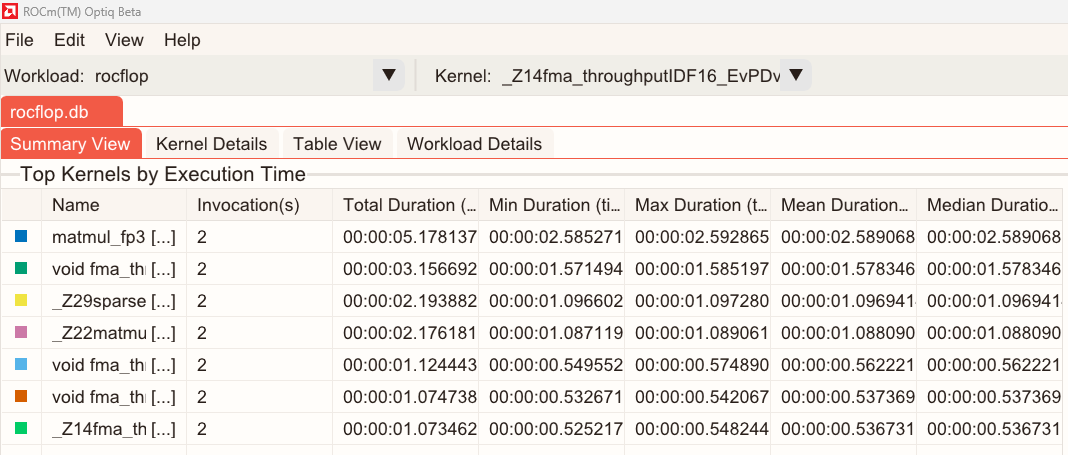
The table in Summary View lists the top 10 longest-running kernels sorted by Total Execution Time. The table displays kernel names, the number of invocations, and statistics including Total, Min, Max, Mean, and Median durations.
Summary View – Charts#
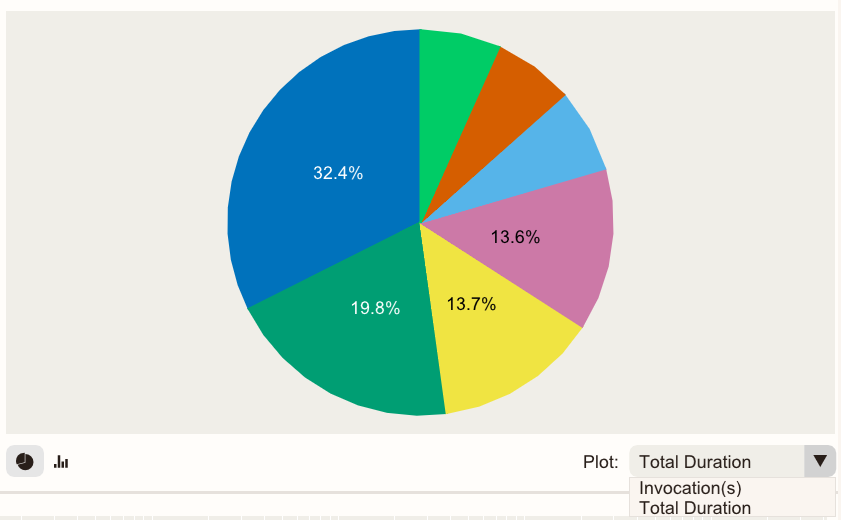
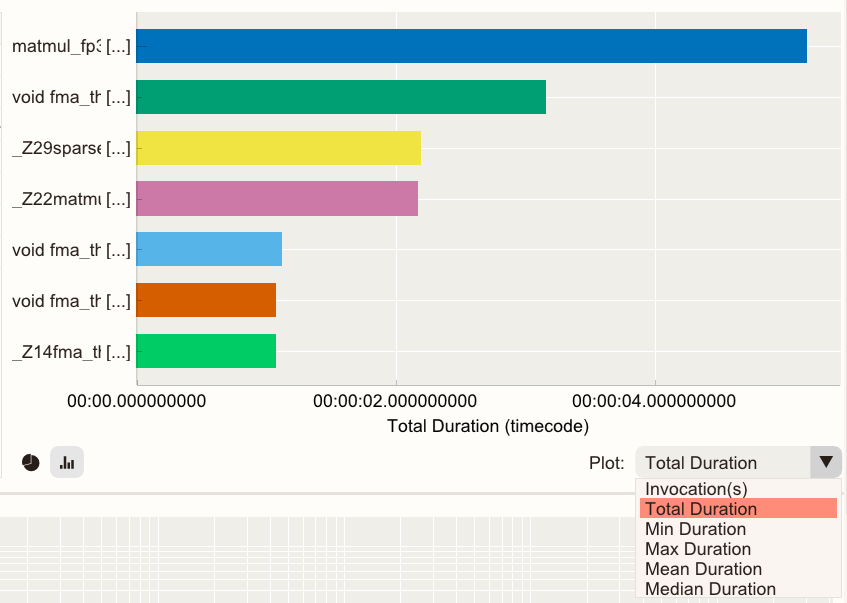
Charts display as bar or pie charts.
The pie chart plots:
Total Duration: The total duration as a percentage for the kernels.
Invocation(s): The number of invocations as a percentage for the kernels.
Tip
The kernel name and duration are displayed when you hold your cursor over a section of the pie chart.
The bar chart displays per-kernel metrics including the number of invocations, and the Total, Min, Max, Mean, and Median duration data.
Summary View – Roofline Chart#
The chart plots kernel performance against empirical hardware ceilings to reveal the dominant performance bottleneck for all kernels. Showing where kernels are positioned relative to these rooflines helps determine whether performance is memory-bound or compute-bound, and identify the most impactful optimization direction.
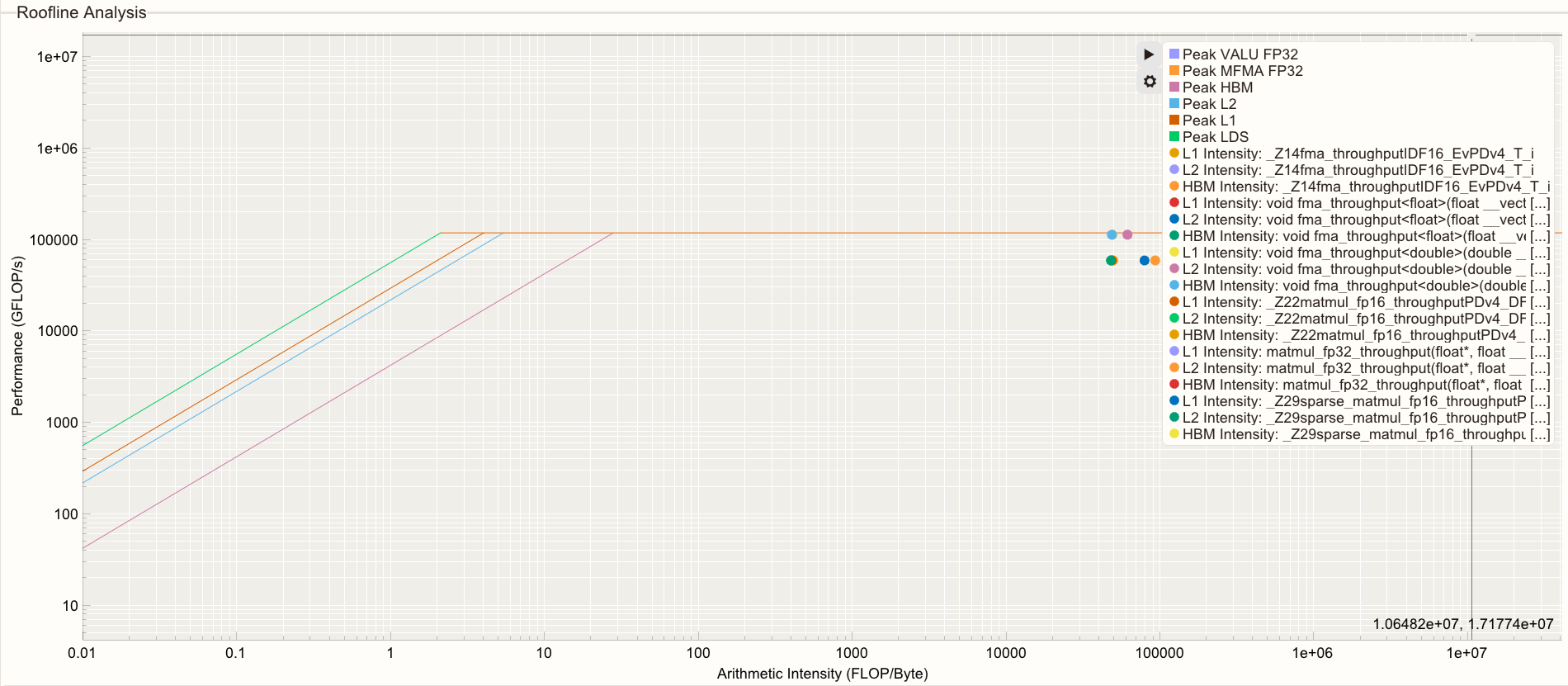
The kernel performance at each cache level is displayed as individual dots in the roofline chart.
Click
 in the menu to adjust your view:
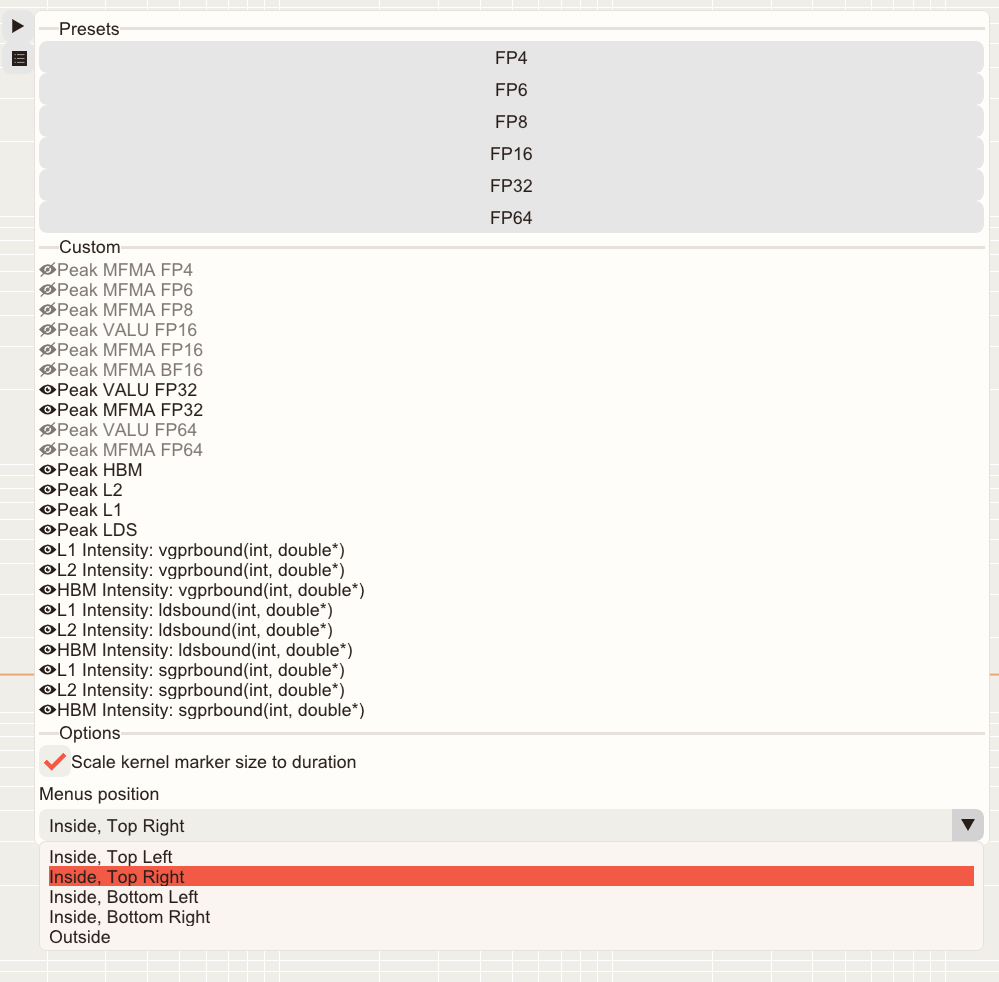
Under Custom, click on a roofline or an arithmetic intensity point to show or hide it.
Under Options, select Scale kernel marker size to duration to make the size of each kernel performance dot represent the kernel’s duration.
Hold your cursor over a dot to view detailed information about the kernel it represents. The information includes the Kernel name, Invocation(s), Duration, Arithmetic Intensity, and Performance.
Use the filter dropdowns at the top of the Roofline Analysis pane to show or hide groups of chart elements together, instead of toggling them one by one in the Custom section of the
menu:Compute Peak: Enables ceilings of a specific precision.
Bandwidth Peak: Enables ceilings of a specific cache or memory level.
Kernel: Enables kernel markers for a specific kernel.
Kernel Bandwidth: Enables kernel markers for a specific cache or memory level.
Use the Roofline Legend/Menu position control options to reposition the Roofline Legend/Menu. The options include:
Inside, Top Left
Inside, Top Right
Inside, Bottom Left
Inside, Bottom Right
Outside (which pushes the legend outside of the plot area)
Summary View – System Speed-of-Light#
Provides an aggregated, system-level summary of key performance and hardware utilization metrics across all kernels in the selected workload, highlighting utilization relative to peak architectural capabilities.
The Summary View – System Speed-of-Light table includes the following columns: Metric ID, Metric Name, Average Value, Peak, Percent-of-Peak, and Unit.
Metrics are aggregated across kernels to reflect overall application behavior rather than per-kernel performance.
Use the Percent-of-Peak column to quickly identify whether execution is limited. Execution could be limited by compute, memory, or other hardware subsystems.
Hover over a metric name to see a tooltip with a detailed description.
Kernel Details#
Kernel Details focuses on one kernel at a time. It has these components:
Kernel Selection Table: Helps you identify and choose a kernel of interest for further analysis.
Memory Chart: Displays an architecture-specific diagram of the memory hierarchy with per-block metrics overlaid on each memory component.
System Speed-of-Light: A table view of kernel metrics with their unit, average, peak, and percentage of peak values.
Roofline analysis: Displays kernel performance relative to the system’s capabilities for the selected kernel.
Kernel Details – Kernel Selection Table#
The Kernel Selection Table displays kernel information, including names and GPU metrics.

Click Add Metric to select additional GPU metrics as new columns for the table.
Enter a condition in the text input below each column header to filter the data.
For the Name column, use this format:
LIKE %text%.For all other columns, use
>,<,=,>=,<=, or!=, followed by a number. For example,metricA>threshold.Combine multiple filters to narrow the analysis.
Click Apply Filters.
Click a column header to sort the table by that column. Click the same header again to toggle between ascending and descending order.
Select a kernel in the Kernel Selection Table or the Kernel dropdown to update the Memory Chart, System Speed-of-Light, Roofline Analysis, and Table View.
Click
 to hide the table and maximize the space available for charts.
Select Show Bar Charts or Hide Bar Charts to show or hide bar charts for metric values.
You can also right-click a metric column header and select Show Bar Chart or Hide Bar Charts to show or hide the bar chart for that metric.
Hover over a clipped kernel name to view the full name in a tooltip.
Right-click a row or cell to Copy Row Data or Copy Cell Data.
Kernel Details – Memory Chart#
The Memory Chart displays memory transactions and throughput for the selected kernel. The diagram layout comes from the analysis database for that workload, so the blocks and connections match the GPU architecture that was profiled (for example, gfx940 and gfx950 series).
Each cache or memory block presents its associated counter values and derived metrics, helping you understand memory behavior across the hardware memory hierarchy.
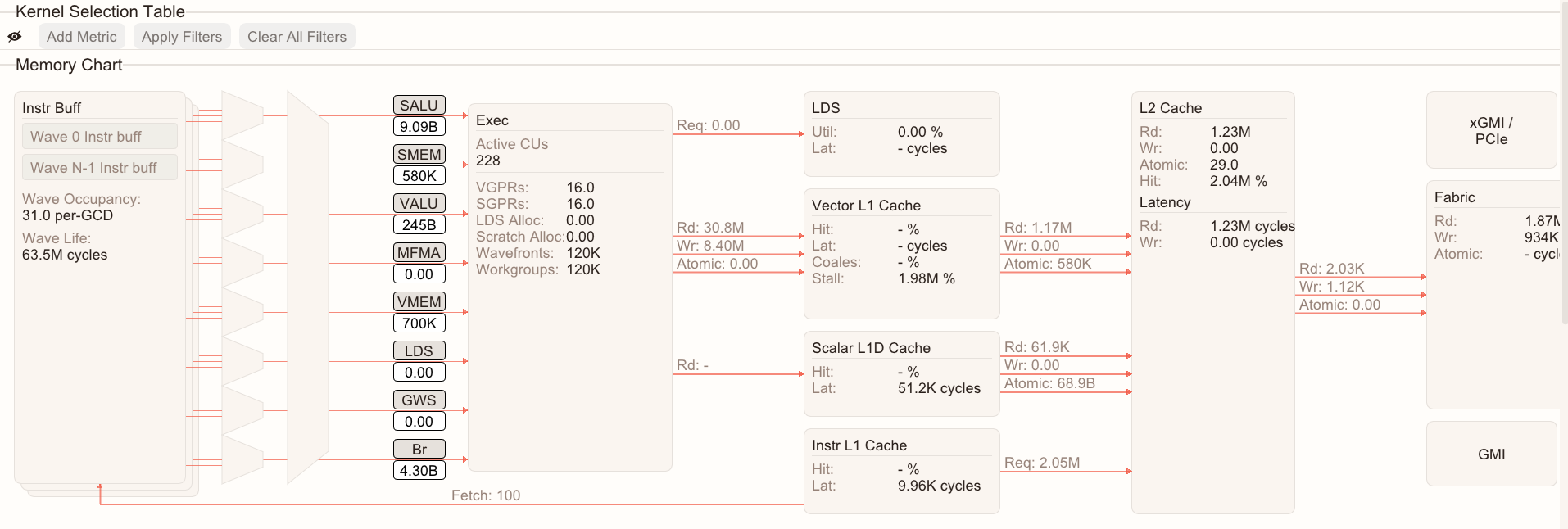
This visual diagram displays counter values and calculations to help you understand which cache level each memory transaction corresponds to and how they interact.
Select a kernel in the Kernel Selection Table or the Kernel dropdown to view the memory chart of the selected kernel. See Select a workload and kernel.
Kernel Details – System Speed-of-Light#
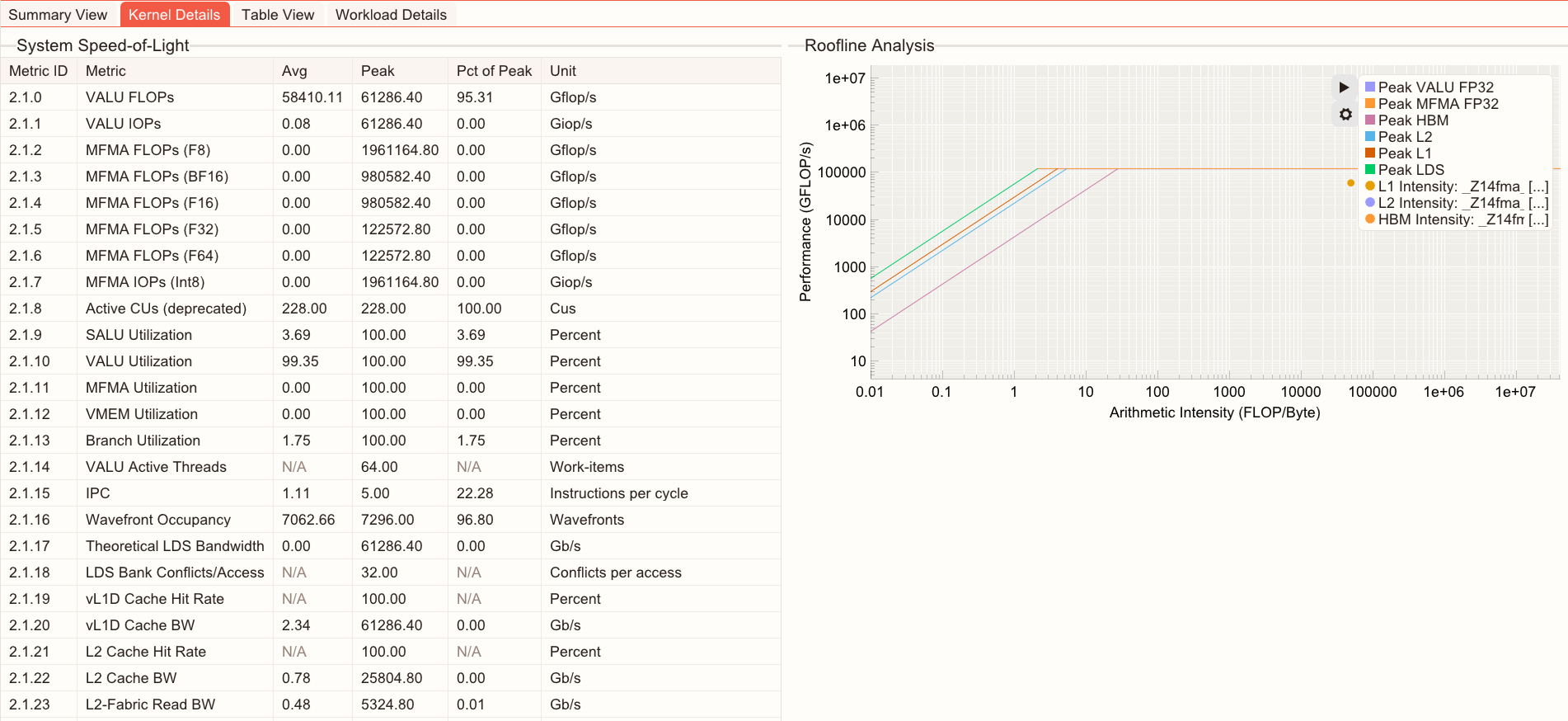
The System Speed-of-Light displays key kernel-level performance metrics to show the overall compute performance and hardware utilization.
Kernel Details – Kernel Roofline Chart#
The Kernel Roofline Chart displays a kernel-specific roofline analysis, which helps you determine whether the kernel is compute-bound or memory-bound.
Click
to show or hide rooflines or arithmetic intensity points.Hold your cursor over a dot to view detailed information of the kernel.
Use the Menu position control to choose options to reposition the Roofline Legend/Menu.
Table View#
The Table View displays a complete list of available metrics for the selected kernel. If the loaded database has no metrics, this tab is disabled and a tooltip explains why.
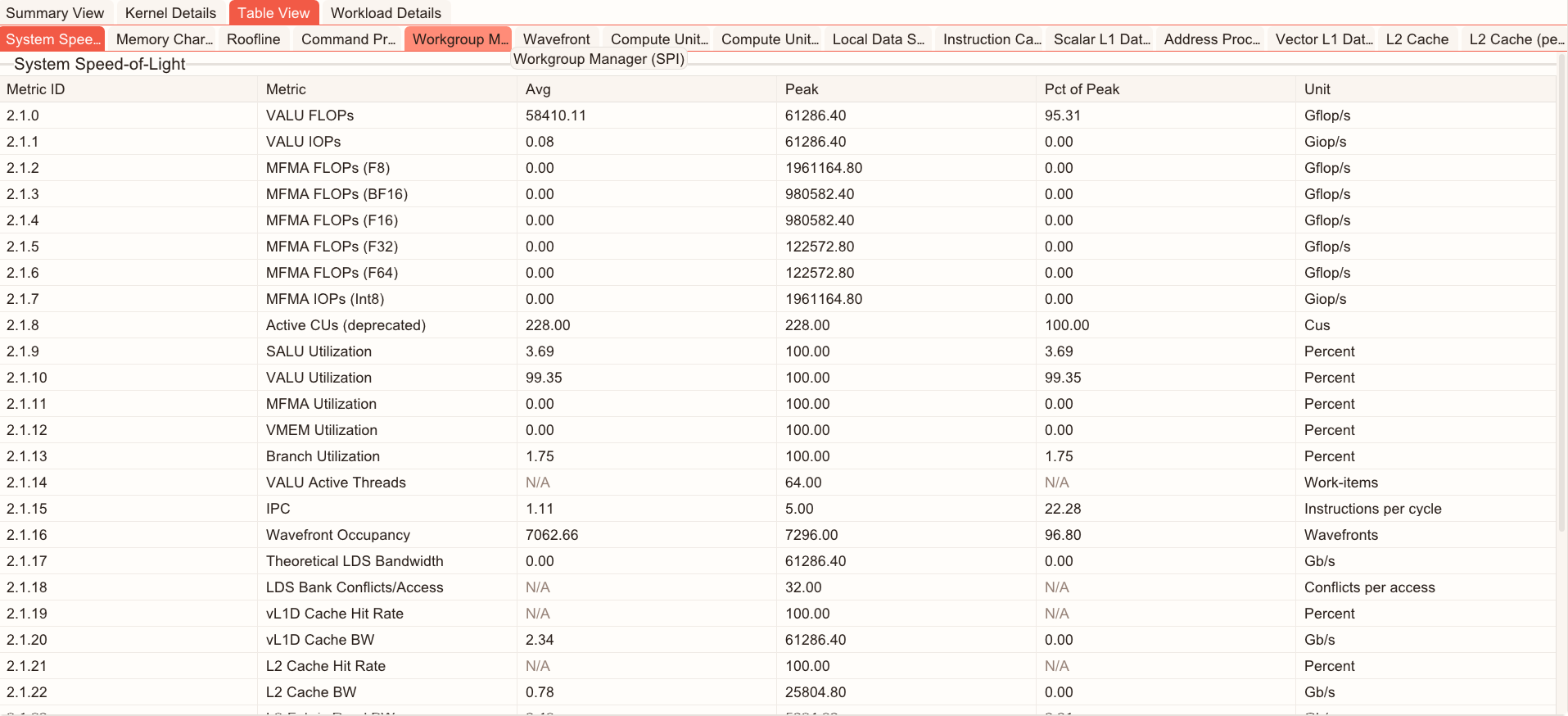
Metrics are grouped into tabs that match compute categories, including:
Compute Units - Instruction Mix
System Speed-of-Light
Compute Units - Compute Pipeline
Memory Chart
Roofline Performance Rates
Command Processor (CPC/CPF)
Work Group Manager (SPI)
Wavefront
Local Data Share (LDS)
Instruction Cache
Scalar L1 Data Cache
Address Processing Unit and Data Return Path (TA/TD)
Vector L1 Data Cache
L2 Cache
L2 Cache (per channel)
You can pin a metric for focused analysis by selecting the checkbox beside the metric. Pinned metric configurations can be saved to be persisted across sessions (see Presets for more information).
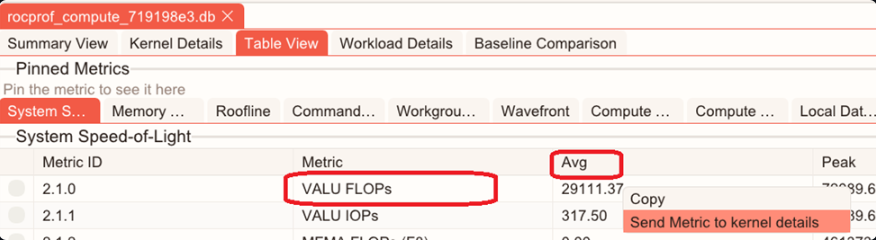
You can add a metric to the Kernel Details by right-clicking that metric in Table View and selecting Send metric to kernel details. For example, clicking on Avg (or Min or Max) cell of VALU FLOPs as in the screenshot below will add VALU FLOPs Avg (or Min or Max) to the Kernel Selection table. When you hover on a metric name, a tooltip shows the metric description.
The following example shows the context menu for adding a metric to the Kernel Selection Table:
Workload Details#
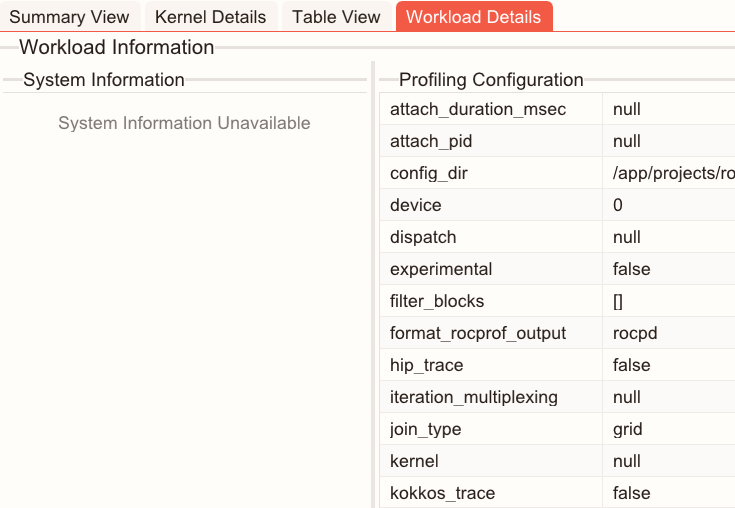
Workload Details provides contextual information about the workload, such as:
System information: Hardware details of the system at the time the profiling data was collected.
Profiling configuration: ROCm Compute Profiler parameters and settings used when the data was captured.
Baseline Comparison#
The Baseline Comparison shows side-by-side the performance differences between two workload measurements (baseline and target). If the loaded database has no metrics, this tab is disabled and a tooltip explains why. It’s useful for scenarios such as:
Comparing results before and after optimization or tuning changes.
Measuring the impact of code, algorithm, or kernel changes.
Evaluating the effect of environment updates.
Validating performance stability across multiple runs.
Baseline Comparison presents a unified table of available metrics for both runs, making it easy to identify regressions, improvements, and other behavior changes.
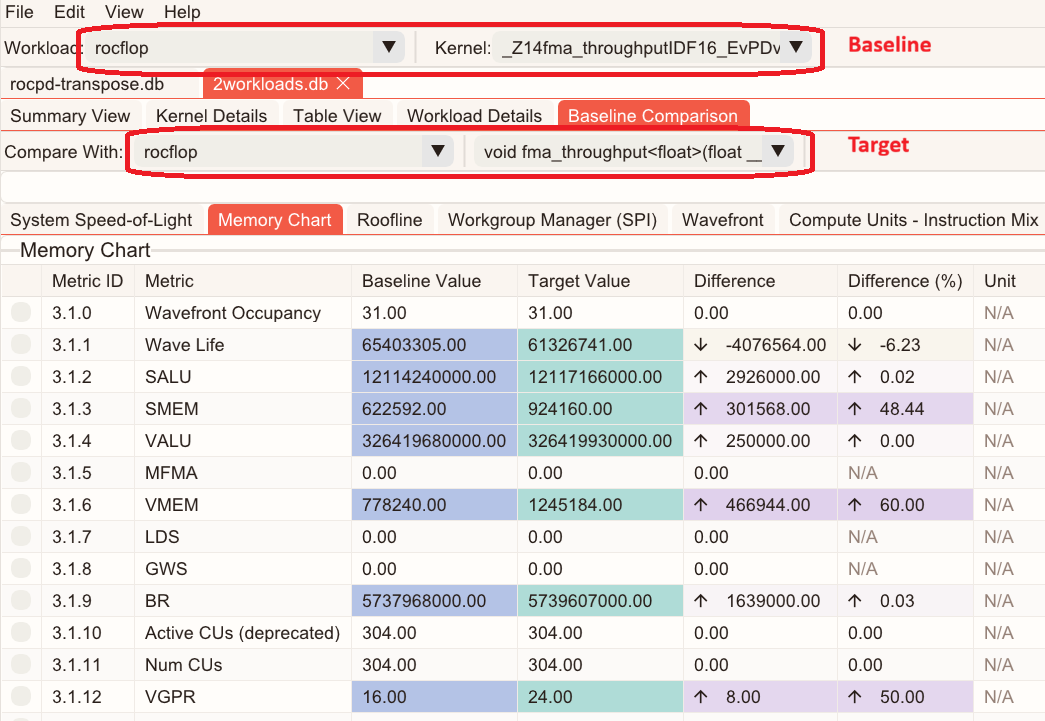
Use the dropdowns to select the baseline, target workload, and kernel. The comparison table updates to show statistics for the selected selections. You can also compare two kernels within the same workload.
When you compare workloads from different GPU architectures, some metrics might exist on one architecture and not the other. Choose how those metrics are displayed:
Show Common Metrics: Shows only metrics that exist in both the baseline and the target. Hides unmatched metrics.
Show All Metrics: Shows all metrics, including unmatched ones.
You can also pin metrics for focused analysis. Pinned metrics can be persisted across sessions (see Presets for more information).
For each metric, Baseline Comparison shows:
Baseline statistics available in the database (for example, average, median, minimum, and maximum).
Target statistics available in the database (for example, average, median, minimum, and maximum).
The difference (delta) between baseline and target values.
The percentage change between baseline and target values.
The Baseline, Target, Difference, and Difference (%) columns are color-coded to make changes easy to spot and quantify.
A combination of side-by-side statistics with clear delta reporting to provide a fast way to understand performance trends across workloads.
You can configure a delta-threshold for comparison metrics to suppress the noise of minor deviations or filter out changes below a certain level. You can either double-click the threshold control to enter a value or drag within the threshold box to adjust it.

Note
To compare two runs in ROCm Optiq, both sets of analysis results must be present in the same database.
To generate a database that contains multiple workloads with ROCm Compute Profiler for comparison, profile each workload and then run analysis with database output enabled:
$ rocprof-compute profile -n <workload_name_1> -- <application>
...
$ rocprof-compute profile -n <workload_name_N> -- <application>

$ rocprof-compute analyze -p <path to workload_name_1> ... -p <path to workload_name_N> --output-format db
Copy the generated
.dbfile to the host system and open it in ROCm Optiq. Then, go to the Baseline Comparison tab and select a baseline workload under Workload: and a target workload under Compare With:. Select a kernel for each workload to compare.