RCCL usage tips#
This topic describes common RCCL configuration options and usage tips.
Profiling#
For fine-grained profiling of collective operations, use the RCCL profiler plugin API and related tooling rather than legacy in-tree profilers.
MSCCL and MSCCL++ integration has been removed from RCCL. The legacy API symbols mscclLoadAlgo,
mscclRunAlgo, and mscclUnloadAlgo remain as no-ops for link compatibility.
Enabling peer-to-peer transport#
To enable peer-to-peer access on machines with PCIe-connected GPUs, set the HSA environment variable as follows:
HSA_FORCE_FINE_GRAIN_PCIE=1
This feature requires GPUs that support peer-to-peer access along with proper large BAR addressing support.
Symmetric memory and NCCL_P2P_LEVEL#
RCCL can accelerate some collectives (for example, allreduce, allgather, and
reduce-scatter) through a symmetric memory path. This path uses
Virtual Memory Management-backed
buffers that are registered as symmetric windows (ncclCommWindowRegister
with the NCCL_WIN_COLL_SYMMETRIC flag) so that every participating rank can
address the buffer directly. ncclMemAlloc allocates memory suitable for such
a registration, but it does not create a symmetric window on its own.
Whether a communicator can use symmetric memory is decided once at
ncclCommInitRank time. The prerequisites are:
All local ranks are peer-to-peer capable with each other (on AMD GPUs this means they are on the same host over PCIe or XGMI, or are reachable through a Multi-Node Infinity Fabric clique).
Virtual Memory Management is enabled (
NCCL_CUMEM_ENABLE=1).Symmetric windows are enabled (
NCCL_WIN_ENABLE=1, the default).Either GPU-Initiated Networking (GIN) is available, or the communicator is a single locality (one-LSA) team.
Note
Symmetric-memory availability does not depend on the
NCCL_P2P_LEVEL distance setting. This matches the behavior introduced in
upstream NCCL 2.28.7, which removed the topology-distance check from the
symmetric-memory decision. Restricting peer-to-peer reach with a value such
as NCCL_P2P_LEVEL=PHB (or even disabling distance-based P2P entirely with
NCCL_P2P_DISABLE=1) changes how the flat P2P transport schedule is
built, but it does not by itself turn off the symmetric path: as long as
the GPUs are CUDA peer-to-peer capable, symmetric memory remains eligible.
To confirm whether symmetric memory was enabled for a run, inspect the init logs:
NCCL_DEBUG=INFO NCCL_DEBUG_SUBSYS=INIT ./your_app
When symmetric memory is not available, RCCL logs a line that begins with
Symmetric memory is not supported and reports which prerequisite was
missing (for example, cuMemEnable or globalGinSupport). If you expect
the symmetric path but it is disabled, check those prerequisites rather than
NCCL_P2P_LEVEL.
Device-side symmetric memory access (ncclFindWindow)#
In addition to the host-side collective API, RCCL exposes a device-side API that lets your own GPU kernels read and write peer ranks’ symmetric buffers directly, without a host-driven collective. This is the mechanism that backs RCCL’s fused symmetric kernels. It requires the same symmetric-memory prerequisites described above.
Working with symmetric memory from a kernel involves three pieces:
A device communicator (
ncclDevComm), created on the host withncclDevCommCreateand passed to the kernel by value. It carries the rank layout, barriers, and the device-side window registry.One or more symmetric windows, registered on the host with
ncclCommWindowRegisterusing theNCCL_WIN_COLL_SYMMETRICflag.ncclMemAlloconly allocates and maps symmetric-capable memory; it does not populate the window registry, so the explicit registration call is required.The device API (available through
nccl_device.h) that turns a window plus an offset into a pointer to a specific peer’s copy of the buffer.
When a kernel already holds the ncclWindow_t handle (for example, because
the host passed it as a launch argument), it can call ncclGetLsaPointer
directly. When a kernel only has a raw device pointer, it can resolve the
backing window from the device-side registry with ncclFindWindow (introduced
in NCCL 2.28.7), with no host round-trip:
template <typename Coop>
ncclWindow_t ncclFindWindow(Coop coop, ncclDevComm const& comm, void const* ptr);
coopis a cooperative-thread group (for examplencclCoopCta()). The lookup is warp-coalesced, so every thread in the group must call it; the same window handle is returned to all participating threads.commis the device communicator passed to the kernel.ptris any address that falls within a registered symmetric window’s[base, base + size)range.
ncclFindWindow walks the communicator’s window registry, which
ncclCommWindowRegister populates, and returns the matching ncclWindow_t.
ncclDevCommCreate does not fill this registry; it only publishes a pointer
to it into the device communicator. Passing a pointer that no registered
window covers is undefined behavior rather than a recoverable error: the lookup
returns only from its hit path, so a miss runs past the end of the registry and
faults. Make sure the pointer is covered by a registration instead of testing
the result against nullptr. Once you have a window, resolve a specific
peer’s copy of the buffer with one of the pointer helpers:
ncclGetLsaPointer(window, offset, peer)returns a pointer topeer’s copy of the buffer atoffsetbytes into the window, for peers reachable through Local Symmetric Access (LSA, that is, direct intra-node peer-to-peer).ncclGetPeerPointer(window, offset, team, peer)is the team-relative form.ncclGetMultimemPointer/ncclGetLsaMultimemPointerreturn a multicast pointer when multimem is available.
The offset is measured from the window base, so a buffer registered at its
base address is accessed at offset = 0.
The kernel below is handed only its local buffer pointer. It resolves the backing window on the device, then reads the value stored by its ring neighbor:
#include <nccl_device.h>

__global__ void readPeerValue(void* localPtr, int* out, ncclDevComm_t comm)
{
    // Synchronize the local symmetric team before touching peer memory.
    ncclLsaBarrierSession<ncclCoopCta> barrier(
        ncclCoopCta(), comm, ncclTeamLsa(comm), comm.lsaBarrier, blockIdx.x);
    barrier.sync(ncclCoopCta(), cuda::memory_order_relaxed);

    // Device-side registry lookup (all threads participate).
    ncclWindow_t window = ncclFindWindow(ncclCoopCta(), comm, localPtr);

    if (threadIdx.x == 0) {
        // ncclGetLsaPointer indexes the LSA team, so the peer must be an LSA
        // rank. Use ncclGetPeerPointer(window, 0, team, peer) to address a
        // rank of some other team by its rank in that team.
        int  peer     = (comm.lsaRank + 1) % comm.lsaSize;
        int* peerData = reinterpret_cast<int*>(ncclGetLsaPointer(window, 0, peer));
        out[0] = peerData[0];
    }

    barrier.sync(ncclCoopCta(), cuda::memory_order_release);
}
On the host, register the buffer as a symmetric window and build the device communicator before launching:
ncclCommWindowRegister(comm, buffer, bytes, &window, NCCL_WIN_COLL_SYMMETRIC);

ncclDevCommRequirements_t req = NCCL_DEV_COMM_REQUIREMENTS_INITIALIZER;
req.lsaBarrierCount = 1;
ncclDevComm_t devComm;
ncclDevCommCreate(comm, &req, &devComm);

readPeerValue<<<1, 64, 0, stream>>>(buffer, out, devComm);
The device communicator holds a pointer to the communicator’s live window
registry, so ncclFindWindow resolves any window registered with
NCCL_WIN_COLL_SYMMETRIC, whether it was registered before or after
ncclDevCommCreate. The only ordering requirement is that the registration
completes before the kernel that calls ncclFindWindow runs, on a
communicator for which symmetric memory is available. If ncclDevCommCreate
returns ncclInvalidUsage, or a kernel
faults inside the lookup, confirm the prerequisites above
(NCCL_CUMEM_ENABLE=1, NCCL_WIN_ENABLE=1, peer-to-peer capable ranks),
that the buffer was registered with NCCL_WIN_COLL_SYMMETRIC, and that the
pointer passed to ncclFindWindow lies within that registration.
Ignoring CPU affinity with multi-node#
Depending on the job launcher and the requirements of your workload, performance as the communication workload scales
can be improved by setting NCCL_IGNORE_CPU_AFFINITY. This allows the RCCL communication library to
ignore the job’s supplied CPU affinity and use the GPU affinity only.
NCCL_IGNORE_CPU_AFFINITY=1
For general usage, this environment variable is not set so it doesn’t interfere with the user or launcher supplied preferences.
Improving performance on the MI200 series#
On MI200 series (gfx90a) systems, such as MI210, MI250, and MI250X, running
ROCm 7.13 or later, set HSA_NO_SCRATCH_RECLAIM=1 when running RCCL:
export HSA_NO_SCRATCH_RECLAIM=1
Without this setting, per-launch scratch-memory reclaim in the runtime adds a
fixed overhead to every collective launch. This overhead dominates
small-message (under 16 MB) latency and can degrade it by roughly
5-10x compared to earlier ROCm releases. Setting HSA_NO_SCRATCH_RECLAIM=1
removes the overhead and restores the expected small-message latency.
Improving performance on the MI300X and MI350X#
This section outlines ways to improve RCCL performance on MI300X and MI350X systems, including guidelines for systems with fewer than eight GPUs, the most efficient GPU partition modes, and channel tuning for multi-node configurations. Where behavior applies to both architectures, both are called out together; where behavior differs, the difference is described in its own subsection.
Configuration with fewer than eight GPUs#
On a system with eight MI300X accelerators, each pair of accelerators is
connected with dedicated Infinity Fabric™ links in a fully connected topology.
For collective operations, this can achieve good performance when all eight
accelerators (and all Infinity Fabric links) are used. When fewer than eight
GPUs are used, however, this can only achieve a fraction of the potential
bandwidth on the system. However, if your workload warrants using fewer than
eight MI300X accelerators on a system, you can set the run-time variable
NCCL_MIN_NCHANNELS to increase the number of channels. For example:
export NCCL_MIN_NCHANNELS=32
Increasing the number of channels can benefit performance, but it also increases GPU utilization for collective operations. Additionally, RCCL pre-defines a higher number of channels when only two or four accelerators are in use on a 8*MI300X system. In this situation, RCCL uses 32 channels with two MI300X accelerators and 24 channels for four MI300X accelerators.
NPS4 and CPX partition modes#
The term compute partitioning modes, or Modular Chiplet Platform (MCP), refers to the logical partitioning of XCDs into devices in the ROCm stack. The names are derived from the number of logical partitions that are created out of the eight XCDs. In the default mode, SPX (Single Partition X-celerator), all eight XCDs are viewed as a single logical compute element, meaning that the amd-smi utility will show a single MI300X or MI350X device. In CPX (Core Partitioned X-celerator) mode, each XCD appears as a separate logical GPU, for example, as eight separate GPUs in amd-smi per MI300X or MI350X device. CPX mode can be viewed as having explicit scheduling privileges for each individual compute element (XCD). Both the MI300X and MI350X support SPX and CPX compute partitioning modes.
While compute partitioning modes change the space on which you can assign work to compute units, the memory partitioning modes (known as Non-Uniform Memory Access (NUMA) Per Socket (NPS)) change the number of NUMA domains that a device exposes. In other words, it changes the number of HBM stacks which are accessible to a compute unit, and therefore the size of its memory space. However, for the MI300X and MI350X, the number of memory partitions must be less than or equal to the number of compute partitions. On the MI300X, NPS4 (viewing pairs of HBM stacks as a disparate element), for example, is only enabled when in CPX mode (viewing each XCD as a disparate element). The MI350X doesn’t support NPS4; see `MI350X partition mode differences`_ for the memory partitioning modes it supports instead.
Compute partition modes
In SPX mode, workgroups launched to the device are distributed round-robin to the XCDs in the device, meaning that the programmer cannot have explicit control over which XCD a workgroup is assigned to.
In CPX mode, workgroups are launched to a single XCD, meaning the programmer has explicit control over work placement onto the XCDs.
Memory partition modes
In NPS1 mode (compatible with CPX and SPX), the entire memory is accessible to all XCDs.
In NPS4 mode (compatible with CPX), each memory quadrant of the memory is directly visible to the logical devices in its quadrant. An XCD can still access all portions of memory through multi-GPU programming techniques.
The MI300X CPX mode can be accessed using the following amdsmi:index commands.
amd-smi set --gpu all --compute-partition CPX
amd-smi set --gpu all --memory-partition NPS4
MI350X/MI355X partition modes#
For MI350X/MI355X, RCCL supports the DPX compute partitioning mode and the NPS2 memory partitioning mode.
amd-smi set --gpu all --compute-partition DPX
amd-smi set --gpu all --memory-partition NPS2
RCCL performance with CPX and NPS4 on MI300X#
The following benchmark results were measured on MI300X systems. To run RCCL allreduce on 64 GPUs with CPX+NPS4 mode on the MI300X, use this example:
mpirun -np 64 --bind-to numa rccl-tests/build/all_reduce_perf -b 8 -e 1G -f 2 -g 1
To run RCCL allreduce on 8 GPUs in the same OAM with CPX+NPS4 mode on the MI300X, use this example:
export ROCR_VISIBLE_DEVICES=0,1,2,3,4,5,6,7

mpirun -np 8 --bind-to numa rccl-tests/build/all_reduce_perf -b 8 -e 1G -f 2 -g 1
RCCL delivers improved allreduce performance in CPX mode for TP=8 (8 GPUs in the same OAM) on the MI300X.
export HIP_FORCE_DEV_KERNARG=1
export ROCR_VISIBLE_DEVICES=0,1,2,3,4,5,6,7

mpirun -np 8 --bind-to numa rccl-tests/build/all_reduce_perf -b 32 -e 1G -f 2 -g 1 -G 2 -w 20 -n 50
Here are the benchmark results for in-place (where the output buffer is used as the input buffer) and out-of-place allreduce bus bandwidth.
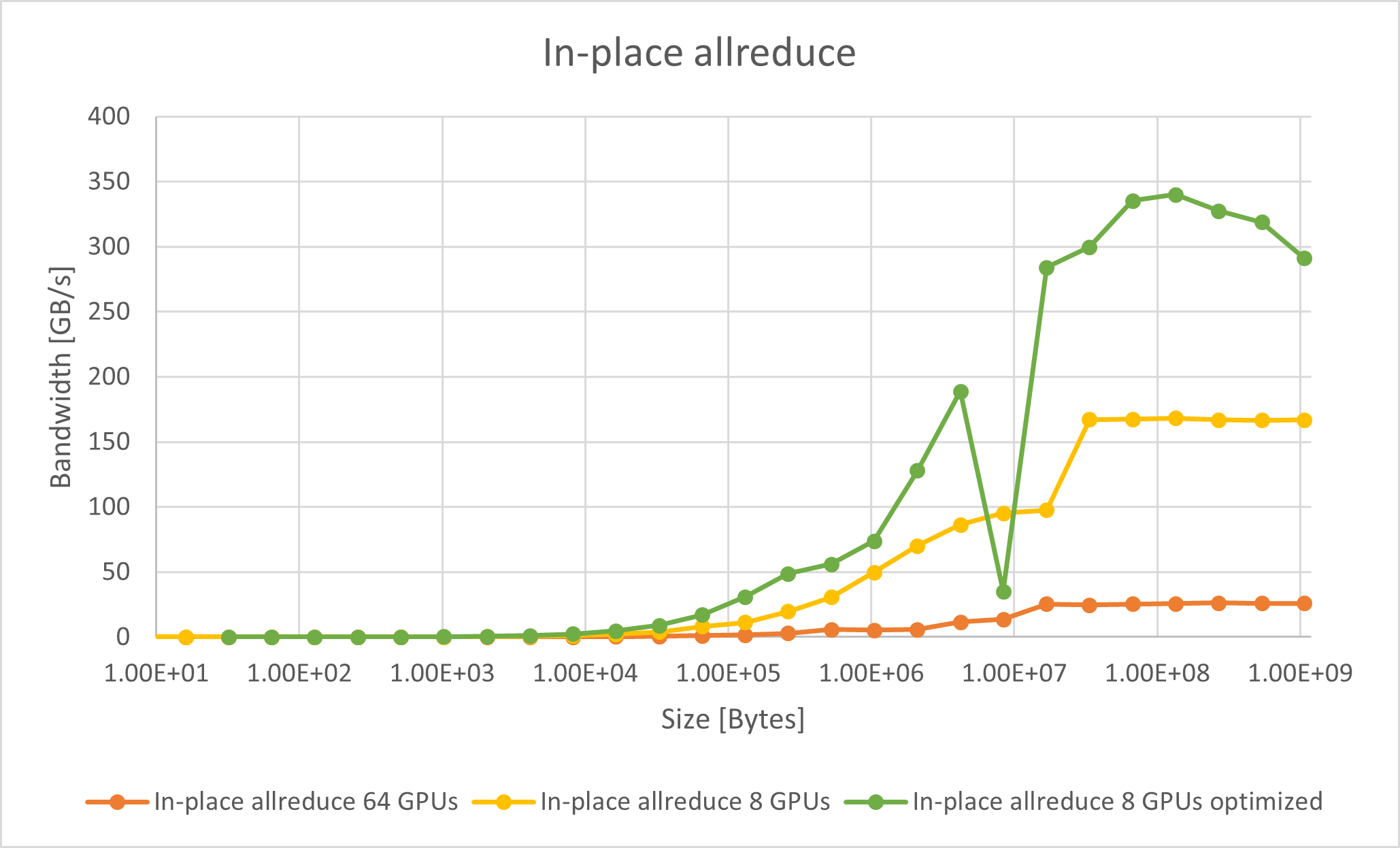
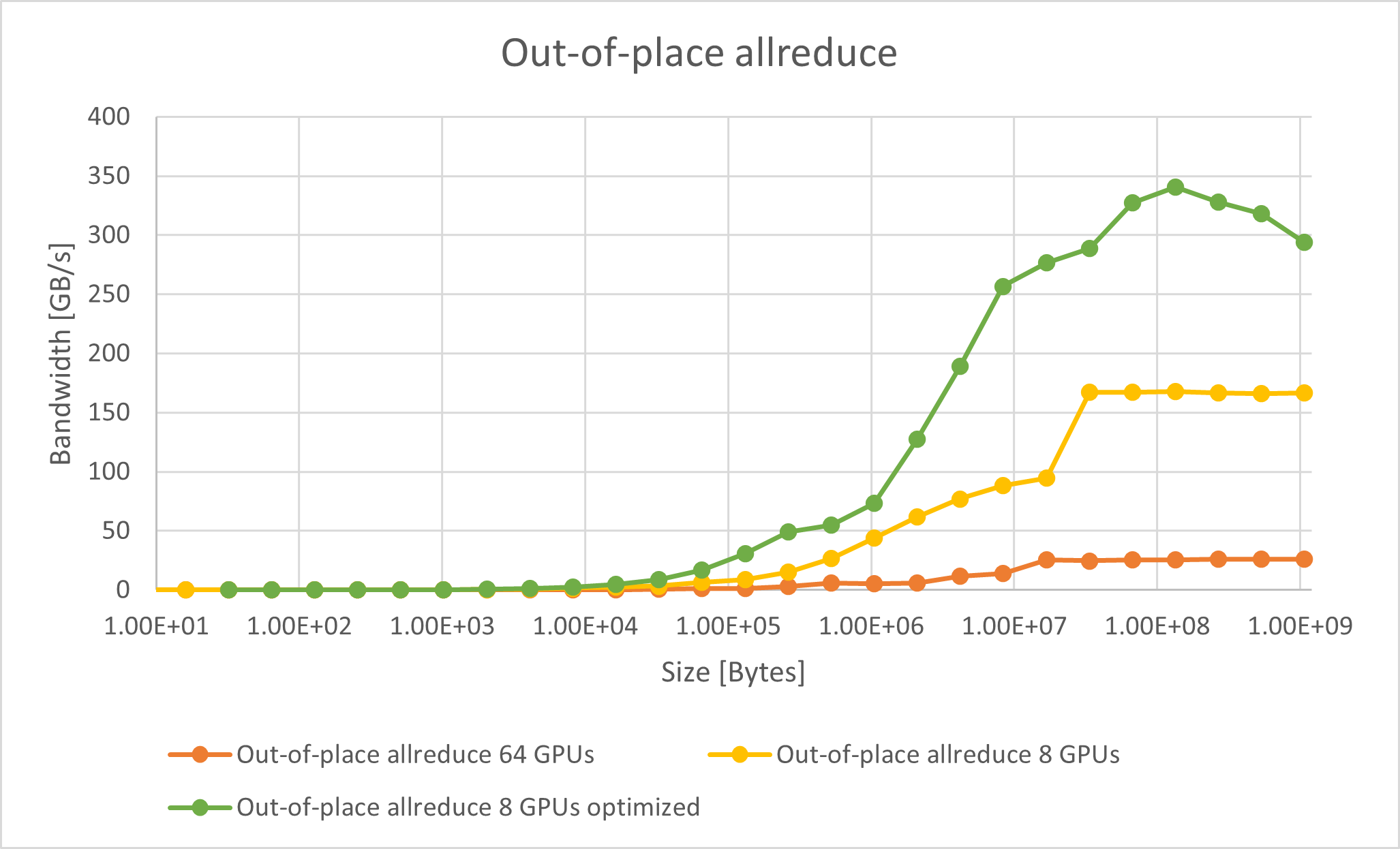
A significant performance improvement is achievable with optimized CPX mode, which peaks at ~340 GB/s with a single OAM. The difference in bus bandwidth between the unoptimized and optimized modes increases as the buffer size grows.
Using RCCL and CPX in PyTorch on MI300X#
The following benchmark results were measured on MI300X systems. The PyTorch all_reduce benchmark is used to reproduce the performance reported by RCCL-Tests with the RCCL and CPX optimizations.
Note
To use RCCL with CPX mode in PyTorch, check the RCCL version used by PyTorch.
For a virtualenv with a .whl-based PyTorch setup (such as nightly/rocm6.2),
this would be in
<path-to-your-venv>/lib/<python-version>/site-packages/torch/lib/librccl.so
This is the version of RCCL that is packaged as part of ROCm version 6.2.
RCCL for CPX mode was enabled in ROCm 6.3.0. To use the CPX features, replace
the existing librccl.so with one from ROCm 6.3.0 or newer or from a local
build of the RCCL develop branch.
To test the effects of RCCL on PyTorch, the stas00 all reduce benchmark was used. The following command is used to run a single OAM allreduce benchmark:
export ROCR_VISIBLE_DEVICES=0,1,2,3,4,5,6,7
python -u -m torch.distributed.run --nproc_per_node=8 --rdzv_endpoint localhost:6000  --rdzv_backend c10d all_reduce_bench.py
For better performance, the HIP_FORCE_DEV_KERNARG and
TORCH_NCCL_USE_TENSOR_REGISTER_ALLOCATOR_HOOK environment variables are
set during the benchmark in the following manner:
export TORCH_NCCL_USE_TENSOR_REGISTER_ALLOCATOR_HOOK=1
export HIP_FORCE_DEV_KERNARG=1
export ROCR_VISIBLE_DEVICES=0,1,2,3,4,5,6,7
python -u -m torch.distributed.run --nproc_per_node=8 --rdzv_endpoint localhost:6000  --rdzv_backend c10d all_reduce_bench.py
The default allreduce PyTorch benchmark peak bus bandwidth performance is ~170 GB/s on a single OAM with ROCm 6.2.4, while the optimized run for CPX on a single OAM peaks at ~315 GB/s.
RCCL channel tuning for multi-node MI350X (ROCm 7.14 / RCCL 2.30.4)#
Starting with RCCL 2.30.4 (ROCm 7.14), the default number of communication
channels for multi-node collectives on MI350X/MI355X in SPX mode has been reduced from 64 to 48,
leaving additional Compute Units (CUs) free for compute kernels that run
concurrently with communication. For computation-bound workloads that rely
heavily on communication-computation overlap, staying with this default may
be beneficial since it leaves more CUs available for compute, but this is a
deliberate trade-off against raw communication bandwidth, so users measuring
standalone rccl-tests bandwidth (with no concurrent compute contending for
CUs) or running communication-bound workloads with negligible concurrent
compute may see a regression compared to ROCm 7.2.1/RCCL 2.27.7. This expected
behavior can be recovered by setting both NCCL_MAX_NCHANNELS=64 and
NCCL_MIN_NCHANNELS=64 (64 is the effective ceiling for multi-node jobs).
In either case, the actual channel count in use should be confirmed via
NCCL_DEBUG=INFO NCCL_DEBUG_SUBSYS=INIT,TUNING,COLL before drawing
performance conclusions.
As of ROCm 10.0, the default communication channel count will revert back to 64 CUs.
ROCm version |
Default max multi-node CUs |
|---|---|
7.14 |
48 |
10.0 |
64 |
Context tracking on GPUs#
Context tracking is disabled by default for optimal performance. However, enabling of context tracking can significantly improve performance in certain scenarios. To enable context tracking, set the following environment variable:
export RCCL_ENABLE_CONTEXT_TRACKING=1
Suspending and resuming a communicator#
A long-lived application can hold several RCCL communicators that are only used during specific phases. While a communicator is idle, the GPU memory it holds for channel buffers, transport FIFOs, and similar resources stays reserved and is unavailable to the rest of the application. RCCL provides an API to release those resources while a communicator is idle and to reacquire them later without destroying and recreating the communicator.
The relevant functions, declared in rccl.h, are described in full in
Communicator suspend and resume:
ncclCommSuspendreleases the resources selected by itsflagsargument. PassNCCL_SUSPEND_MEMto release dynamic GPU memory allocations. After this call, the communicator can’t be used until it’s resumed: a collective issued while it’s suspended is rejected withncclInvalidUsage.ncclCommResumereacquires every resource that the matchingncclCommSuspendcall released, after which the communicator can run collectives again.ncclCommMemStatsreports per-communicator memory counters, such as the amount of GPU memory that can be suspended and whether the communicator is currently suspended.
Requirements#
Releasing the physical backing of a suspended communicator while keeping its GPU virtual address space requires cuMem virtual memory management (VMM) support. VMM is available only when all of the following conditions are met:
NCCL_CUMEM_ENABLEis set to1, or left at its default of-2, which enables VMM automatically when the platform supports it. Auto-detection is limited to gfx1250; on other architectures set1explicitly.The HIP/ROCm runtime provides the cuMem VMM APIs: ROCm 7.12 or later, or a ROCm 7.0.x build that includes the cuMem backport.
The Linux kernel is version 6.8 or later.
The GPU and driver report VMM support.
Without VMM support, ncclCommSuspend and ncclCommResume still succeed,
but they can’t release the physical GPU memory, so the operation is
effectively a no-op.
Example#
The following example suspends an idle communicator, queries how much GPU memory was freed, and later resumes it:
// comm is an initialized ncclComm_t that is currently idle.
uint64_t suspendable = 0, suspended = 0;

NCCLCHECK(ncclCommMemStats(comm, ncclStatGpuMemSuspend, &suspendable));
// suspendable is bytes of GPU memory Suspend can release; 0 means none right
// now. This query is informational; Suspend does not require suspendable > 0

// Release dynamic GPU memory held by the communicator.
NCCLCHECK(ncclCommSuspend(comm, NCCL_SUSPEND_MEM));

NCCLCHECK(ncclCommMemStats(comm, ncclStatGpuMemSuspended, &suspended));
// suspended == 1 while the communicator is suspended.

// ... run other work that needs the freed GPU memory ...

// Reacquire the resources before using the communicator again.
NCCLCHECK(ncclCommResume(comm));
To suspend or resume several communicators together, wrap the calls in
ncclGroupStart and ncclGroupEnd
(see Communicator suspend and resume):
NCCLCHECK(ncclGroupStart());
NCCLCHECK(ncclCommSuspend(commA, NCCL_SUSPEND_MEM));
NCCLCHECK(ncclCommSuspend(commB, NCCL_SUSPEND_MEM));
NCCLCHECK(ncclGroupEnd());

// ... later, the matching resume ...

NCCLCHECK(ncclGroupStart());
NCCLCHECK(ncclCommResume(commA));
NCCLCHECK(ncclCommResume(commB));
NCCLCHECK(ncclGroupEnd());
Note
When a single process owns one communicator per device through
ncclCommInitAll, ncclCommSuspend and ncclCommResume need to be
wrapped around a group API.