DLRMv4 benchmark reference#
What the MLPerf Training dlrmv4 benchmark trains and how it is scored: the
dataset, the data order, the model and the quality target. To run it, see the
DLRMv4 guide.
Problem#
The model predicts what a person will listen to next. It reads a user’s history of played, liked and skipped songs and ranks how likely the user is to really listen to a candidate song (play at least 50% of it) instead of skipping it.
It is a sequential recommender. A classic click-through-rate model such as
DLRM-DCNv2 scores each interaction on its own. HSTU instead reads the user’s
chronologically ordered interaction history as a sequence, through a
Transformer-style attention stack. Each training example is one listen event
(the anchor), the user’s history before it (UIH, user interaction history)
and a set of contextual and cross features. The label is binary: listen_plus
(played at least 50%) versus a skip.
Training follows time. The timeline is cut into daily windows. The model trains on windows 0–298 in order and is evaluated on window 299, the day after the last training window. Every metric therefore measures prediction of the future. The quality metric is AUC on that held-out day, and the target is AUC ≥ 0.75.
Dataset#
Yambda-5b is a public, anonymized music-recommendation dataset from Yandex Music (arXiv:2505.22238), distributed under the terms of its HuggingFace repository.
After preprocessing |
|
|---|---|
Interaction events |
4.76 B (train: 300 days, 4.76 B; test: 1 day, 22.4 M) |
Users |
1.00 M (median 2,695 events, max 27,738) |
Item catalog |
9.39 M |
Event pool |
Definition |
Share |
|---|---|---|
listen_plus (lp) |
listened, played ≥ 50% |
61.3% |
skip |
listened, played < 50% |
35.9% |
like |
explicit like |
1.9% |
other |
dislike / unlike / undislike |
1.0% |
Getting the data#
There are two routes, and both end in the same files:
$DLRM_DATA_PATH/                                   A: download   B: build
├── processed_5b/
│   ├── hstu_cache_L4086/            227.24 GB     yes           built on the 1st training run
│   ├── item_popularity.npy              75 MB     yes           preprocessing
│   ├── train_sessions.parquet        46.79 GB     -             preprocessing
│   ├── session_index.parquet           600 MB     -             preprocessing
│   ├── test_events.parquet             152 MB     -             preprocessing
│   └── split_meta.json                  361 B     -             preprocessing
└── shared_metadata/
    ├── album_item_mapping.parquet     54.5 MB     yes           download
    └── artist_item_mapping.parquet    38.3 MB     yes           download
The trainer reads only hstu_cache_L4086/ and the two mappings.
item_popularity.npy is used to cross-check the vocabulary size.
A: download the prepared dataset (227.41 GB, recommended). It comes from the
MLCommons training data page;
the command is in the guide’s quick start. The
downloader checks each file’s md5, and examples/mlperf/dlrm_v4/data/verify_dataset.sh
checks the cache against
sha256sums_yambda_5b_cache.txt
and the other files against
md5sums_yambda_5b_processed.txt.
B: build it from the HuggingFace release. This takes about 53 minutes for
download and preprocessing, about 313 GB of disk at the peak (about 275 GB after
deleting raw/), and a host with about 190 GB of RAM for the cache build. Run it
in the rocm/primus:v26.9 image with polars-u64-idx installed
(pip install --no-deps polars-u64-idx==1.33.1; the install hook does this at a
container’s first training launch). Stock polars silently overflows its 32-bit
row index on Yambda-5b.
DLRM_DATA_PATH=/data/mlperf_dlrm_v4 examples/mlperf/dlrm_v4/data/download_dataset.sh   # download + preprocess
DLRM_DATA_PATH=/data/mlperf_dlrm_v4 examples/mlperf/dlrm_v4/data/verify_dataset.sh     # verify
The script downloads 38.3 GB from yandex/yambda (flat/5b/multi_event.parquet
and the two mappings), then runs generative_recommenders.dlrm_v4.preprocess_public_data:
Encode the event type (listen, like, dislike, unlike, undislike).
Split the events in time: 300 training days, a 30-minute gap, 1 test day (the dataset’s Global Temporal Split).
Cut each user’s timeline into sessions at 30 minutes of inactivity.
Count item popularity.
The first training run builds hstu_cache_L4086/ from train_sessions.parquet.
The build is deterministic, so a locally built cache matches the same sha256
sums as the download: run verify_dataset.sh again afterwards.
Window index#
The data loader finds each window’s anchors through an index
(ts_indices_*.npy, ts_offsets_*.npy, about 18 GB) in the cache directory. The
first run builds it if it is missing. On a read-only data mount, build it
beforehand:
python3 tools/recommendation/dlrm_v4/ts_index_tool.py prebuild \
    --cache-dir "$DLRM_DATA_PATH/processed_5b/hstu_cache_L4086" --history-length 4086
ts_index_tool.py can also verify, report status, and check-staged copies.
DL_WINDOW_INDEX=0 scans the full cache per window instead (slow).
Features#
For each anchor (a listen event with at least min_history = 4086 earlier
events), the loader builds:
UIH (user interaction history)
  sequence, chronologically interleaved from 3 pools:
    item_id, artist_id, album_id, action_weight (lp / like / skip bits),
    action_timestamp, watch time
  contextual (1 entry each): uid + 7 cross-feature hashes
    (user_x_artist, item_x_hour, ...)

Candidate (the anchor listen event)
  item_id, artist_id, album_id, query time,
  action_weight (lp bit if listen_plus, else 0)  <- the label
From the last 20,000 events before the anchor, the loader takes the most recent
4086 // 3 = 1362 events of each pool (lp, like, skip) and sorts them back into
time order. With 8 contextual entries and the candidate this fills
3 × 1362 + 8 + 1 = 4095 ≤ 4096 positions. The rare like pool under-fills
(about 105 events per anchor); the attention kernels skip empty positions.
Data order#
Windows. A window is the set of anchors whose timestamp falls in one day (86,400 s); windows are numbered from 0 in time order.
Training order. The run trains on windows 0–298 (START_TS=0,
NUM_TRAIN_TS=299) in time order, never shuffled. Within a window, anchors are
read in dataset order. STREAMING_SHUFFLE_FRACTION (default 0) can shuffle
inside a window without crossing window boundaries.
Eval set. Every eval scores the same fixed set: all anchors of window 299
(EVAL_HOLDOUT_TS=299), 2,058,204 samples, with no subsampling. Training never
reaches that window, and within an anchor, history is gathered only from events
strictly before it, so no future event leaks into training or into features.
Each eval scores the whole set, so the order does not affect the AUC.
Model#
HSTU (Hierarchical Sequential Transduction Units), from Actions Speak
Louder than Words: Trillion-Parameter Sequential Transducers for Generative
Recommendations (ICML’24, arXiv:2402.17152).
The code is derived from
meta-recsys/generative-recommenders;
the configuration is in generative_recommenders/dlrm_v4/configs.py.
1. Embeddings. TorchRec EmbeddingCollection, sharded across GPUs. Every
table has dimension 512 and is stored in FP32:
Table |
Rows |
Table |
Rows |
|---|---|---|---|
|
9,390,624 |
|
40,000,000 |
|
1,293,395 |
|
24,000,000 |
|
3,367,692 |
|
40,000,000 |
|
1,000,001 |
|
32,000,000 |
|
100,000,000 |
|
2,000,000 |
|
40,000,000 |
2. User path (HSTUTransducer), over the history plus the candidate:
A contextual preprocessor: linear layers over the 8 contextual entries, a content MLP, and an action encoder over the action bits, summed (512 wide).
Position (8192 buckets) and time (2048 buckets) embeddings; input dropout 0.2.
3 STU layers (
HSTU_NUM_LAYERS): width 512, 4 heads, Q/K and U/V dimension 128 per head, causal target-aware attention. HSTU fuses attention and the feed-forward block into one UVQK projection with SiLU gating, so there is no separate FFN. Linear dropout 0.1.A postprocessor: cyclical time features (hour of day, day of week), then
Linear(516 → 512) → LayerNorm.
3. Item path: the candidate’s item, artist and album embeddings
concatenated (1536), then
Linear(1536 → 512) → SwishLayerNorm → Linear(512 → 512) → LayerNorm.
4. Head: the element-wise product of the user and item vectors, then
Linear(512 → 512) → SwishLayerNorm → Linear(512 → 1): one logit for
listen_plus.
Initialization#
Embedding tables: uniform in
±1/sqrt(rows). Each table’s generator is seeded fromsha256(seed:table_name), so a seed gives the same tables on every rank and run.Dense layers: Xavier-uniform weights and zero biases. Inside the STU layers, the UVQK and output weights are Xavier-uniform and the norms start at one.
Action embeddings: normal with std 0.1.
Dense initialization is identical on every rank. After it, each rank re-seeds with
seed + rankso dropout differs per rank.
Loss, optimizer, precision#
Loss: binary cross-entropy with logits on the
listen_pluslabel, scaled by 0.2. The head emits raw logits; sigmoid is applied only for predictions.Dense parameters: Adam, betas (0.95, 0.999), eps 1e-8, no weight decay, gradient clipping at norm 1.0 (
GRAD_CLIP_NORM).Embeddings: row-wise Adagrad fused into the FBGEMM embedding kernels, eps 1e-8, no weight decay.
Learning rate: linear warmup from 0 over 24000 steps to
DENSE_LR/SPARSE_LR(1e-6 at a global batch of 8192), then constant.Precision: bf16 mixed precision with FP8 HSTU layers (see Precision). The sparse all-to-all runs in fp16 (
SPARSE_A2A_FWD/SPARSE_A2A_BWD).
Compute cost#
The model FLOPs per sample, used as the denominator of the MFU the train log reports, are 315.7 GFLOP (forward plus backward, sequence length 4096, 3 layers):
Part |
GFLOP / sample |
Formula (forward MACs per layer) |
|---|---|---|
Attention (causal) |
180.4 |
|
UVQK projection |
77.3 |
|
Output projection |
58.0 |
|
S = 4096, D = 512, H = 4, d_qk = d_v = 128. There are 2 FLOPs per MAC.
The figure leaves out embeddings, communication, norms and the per-candidate MLPs.
It prices every sequence at its full length, so the log also reports fill
(the share of positions sequences actually use) and exec (the share of the
FLOPs actually executed). Use global_sps (samples per second) to compare runs.
Quality#
Target and metric#
The metric is the AUC of listen_plus on the eval set (window_auc), and
the target is 0.75. The run stops at the first eval that reaches it and
logs run_stop with status success.
Eval schedule#
The run evaluates every 0.1% of the training data
(EVAL_EVERY_DATA_PCT=0.001; one epoch is 2,290,835,423 samples). The interval
is rounded to whole steps: 2,293,760 samples, which is 280 / 140 / 70 steps at a
global batch of 8192 / 16384 / 32768.
Each eval costs about 0.4× the training block before it, and no run reaches the
target in the first 2.7% of the epoch. So the early evals are skipped. By
default (SKIP_EVAL_EPOCH_PCT=-1), the first eval follows the MLPerf rule for
the run’s global batch:
start_eval_samples  = FLOOR((4480 × GBS + 135331840) / 3)
skip_eval_epoch_pct = start_eval_samples / 2290835423
Global batch |
|
First eval |
Earliest crossing in the reference runs |
Eval share of run time |
|---|---|---|---|---|
8192 |
0.025 |
#25 |
#27 |
6.9% |
16384 |
0.0303 |
#31 |
#34 |
6.7% |
32768 |
0.041 |
#41 |
#43 |
5.5% |
Without skipping, evaluation takes about 29% of the run.
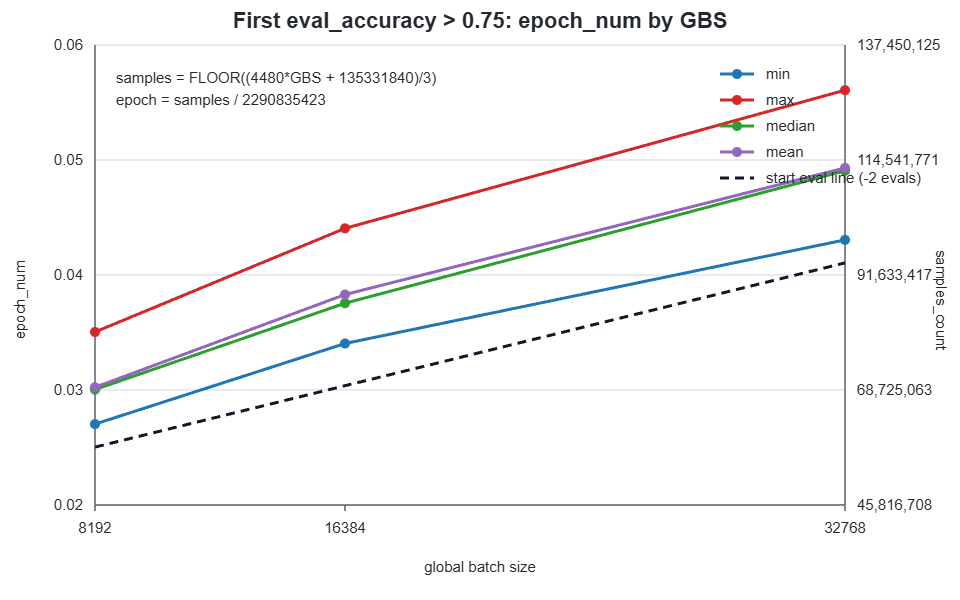
The line is fitted through the earliest crossing of 20 reference runs at global
batches 8192 and 32768, and moved two eval intervals earlier as a safety margin.
Evaluation starts before any reference run converges, while still skipping most
early evals. The MLPerf compliance checker recomputes the first eval from the
logged global batch, so a wrong SKIP_EVAL_EPOCH_PCT fails compliance. Skipping
never changes training; the final eval always runs.
Reference convergence points#
The reference convergence points come from 20 seeds at each of 3 global batch sizes, all reaching AUC 0.75 (MI350X, bf16, before the trainer’s performance work):
Global batch |
GPUs |
LR |
Samples to target (min / mean / max) |
CV |
Epochs to target (mean) |
Time to target (min / mean / max) |
|---|---|---|---|---|---|---|
8192 |
8 |
1e-6 |
61.9 M / 69.3 M / 80.3 M |
5.6% |
0.030 |
2h22m / 2h39m / 2h59m |
16384 |
16 |
2e-6 |
78.0 M / 87.7 M / 100.9 M |
7.2% |
0.038 |
1h39m / 1h52m / 2h12m |
32768 |
32 |
4e-6 |
98.6 M / 113.0 M / 128.5 M |
6.7% |
0.049 |
1h17m / 1h23m / 1h36m |
These times ran every eval (no skipping). For current MI355X times, see Results.
Tunable for a submission: the global batch size and the post-warmup learning
rate. Fixed: warmup from LR 0 over 24000 steps, the eval interval and
skip_eval_epoch_pct. Every fixed value is written to the MLPerf log at
run_start, so the compliance checker can verify it.
License#
Apache 2.0, inherited from generative-recommenders.