Hyperloom optimization loop#
2026-08-25
11 min read time
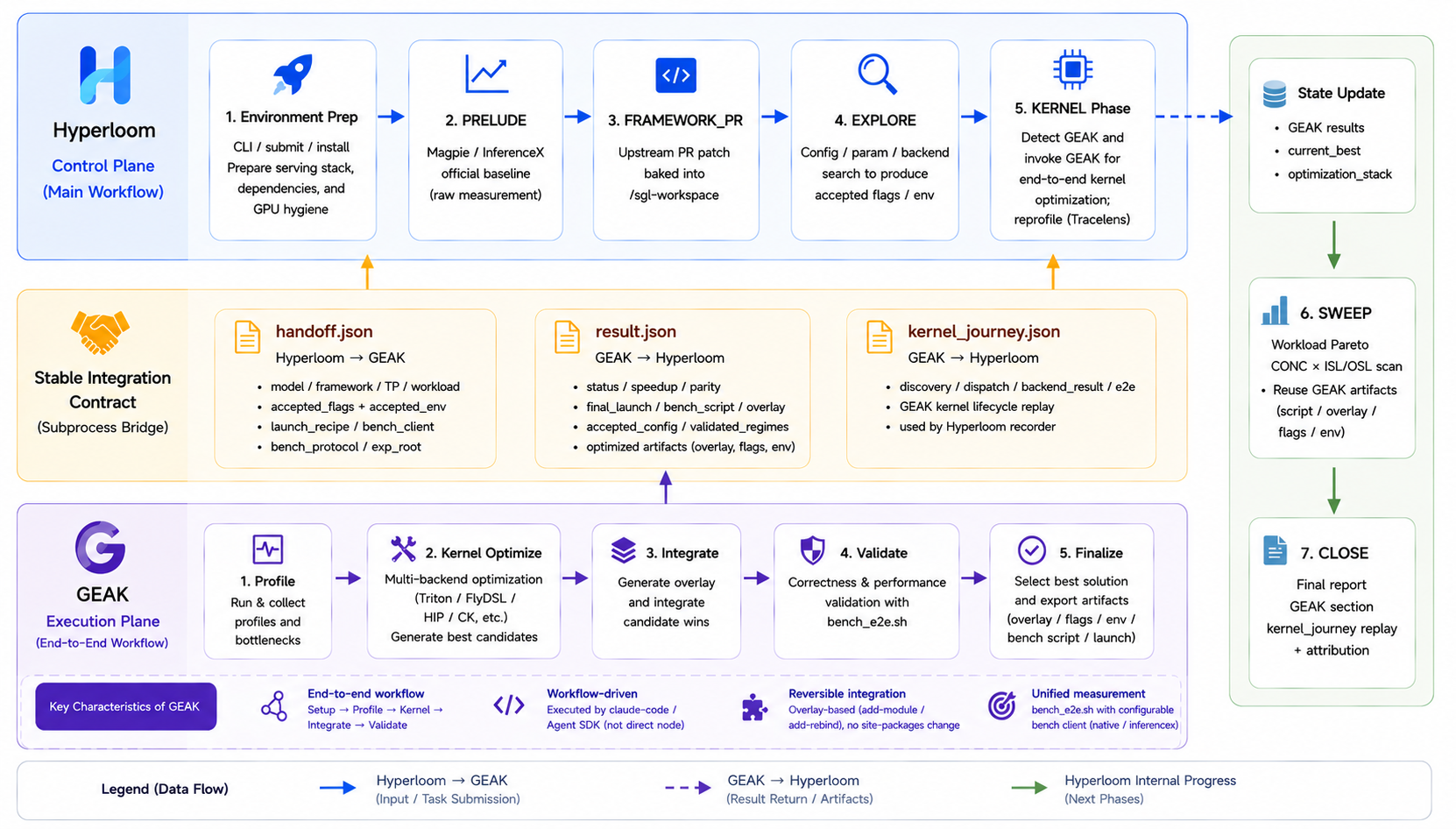
This topic describes the current Hyperloom agentic code optimizer loop from the runtime contracts outward. It intentionally avoids retired action names and old DFS demo mechanics; the live action catalog, phase allowlist, PolicyGate, and session artifacts are the source of truth. This optimization loop runs alongside the agentic kernel optimizer.
Runtime contract#
The optimizer is launched through python -m hyperloom.inference_optimizer.cli optimize. A run
must be able to:
Create or resume a session directory,
Write
manifest.json,state.json,storage/coordinator.db, action run workspaces, reports, andsession_breakdown.json,Route intents through the Orchestration, Critic, and Robustness LLM roles, and dispatch kernel work to programmatic Python handlers,
Produce a final report and a dashboard-consumable breakdown.
Private helper names and internal prompt wording are not contracts. The observable session artifacts and subprocess JSON bridges are.
Phase order#
The Coordinator advances through the live phase chain:
PRELUDE -> FRAMEWORK_AGENT -> EXPLORE -> KERNEL_AGENT -> SWEEP -> CLOSE
Cyclic macro-cycling is always enabled. After SWEEP, the Coordinator can
cycle_reloop back to FRAMEWORK_AGENT / EXPLORE for another pass while
budget and leverage remain. The effective minimum remaining budget to justify
opening a new cycle scales with session length (capped at the 3-hour absolute
floor), so shorter sessions can also reloop when they have proportionally
sufficient time left. The 24-hour threshold only selects long-run budget
accounting: short bounded runs keep charge-back phase budgeting, while long /
unbounded runs use the fixed per-cycle budget window.
Whether another cycle is feasible is surfaced as cycle_reloop_feasible in
the === Phase === block for the four middle phases.
machine_state.PHASE_ALLOWED_ACTIONS and PolicyGate enforce which
actions can run in each phase. Coordinator-owned actions such as
analysis refreshes and close sequencing might be enqueued internally even
when the LLM is not allowed to propose them.
PRELUDE#
PRELUDE establishes the session baseline:
target_analysiswrites the target comparison artifact. If no external target GPU is configured, it writes a no-target marker rather than pretending target data exists.baselinemeasures the starting throughput and records the benchmark invocation needed to reproduce it.rooflineorprofilecaptures the first performance analysis.rooflineis the preferred composite path when enabled; it wraps profiling, trace analysis, andanalysis.mdsnapshot publication.
model_class is supplied by the launcher or derived once from model
metadata at boot. There is no separate live classify action.
FRAMEWORK_AGENT#
When enabled, the FRAMEWORK_AGENT phase (framework enablement) is managed
by the Coordinator. It covers discovery/ranking/audit through fa phase-discover,
plus authoring-specialist dispatch (framework_agent_authoring_enabled is on by
default), enablement repair, and Critic review of each candidate — discovery is
one integration among several, not the only one.
For each candidate:
The framework-agent returns candidate metadata and diff information,
The Critic reviews the candidate before apply,
The framework-agent executor applies, benchmarks, and either keeps or reverts the candidate,
Progress is recorded in
SharedStateand later surfaced insession_breakdown.json.
The LLM doesn’t own a separate framework role in the current runtime.
Enablement escalation ladder#
Enablement admission is controlled by --enablement {off,launch,eval,all},
defaulting to all. launch admits the boot-failure lane, eval the
accuracy-failure lane, all both. With off, neither engages and a baseline
that keeps failing terminates the run with stop_reason='baseline_failed'
rather than opening an authoring loop.
When the admitted lane fires — a (model, backend) combination cannot launch, or
it launches but fails its accuracy eval (accuracy_below_floor /
eval_runtime_failure) — enablement repairs it along two axes. Diagnosis (once): work out which capability layer is
missing — read the failure signature, the model’s config.json architecture,
the framework’s supported-architecture registry and installed version, and
upstream (whether the capability already exists and in which version/PR). That
picks the entry rung. Climb (as needed): start at the lowest plausible rung
and go up only when the current rung cannot make it boot; after each cleared
boot failure, re-diagnose the new (deeper) failure and pick a rung again
(serial enablement — progress is stacked). A model whose architecture is
already supported but merely un-wired needs only the cheap top rungs; a
genuinely-new architecture climbs higher.
The full rendered methodology (the advisory “ladder book”) is the canonical
text, built by build_enablement_ladder_book in
hyperloom.agents.framework.enablement_ops and injected into the enablement
authoring specialist’s prompt. The rungs, in increasing complexity:
Rung 0 — diagnose / capability-gap localization. Read-only: classify the failure, read
config.json, check the supported-arch registry and version, and look up upstream. Output: the missing layer and the entry rung.Rung 1 — serve-flag / config wire-up. The architecture is supported and only a serve flag / env / tokenizer-mode / trivial registration alias is missing. No new code or dependencies.
Rung 2 — in-tree source patch. A unified diff against the installed source tree: register the arch, a small forward/config/tokenizer bridge, or backport a merged PR. Pure Python, no compile.
Rung 3 — attempt-scoped runtime. Acquire a runtime (a published wheel, an editable checkout at a ref, or a local source tree) into an isolated per-attempt venv. That venv is activated only through the per-variant YAML benchmark envs; the Coordinator never mutates its own process environment to point at an attempt runtime.
Rung 4 — source localization. Localize a merged-PR or vendored closure into the source tree. A change that touches compiled or build-backend files cannot be satisfied by a plain source edit, so it defers to Rung 5.
Rung 5 — off-loop compiled build. Perform a compiled-component build (AITER kernels, sgl-kernel, or vLLM-from-source). Builds run off the coordinator tick loop on a dedicated single-slot build lane: each build is spawned detached and reaped across later ticks against a wall-clock budget, so a long compile never blocks the loop. Auto-escalation into Rung 5 can be disabled with the
HYPERLOOM_ENABLEMENT_DISABLE_TARGETED_BUILDenvironment variable (see Targeted builds (Rung 5)).
Runnable gate (earned KEEP)#
A verified build does not KEEP on artifact verification alone. After a build’s artifacts verify, the Coordinator runs a launch probe: it boots the actual model with the built runtime through the same runnable-decision gate the authored-patch lane uses. Only a runtime that actually launches — and passes minimal correctness — earns KEEP. For an eval-origin trigger the gate additionally re-runs the accuracy eval against the captured contract and a KEEP requires the accuracy to meet the floor; the KEEP is finalized only after a genuine baseline revalidates it. Otherwise the build reverts, or, if the boot advanced past the original failure to a new or deeper gap, the loop advances to the next round to repair that gap.
Discovery-driven build refs#
Candidate PR refs discovered by the framework-agent feed directly into the
build: a PR reference becomes a checkout of that PR’s head, not just a
released-tag autoselect. This makes support that exists only in an
unreleased PR or branch reachable. When a discovered PR ref drives the
build, the source PR URL is recorded as build provenance in the session
breakdown’s installed_versions map (source_pr_url); see the
enablement section.
Novelty and crash safety#
Novelty-ledger stall gate. Repeated identical build attempts — same component, ref, GPU arch, and build command — are treated as a stall and revert. A novel attempt, or a time-based failure such as a timeout, advances instead, so the loop keeps making forward progress rather than looping on an identical failing build.
Crash / resume. An in-flight build is tracked by a durable sentinel, so a crash or resume reclaims the running build or cleans up the orphaned one rather than leaking it.
EXPLORE#
EXPLORE searches configuration and source-patch levers through the
canonical explore ledger:
exploreruns server-argument and environment variants.specialistdelegates targeted research or patch proposals. A single unified specialist covers single-domain, cross-domain (scope=domains), and free-form (scope=freeform) investigations through its dispatch dials (scope/mode/bench/lane). Specialist is also available in FRAMEWORK_AGENT and KERNEL_AGENT so source-level failures can go straight to investigation without waiting for a reloop.integrate_patchapplies Critic-reviewed specialist patches and benchmarks them.
The old backends and params action names are compatibility aliases
for archived reporting only. New sessions write the merged
explore_search ledger.
After each KEEP, the runtime revalidates the full stack end to end, so
the reported cumulative_gain_validated always comes from a measurement
taken with every accepted change applied.
KERNEL_AGENT#
The KERNEL_AGENT phase is the bridge to kernel-agent work. Orchestration might
send kernel requests, but the Coordinator owns the request handlers and safety
gates.
What the phase actually does depends on the kernel backend, and the branches look very different from Orchestration’s side:
Default (
geak): entering the phase hands it to a single Coordinator-owned whole-pipeline GEAK e2e run, which then sets theskip_to_sweepescalate hint. When the run produces no win,exit_normal_kernelhonours the hint immediately and the phase closes without Orchestration ever taking a turn in it.On a GEAK win, the Coordinator enqueues a same-harness revalidation rebench and marks
geak_pending.status = "awaiting_rebench"with the task id.kernel_work_pendingthen reportsTrue, andexit_normal_kernelrefuses theskip_to_sweephandoff while work is pending — so KERNEL stays open, and Orchestration does tick until the rebench lands (or the revalidation turns out to be unavailable, which drops the pending slot and lets the exit through).Forge (
KERNEL_OPT_BACKEND_ORDER=forge): the phase runs the deterministic KERNEL-entry ladder — GEMM tuning, the fusion and collective lanes, then per-kernelkernel_opt— and Orchestration drives the remaining kernel work through the request channel.
See Kernel optimization execution path for the entry-hook branch order.
The phase allowlist (machine_state.PHASE_ALLOWED_ACTIONS[KERNEL_AGENT])
admits these actions:
kernel_optintegrategemm_tuningspecialistrooflineprofilerecover
Within the kernel-agent request channel, the handler dispatches request kinds
such as trace_analyze, run_optimization, and run_gemm_tuning
(request_handlers.py); these are handler kinds, not phase actions.
Kernel-owned results are recorded separately from non-kernel action attempts. A KEEP must be integrated before the run can proceed to final reporting, and hot reusable kernels above the configured threshold must be attempted or explicitly rejected before report can close the run.
SWEEP#
SWEEP checks whether the optimized stack still wins across workload
frontiers. The normal sweep action explores concurrency and ISL/OSL
points; conc_sweep can run a post-sweep concurrency ladder when
enabled.
Sweep results update last_sweep / last_conc_sweep and feed the final
report and breakdown.
CLOSE#
CLOSE drains the final artifacts:
reportrenders the operator-facing final report.session_breakdownwrites the downstream JSON contract.The CLI finally-block writes a safety-net breakdown if the close sequencer did not already finish cleanly.
The close path must be idempotent because sessions can end through a normal phase transition, a wall-clock deadline, an operator interrupt, or a resumed run.
Orchestration conversation model#
The Orchestration role runs as a single persistent multi-turn conversation that continues across ticks, rather than a fresh stateless call each tick. The agent’s plan and reasoning live in the conversation, so reasoning continuity is preserved between ticks.
Delta prompts: The first turn of a (re)started conversation gets a full state seed; later turns get only a delta (current phase, mission progress, time budget, and new inbox events). The agent pulls anything else it needs on demand using read-only context tools (
get_shared_state,get_gaps,get_warm_start,get_proposal_scores,get_intervention_mix,why_denied,show_analysis_md,get_inbox) instead of receiving a full state dump every tick.Checkpoint / compaction: Periodically (phase boundaries and a tick/time/size cadence) the Coordinator asks the agent to summarize its working memory, persists it to
state.json(orchestration_memory), then resets and re-seeds the conversation from that compacted memory so context stays bounded on long runs.Resume: On resume the conversation is rebuilt from
orchestration_memoryplus the authoritativeSharedStatefacts — not by replaying a non-deterministic transcript.Write path unchanged: All write actions still flow through
emit_intent→ the Coordinator’s intent handler, so Critic review, the accuracy gate, Robustness escalation, and PolicyGate’s real invariants (path sandbox, resource leases, phase ordering, data dependencies, single-writer rules) apply exactly as before. Only the compensatory anti-amnesia guards (for example, the baseline same-fingerprint self-loop deny) were removed, since a conversational agent remembers its own prior attempts. Robustness additionally surfaces a conversation no-progress signal as an external circuit-breaker.
The other two roles (Critic, Robustness) remain reactive and stateless per tick.
Feedback loops#
The loop adapts through facts, not through retired score tables:
SharedStatecarries current best, stack entries, phase history, action attempts, kernel attempts, framework-agent progress, and warnings.RecipeKBrecords durable lessons and pitfalls for future sessions.Critic verdicts gate risky patches and framework candidates.
Robustness watches stalls, crashes, config-only loops, specialist storms, and recovery signals.
PolicyGate blocks retired actions, wrong-phase actions, unsafe paths, and invalid envelopes before they mutate runtime state.
What is retired#
These names shouldn’t appear as live positive instructions in prompts or docs:
setupclassifybackendsparamsvalidate_stackselect_kernels
They can remain only in migration readers, archived breakdown aliases, or explicit rejection tests.
Artifacts to inspect#
For a finished or interrupted session, start with:
manifest.jsonstate.jsonstorage/coordinator.dbruns/<action>/<task_id>/reports/session_breakdown.json
For reports and dashboards, session_breakdown.json is the external
contract. Its producer code lives under
src/hyperloom/inference_optimizer/breakdown/,
and its consumer-facing shape is documented in
session_breakdown.json integration in Hyperloom.